



Furalaxyl
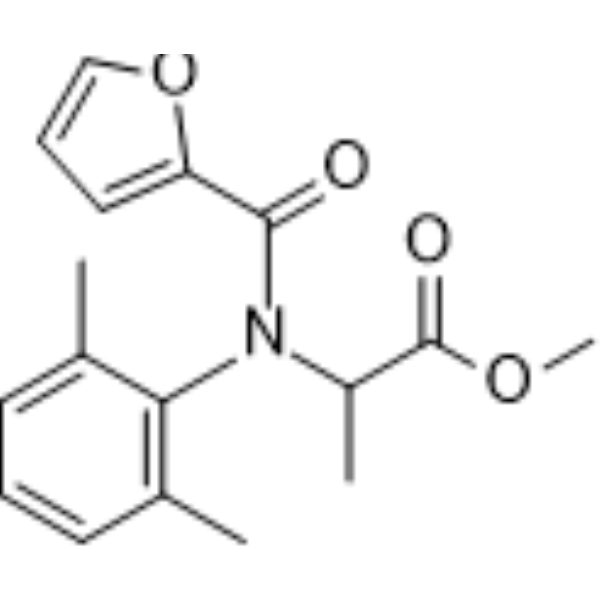
Furalaxyl (CGA 38140) is an acylalanine fungicide with high selectivity against the order Peronosporales. Furalaxyl inhibits mycelial growth of Pythium ultimum. Furalaxyl inhibits fungal protein and nucleic acid synthesis, with RNA synthesis being more strongly inhibited than DNA synthesis. The primary mode of action of Furalaxyl is considered to involve impairment of fungal RNA biosynthesis and associated effects on mitosis. Furalaxyl is applicable for studies on oomycete growth inhibition, fungal RNA biosynthesis, and pesticide photodegradation.
For research use only. We do not sell to patients.
- CAS No.: 57646-30-7
- Formula: C17H19NO4
- Molecular Weight:301.34
-
Storage:Powder -20°C, 3 years , 4°C, 2 years ; In solvent -80°C, 6 months , -20°C, 1 month

To place orders, for customer services and technical support, please contact: MedChemExpress USA
Tel: 609-228-6898 E-mail: [email protected] [email protected]


-
 Biological Activity
-
Chemical Information
- Protocols
- Purity & Documentation
- References
-
 Help & FAQs


All DNA/RNA Synthesis Isoforms
More

Biological Activity
Description
In Vitro
Furalaxyl (CGA 38140) (compound 1) (0.02 M; 3 h; CH3CN; O2 saturated; UV/Pyrex) shows 100% conversion under photosensitized conditions with methylene blue, 9,10-dicyanoanthracene, or rose bengal, while conversion is <10% and 30% under phenanthrene and benzophenone conditions, respectively; under visible light/triphenylpyrylium tetrafluoroborate conditions, conversion is 70%[1].
Furalaxyl (1 × 10⁻³ M; sunlight; CH3CN) reaches 100% conversion within 1 d in the presence of rose bengal, whereas without the photosensitizer, the conversion is <5% after 1 d. In water containing 1% CH3CN, the conversion is <2% after 8 d of irradiation without the photosensitizer, and reaches 10% after 1 d of irradiation with rose bengal added[1].
Furalaxyl (3 d) inhibits the growth of Pseudokirchneriella subcapitata algae, with an IC50 of 23.98 mg/L[1].
Furalaxyl inhibits sporangium formation in Phytophthora palmivora with an ED50 of 0.05 μM, whereas the ED50 values for sporangium germination and zoospore germination are both >10 μM[2].
Furalaxyl (1, 5, or 10 μM; 1 h) does not inhibit oxygen uptake in Pythium ultimum, Phytophthora nicotianae, and Phytophthora palmivora; at 10 μM, oxygen uptake is 132%, 141%, and 196% of the untreated control, respectively[2].
Furalaxyl (0.03-3 μg/mL; 4 h) does not inhibit glucose-dependent oxygen consumption in Pythium splendens[3].
Furalaxyl inhibits mycelial growth of Pythium ultimum, with ED50 values of 0.03 μM in both potato dextrose agar and potato dextrose broth[2].
Furalaxyl inhibits mycelial growth of Phytophthora nicotianae, with ED50 values of 1.44 μM and 2.9 μM in potato dextrose agar and potato dextrose broth, respectively[2].
Furalaxyl inhibits mycelial growth of Phytophthora palmivora, with ED50 values of <0.5 μM and 0.35 μM in potato dextrose agar and potato dextrose broth, respectively[2].
Furalaxyl (0.1-1 μM; 4 h) inhibits the incorporation of [14C]-labeled amino acids into proteins in Pythium ultimum, Phytophthora palmivora, and Phytophthora nicotianae; at 1 μM, the inhibition rates are 19.1%, 23.2%, and 37.8%, respectively[2].
Furalaxyl (up to 12 h) inhibits Phytophthora palmivora DNA and RNA synthesis, with RNA synthesis being more strongly inhibited; after 12 h of treatment, the degree of RNA synthesis inhibition is at least twice that of DNA synthesis[2].
Furalaxyl causes germ tubes of Phytophthora palmivora to twist and increases hyphal branching, whereas sporangia and zoospores still germinate normally at the ED50 concentration[2].
Furalaxyl results in 21 nuclei per 100 μm at the growing hyphal tips of Phytophthora palmivora, compared with 25 nuclei per 100 μm in the control, suggesting that nuclear division may be inhibited[2].
Furalaxyl (24 °C; 1-3 weeks) exhibits selective antifungal activity against the Peronosporales in oomycetes, with various Phytophthora and Pythium species being sensitive to Furalaxyl, while a large number of other fungi remain insensitive at concentrations up to 300 μg/mL[3].
The activity of Furalaxyl against Pythium splendens and Phytophthora cinnamomi increases with decreasing culture temperature; at 10, 15, and 30 °C, the EC50/MIC values for P. splendens are 0.01/0.03, 0.1/0.3, and 0.1/0.3 μg/mL, respectively, while those for P. cinnamomi are 0.03/0.3, 0.3/10, and 3/30 μg/mL[3].
Furalaxyl (10 μg/mL; 1 d) prevents Pythium splendens from resuming growth after transfer to Furalaxyl-free medium; at the MIC concentration, Furalaxyl primarily exhibits growth inhibition during the initial 24 h, and shows fungicidal activity after continuous exposure for 7 d[3].
Furalaxyl (0.03-10 μg/mL; 1-7 d) has a minor effect on the germination of swollen hyphal bodies of Pythium splendens, but exposure to 0.03 μg/mL for 1 d reduces hyphal growth and branching; treatment with 0.3-1 μg/mL and higher concentrations for 3 d induces marked hyphal morphological changes, and after 7 d of treatment, no new swollen hyphal body formation is observed even at the lowest tested concentration[3].
Furalaxyl (5 h) increases total lipid uptake of [14C]acetate by approximately 20% in Pythium ultimum and alters the distribution of lipid components such as phospholipids, diacylglycerols, and triacylglycerols[2].
MedChemExpress (MCE) has not independently confirmed the accuracy of these methods. They are for reference only. Further protocols information, click here.
In Vivo
MedChemExpress (MCE) has not independently confirmed the accuracy of these methods. They are for reference only.


Chemical Information
-
CAS No. 57646-30-7
-
Appearance Solid
-
Molecular Weight 301.34
-
Formula C17H19NO4
-
Color White to off-white
-
SMILES
O=C(C(C)N(C1=C(C)C=CC=C1C)C(C2=CC=CO2)=O)OC
-
Synonyms
CGA 38140
-
Shipping
Room temperature in continental US; may vary elsewhere.
-
Storage
Powder -20°C 3 years 4°C 2 years In solvent -80°C 6 months -20°C 1 month

Protocols
-
EdU Incorporation Assay (Click Chemistry-Based DNA Synthesis Measurement)
The EdU incorporation assay measures DNA synthesis by adding the thymidine analog 5-ethynyl-2′-deoxyuridine to cells or tissues, where it is incorporated into newly synthesized DNA during S phase. Incorporated EdU is detected by copper-catalyzed azide-alkyne cycloaddition, in which a fluorescent azide covalently reacts with the ethynyl group on EdU, allowing S-phase cells to be detected by fluorescence microscopy, flow cytometry, or high-content imaging. EdU detection does not require DNA denaturation or anti-BrdU antibody access, which preserves sample structure and improves compatibility with immunostaining and multiparameter cytometry compared with BrdU-based detection. EdU can be cytotoxic in a cell-type- and exposure-dependent manner, so pulse duration, concentration, and continuous-labeling designs should be validated for each cell type.
-
BrdU Incorporation Assay
Bromodeoxyuridine (BrdU) incorporation assay is based on the principle that BrdU, a thymidine analog, is incorporated into newly synthesized DNA during the S phase of the cell cycle, thereby serving as a marker of DNA replication and cellular proliferation. Incorporated BrdU can be detected using anti-BrdU antibodies following DNA denaturation, enabling visualization or quantification of proliferating cells through immunochemical detection methods such as immunofluorescence or immunohistochemistry.
-
Filamentous Fungal Mold Culture and Sporulation
Filamentous fungal mold culture and sporulation assays grow hyphae under defined nutritional and environmental conditions until asexual spores, commonly conidia, are produced; the main readouts are colony growth, sporulation onset, conidial yield, conidial morphology, viability, and, when relevant, downstream infectivity or stress phenotype.


Purity & Documentation
-
Data Sheet (294 KB)
-
SDS (393 KB)
- English - EN (393 KB)
- Français - FR (393 KB)
- Deutsch - DE (393 KB)
- Norwegian - NO (393 KB)
- Español - ES (393 KB)
- Swedish - SV (393 KB)
- Italian - IT (393 KB)
- Korean - KR (393 KB)
- Portuguese - PT (393 KB)
-
Handling Instructions (2659 KB)
References

Calculators
Concentration (start) × Volume (start) = Concentration (final) × Volume (final)


Furalaxyl Related Classifications
HY-118578 Related Classifications
 Powered by Bioz