



Silver chloride

Based on 1 Customer Validation
Silver chloride (Silver (Ⅰ) Chloride) is an inorganic salt with antibacterial activity and the property of regulating alcohol oxidase. Silver chloride destabilizes alcohol oxidase and reduces its activity over time. Silver chloride exhibits antibacterial activity against human pathogenic Escherichia coli and Candida albicans. Silver chloride can be used in studies related to bacterial infections and fungal infections.
For research use only. We do not sell to patients.
- Assay : 99.5%
- CAS No.: 7783-90-6
- Formula: AgCl
- Molecular Weight:143.32
-
Storage:
4°C, protect from light, stored under nitrogen
* In solvent : -80°C, 6 months; -20°C, 1 month (protect from light, stored under nitrogen)


To place orders, for customer services and technical support, please contact: MedChemExpress USA
Tel: 609-228-6898 E-mail: [email protected] [email protected]


-
 Biological Activity
-
Chemical Information
- Protocols
- Purity & Documentation
- References
-
 Help & FAQs


-

HY-W019930
Silver iodideBiochemical Assay Reagents -
HY-W020983
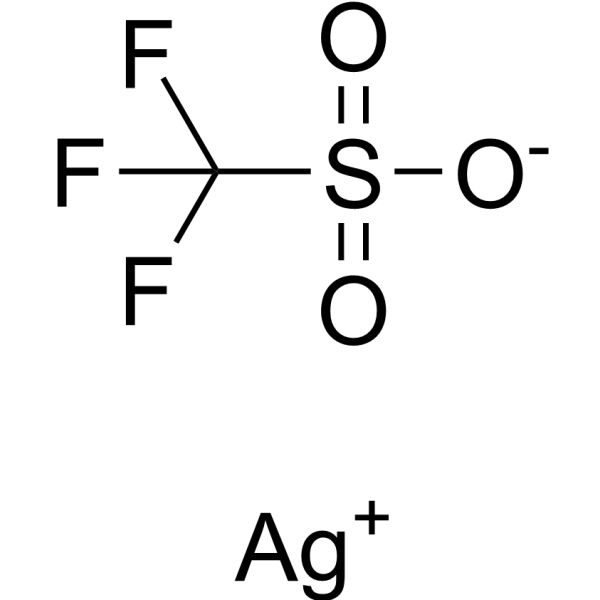
Silver trifluoromethanesulfonateCatalyst -
HY-N3025
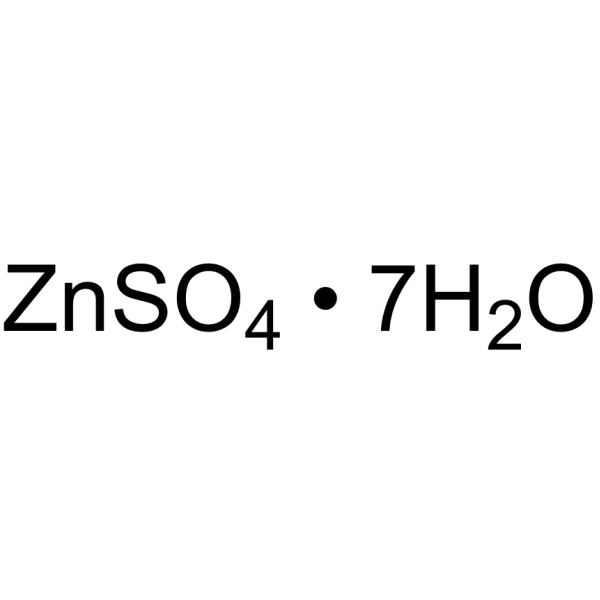
Zinc sulfate heptahydrateDietary Supplement -

HY-W051140
Silver sulfateEthylene Inhibitor -

HY-Y1110H
Magnesium chloride anhydrous, suitable for insect cell cultureCell Culture Medium Component -

HY-Y1110I
Magnesium chloride, for insect cell culture, 97%Mineral Salt -
HY-Y0406E
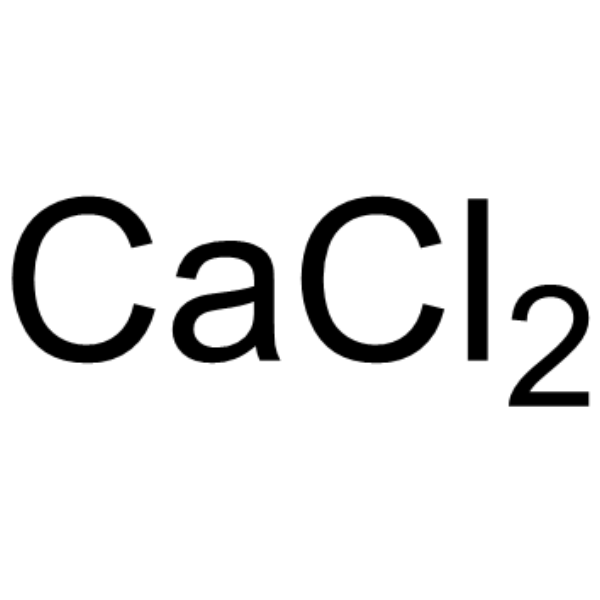
Calcium chloride anhydrous, for cell cultureCalcium Chloride -

HY-W116336B
Zinc oxide, 99.99% metals basisBiochemical Assay Reagents -

HY-Y1878
Copper(Ⅱ) sulfateBiochemical Reagent -

HY-107754
Cesium chloridePotassium Channel Blocker -
HY-W094581
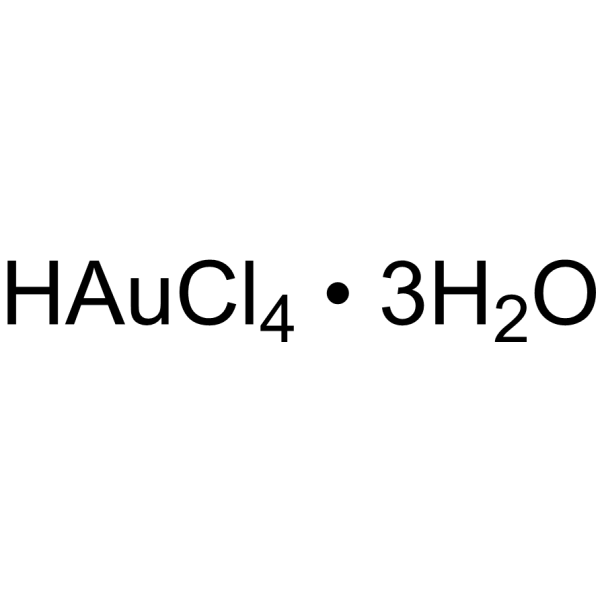
Gold(III) chloride trihydrateReducing Agent


Biological Activity
Description
In Vitro
Silver chloride exhibits weak antibacterial activity, and its antibacterial activity is significantly enhanced when prepared as nanoscale AgCl or incorporated into an Ag/AgCl composite system[2].
Silver chloride, as a component of screen-printed Ag/AgCl quasi-reference electrodes, destabilizes alcohol oxidase, thereby causing detectable loss of enzyme activity within approximately 20 h in electrochemical amperometric detection systems[1].
MedChemExpress (MCE) has not independently confirmed the accuracy of these methods. They are for reference only. Further protocols information, click here.


Chemical Information
-
CAS No. 7783-90-6
-
Appearance Solid
-
Molecular Weight 143.32
-
Formula AgCl
-
Color White to off-white
-
SMILES
[Ag]Cl
-
Synonyms
Silver(Ⅰ) Chloride
-
Shipping
Room temperature in continental US; may vary elsewhere.
-
Storage
4°C, protect from light, stored under nitrogen
* In solvent : -80°C, 6 months; -20°C, 1 month (protect from light, stored under nitrogen)

Protocols
-
Research Protocol for Infectious Diseases
Infectious-disease experiments test how pathogens interact with host barriers, innate immune receptors, inflammatory signaling, pathogen replication, and tissue injury; pattern-recognition receptors such as TLRs, RIG-I-like receptors, NOD-like receptors, and inflammasomes detect microbial molecules and activate NF-κB, interferon, and cytokine responses. The central hypothesis is that infection severity reflects the balance between pathogen burden and host response: protective inflammation restricts pathogen growth, whereas excessive or mislocalized inflammation contributes to tissue damage and disease phenotype. Unresolved questions include which host pathways are protective versus pathogenic, why some infection models fail to translate to human disease, and which combined readouts best predict clinically relevant infection outcomes.
-
Bacterial live/dead nucleic-acid viability staining
The LIVE/DEAD bacterial viability staining method is based on differential permeability of nucleic-acid-binding fluorescent dyes, most commonly SYTO 9 and propidium iodide (PI), which enables discrimination of bacterial populations with intact versus compromised cytoplasmic membranes. SYTO 9 penetrates both intact and damaged bacterial membranes and binds nucleic acids to produce green fluorescence, whereas propidium iodide penetrates only cells with compromised membranes and fluoresces red while also reducing SYTO 9 signal through competitive binding and fluorescence interactions. The resulting fluorescence pattern is interpreted as a proxy for membrane integrity, which is widely used as an indicator of bacterial viability in microscopy, flow cytometry, and spectroscopic platforms. However, mechanistic studies show that SYTO 9 and PI interactions involve displacement and fluorescence resonance energy transfer effects, which can influence signal interpretation depending on dye ratios a


Purity & Documentation
-
Data Sheet (293 KB)
-
SDS (621 KB)
- English - EN (621 KB)
- Français - FR (621 KB)
- Deutsch - DE (621 KB)
- Norwegian - NO (621 KB)
- Español - ES (621 KB)
- Swedish - SV (621 KB)
- Italian - IT (621 KB)
- Korean - KR (621 KB)
- Portuguese - PT (621 KB)
-
Handling Instructions (2659 KB)
References

Calculators
Concentration (start) × Volume (start) = Concentration (final) × Volume (final)


Silver chloride Related Classifications
HY-W019929 Related Classifications
 Powered by Bioz