



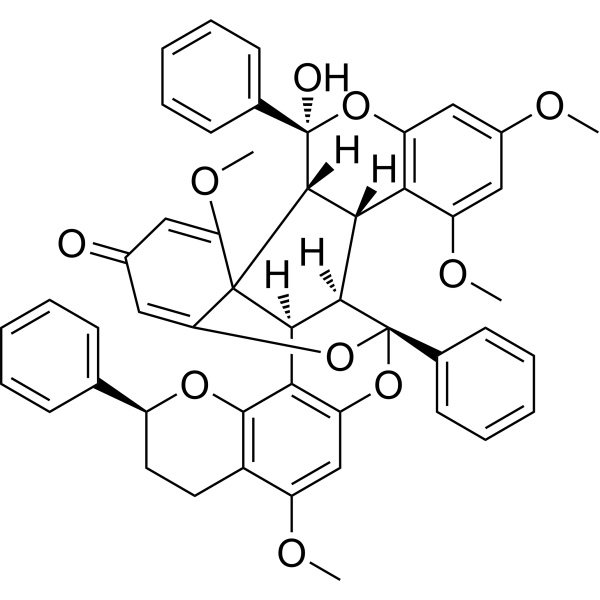
6,6′-Didemethyl-7-methyl dragonbloodin A2
6,6′-Didemethyl-7-methyl dragonbloodin A2 is isolated from the dragon’s blood of Daemonorops draco fruits and is a osteoclastogenesis inhibitor with IC50 value of 36.8 μM[1].
For research use only. We do not sell to patients.
- Formula: C49H42O10
- Molecular Weight:790.85
-
Storage:
Please store the product under the recommended conditions in the Certificate of Analysis.

To place orders, for customer services and technical support, please contact: MedChemExpress USA
Tel: 609-228-6898 E-mail: [email protected] [email protected]


-
 Biological Activity
-
Chemical Information
- Protocols
- Purity & Documentation
- References
-
 Help & FAQs




Biological Activity
Description


Chemical Information
-
Molecular Weight 790.85
-
Formula C49H42O10
-
SMILES
O[C@]([C@]1([H])[C@]2([C@@]3([H])[C@]4(C5=CC=CC=C5)OC6=C(C(O[C@H](C7=CC=CC=C7)CC8)=C8C(OC)=C6)[C@@]3([H])C91C(OC)=CC(C=C9O4)=O)[H])(C%10=CC=CC=C%10)OC%11=C2C(OC)=CC(OC)=C%11
-
Structure Classification
-
Initial Source
-
Shipping
Room temperature in continental US; may vary elsewhere.
-
Storage
Please store the product under the recommended conditions in the Certificate of Analysis.

Protocols
-
Cell Cytotoxicity Assay
Cytotoxicity assays are usually based on the assessment of cell membrane damage, which can also be indirectly detected by measuring cell viability. Detection methods include MTT assay, CKK-8 assay, LDH assay and ATP assay, etc.
-
Osteoclast differentiation from monocyte/macrophage precursors
Osteoclast differentiation is an in vitro induction assay in which monocyte/macrophage-lineage precursors are exposed to macrophage colony-stimulating factor (M-CSF) and receptor activator of NF-κB ligand (RANKL), generating multinucleated osteoclasts that are commonly identified by tartrate-resistant acid phosphatase (TRAP) staining and functionally confirmed by resorption pits on dentin, bone, or mineralized substrates. M-CSF supports survival and expansion of osteoclast precursors, while RANKL binding to RANK drives osteoclast commitment, fusion, maturation, and resorptive function; osteoprotegerin inhibits this pathway by binding RANKL and preventing RANK activation. The main readouts are the number of TRAP-positive multinucleated cells, formation of F-actin rings, and resorbed surface area; TRAP-positive multinucleated cells indicate osteoclast differentiation, whereas pit formation on dentin, bone, or mineralized coating indicates functional bone-resorbing activity.


Purity & Documentation
References

Calculators
Concentration (start) × Volume (start) = Concentration (final) × Volume (final)


6,6′-Didemethyl-7-methyl dragonbloodin A2 Related Classifications
HY-N12555 Related Classifications
 Powered by Bioz