



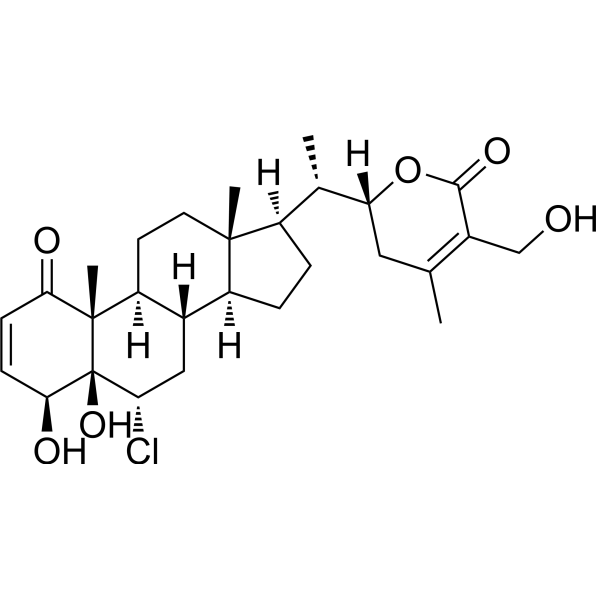
6α-Chloro-5β-hydroxywithaferin A

Based on 1 Customer Validation
6α-Chloro-5β-hydroxywithaferin A is a withanolide that can be isolated from W. somnifera. W. somnifera has antioxidant, anti-inflammatory, immunomodulatory, anticarcinogenic, antibacterial antiparkinsonism and antistress properties.
For research use only. We do not sell to patients.
- Purity : 99.3%
- CAS No.: 52329-20-1
- Formula: C28H39ClO6
- Molecular Weight:507.06
-
Storage:
4°C, sealed storage, away from moisture and light
* In solvent : -80°C, 6 months; -20°C, 1 month (sealed storage, away from moisture and light)

To place orders, for customer services and technical support, please contact: MedChemExpress USA
Tel: 609-228-6898 E-mail: [email protected] [email protected]


-
 Biological Activity
-
Chemical Information
- Protocols
- Purity & Documentation
- References
-
 Help & FAQs




Biological Activity
Description
Cellular Effect
|
Cell Line

|
Type | Value | Description | References |
|---|---|---|---|---|
| A549 | IC50 |
14.7 μM
Compound: 17
|
Cytotoxicity against human A549 cells assessed as cell viability after 48 hrs by MTT assay
Cytotoxicity against human A549 cells assessed as cell viability after 48 hrs by MTT assay
|
[PMID: 22705001] |
| A549 | IC50 |
14.7 μM
Compound: 56
|
Cytotoxicity against human A549 cells assessed as reduction in cell viability using compound addition to cell culture cells in lag phase of growth and incubated for 48 hrs by MTT assay
Cytotoxicity against human A549 cells assessed as reduction in cell viability using compound addition to cell culture cells in lag phase of growth and incubated for 48 hrs by MTT assay
|
[PMID: 28923386] |
| A549 | IC50 |
16.1 μM
Compound: 56
|
Cytotoxicity against human A549 cells assessed as reduction in cell viability using compound addition to cell culture cells in log phase of growth and incubated for 48 hrs by MTT assay
Cytotoxicity against human A549 cells assessed as reduction in cell viability using compound addition to cell culture cells in log phase of growth and incubated for 48 hrs by MTT assay
|
[PMID: 28923386] |
| A549 | IC50 |
8.6 μM
Compound: 17
|
Cytotoxicity against human A549 cells assessed as cell viability after 72 hrs by MTT assay
Cytotoxicity against human A549 cells assessed as cell viability after 72 hrs by MTT assay
|
[PMID: 22705001] |
| HeLa | IC50 |
12.1 μM
Compound: 17
|
Cytotoxicity against human HeLa cells assessed as cell viability after 72 hrs by MTT assay
Cytotoxicity against human HeLa cells assessed as cell viability after 72 hrs by MTT assay
|
[PMID: 22705001] |
| HeLa | IC50 |
13.4 μM
Compound: 17
|
Cytotoxicity against human HeLa cells assessed as cell viability after 48 hrs by MTT assay
Cytotoxicity against human HeLa cells assessed as cell viability after 48 hrs by MTT assay
|
[PMID: 22705001] |
| HeLa | IC50 |
13.4 μM
Compound: 56
|
Cytotoxicity against human HeLa cells assessed as reduction in cell viability using compound addition to cell culture cells in lag phase of growth and incubated for 48 hrs by MTT assay
Cytotoxicity against human HeLa cells assessed as reduction in cell viability using compound addition to cell culture cells in lag phase of growth and incubated for 48 hrs by MTT assay
|
[PMID: 28923386] |
| HeLa | IC50 |
17.5 μM
Compound: 56
|
Cytotoxicity against human HeLa cells assessed as reduction in cell viability using compound addition to cell culture cells in log phase of growth and incubated for 48 hrs by MTT assay
Cytotoxicity against human HeLa cells assessed as reduction in cell viability using compound addition to cell culture cells in log phase of growth and incubated for 48 hrs by MTT assay
|
[PMID: 28923386] |
| MCF7 | IC50 |
1.3 μM
Compound: 17
|
Cytotoxicity against human MCF7 cells assessed as cell viability after 72 hrs by MTT assay
Cytotoxicity against human MCF7 cells assessed as cell viability after 72 hrs by MTT assay
|
[PMID: 22705001] |
| MCF7 | IC50 |
7.5 μM
Compound: 17
|
Cytotoxicity against human MCF7 cells assessed as cell viability after 48 hrs by MTT assay
Cytotoxicity against human MCF7 cells assessed as cell viability after 48 hrs by MTT assay
|
[PMID: 22705001] |
| MCF7 | IC50 |
7.5 μM
Compound: 56
|
Cytotoxicity against human MCF7 cells assessed as reduction in cell viability using compound addition to cell culture cells in lag phase of growth and incubated for 48 hrs by MTT assay
Cytotoxicity against human MCF7 cells assessed as reduction in cell viability using compound addition to cell culture cells in lag phase of growth and incubated for 48 hrs by MTT assay
|
[PMID: 28923386] |
| MCF7 | IC50 |
7.9 μM
Compound: 56
|
Cytotoxicity against human MCF7 cells assessed as reduction in cell viability using compound addition to cell culture cells in log phase of growth and incubated for 48 hrs by MTT assay
Cytotoxicity against human MCF7 cells assessed as reduction in cell viability using compound addition to cell culture cells in log phase of growth and incubated for 48 hrs by MTT assay
|
[PMID: 28923386] |
| Vero | IC50 |
14.8 μM
Compound: 17
|
Cytotoxicity against african green monkey Vero cells assessed as cell viability after 48 hrs by MTT assay
Cytotoxicity against african green monkey Vero cells assessed as cell viability after 48 hrs by MTT assay
|
[PMID: 22705001] |
| Vero | IC50 |
14.8 μM
Compound: 56
|
Cytotoxicity against African green monkey Vero cells assessed as reduction in cell viability using compound addition to cell culture cells in lag phase of growth and incubated for 48 hrs by MTT assay
Cytotoxicity against African green monkey Vero cells assessed as reduction in cell viability using compound addition to cell culture cells in lag phase of growth and incubated for 48 hrs by MTT assay
|
[PMID: 28923386] |
| Vero | IC50 |
7.8 μM
Compound: 17
|
Cytotoxicity against african green monkey Vero cells assessed as cell viability after 72 hrs by MTT assay
Cytotoxicity against african green monkey Vero cells assessed as cell viability after 72 hrs by MTT assay
|
[PMID: 22705001] |
| Vero | IC50 |
7.8 μM
Compound: 56
|
Cytotoxicity against African green monkey Vero cells assessed as reduction in cell viability using compound addition to cell culture cells in log phase of growth and incubated for 48 hrs by MTT assay
Cytotoxicity against African green monkey Vero cells assessed as reduction in cell viability using compound addition to cell culture cells in log phase of growth and incubated for 48 hrs by MTT assay
|
[PMID: 28923386] |


Chemical Information
-
CAS No. 52329-20-1
-
Appearance Solid
-
Molecular Weight 507.06
-
Formula C28H39ClO6
-
Color White to off-white
-
SMILES
C[C@@]12[C@]3([H])[C@](C[C@@H]([C@@]1([C@H](C=CC2=O)O)O)Cl)([H])[C@@]4([H])[C@](CC3)([C@@](CC4)([H])[C@@H]([C@@]5([H])CC(C)=C(C(O5)=O)CO)C)C
-
Structure Classification
-
Initial Source
-
Shipping
Room temperature in continental US; may vary elsewhere.
-
Storage
4°C, sealed storage, away from moisture and light
* In solvent : -80°C, 6 months; -20°C, 1 month (sealed storage, away from moisture and light)

Protocols
-
Research Protocol for Infectious Diseases
Infectious-disease experiments test how pathogens interact with host barriers, innate immune receptors, inflammatory signaling, pathogen replication, and tissue injury; pattern-recognition receptors such as TLRs, RIG-I-like receptors, NOD-like receptors, and inflammasomes detect microbial molecules and activate NF-κB, interferon, and cytokine responses. The central hypothesis is that infection severity reflects the balance between pathogen burden and host response: protective inflammation restricts pathogen growth, whereas excessive or mislocalized inflammation contributes to tissue damage and disease phenotype. Unresolved questions include which host pathways are protective versus pathogenic, why some infection models fail to translate to human disease, and which combined readouts best predict clinically relevant infection outcomes.
-
Research Protocol for Inflammation-related Diseases
The NLRP3 inflammasome is a cytosolic innate immune signaling platform that integrates priming signals and danger-signal activation to promote caspase-1 activation, maturation of IL-1β and IL-18, and gasdermin D-mediated pyroptotic cell death. The core experimental logic is to determine whether inflammatory disease phenotypes are driven by increased NLRP3 expression, ASC-containing inflammasome assembly, caspase-1 cleavage, GSDMD cleavage, and extracellular release of IL-1β/IL-18 rather than by nonspecific cell injury alone. The pathway is strongly linked to inflammation-related disease phenotypes because monosodium urate crystals activate NALP3/NLRP3 inflammasome signaling in gout-like crystal inflammation, cholesterol crystals activate NLRP3 inflammasomes in atherogenesis models, and DSS-induced intestinal inflammation has been reported to involve NLRP3 inflammasome activity. However, experimental colitis studies also show context-dependent protective effects of NLRP3 inflammasome co


Purity & Documentation
-
Data Sheet (271 KB)
-
SDS (252 KB)
- English - EN (252 KB)
- Français - FR (252 KB)
- Deutsch - DE (252 KB)
- Norwegian - NO (252 KB)
- Español - ES (252 KB)
- Swedish - SV (252 KB)
- Italian - IT (252 KB)
- Korean - KR (252 KB)
- Portuguese - PT (252 KB)
-
Handling Instructions (2659 KB)
References

Calculators
Concentration (start) × Volume (start) = Concentration (final) × Volume (final)


6α-Chloro-5β-hydroxywithaferin A Related Classifications
HY-N5113 Related Classifications
 Powered by Bioz