



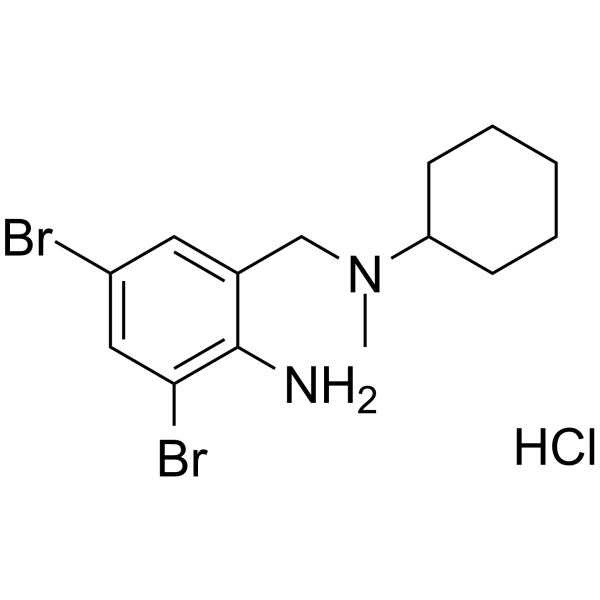
Bromhexine hydrochloride
Based on 4 publication(s) in Google Scholar
Bromhexine hydrochloride is an orally active mucolytic activator. Bromhexine hydrochloride acts as a TMPRSS2 inhibitor and binds hACE2, with an IC50 of 17.3 μM against Omicron pseudovirus infection, disrupting the interaction between the SARS‑CoV‑2 spike protein and hACE2. Bromhexine hydrochloride reduces IDO expression and kynurenine pathway activation, tissue levels of TLR-4 and NF-κB, and TNF-alpha secretion, exerts antioxidant activity, and alleviates acute pruritus. Bromhexine hydrochloride promotes mucin and lipid secretion in conjunctival fornix epithelial cells. Bromhexine hydrochloride attenuates glandular pathological damage in Sjögren's syndrome models. Bromhexine hydrochloride can be used in research on viral infections, pruritus, inflammation-related diseases, and respiratory diseases.
For research use only. We do not sell to patients.
- Purity : 99.93%
- CAS No.: 611-75-6
- Formula: C14H21Br2ClN2
- Molecular Weight:412.59
-
Storage:
4°C, sealed storage, away from moisture
* In solvent : -80°C, 6 months; -20°C, 1 month (sealed storage, away from moisture)

To place orders, for customer services and technical support, please contact: MedChemExpress USA
Tel: 609-228-6898 E-mail: [email protected] [email protected]


-
 Biological Activity
-
Chemical Information
-
Solvent & Solubility
- Protocols
- Purity & Documentation
- References
-
 Help & FAQs




Biological Activity
Description
|
TNF-α |
IDO |
NF-κB |
TLR4 |
In Vitro
Bromhexine hydrochloride (0.56-5 μM; 24 h) increases MUC5AC secreted by primary human conjunctival fornix epithelial cells, with a 2-fold increase at 0.56 μM and a peak level at 1.67 μM, while MUC5AC in cell lysates is also detectable by ELISA[2].
Bromhexine hydrochloride (0.01-500 µM; 2 h pretreatment; 48 h pseudovirus infection) inhibits Omicron pseudovirus infection in HEK-293/ACE2 cells with an IC50 of 17.3 µM[4].
Bromhexine hydrochloride (40 µM; 48 h infection) reduces Alpha, Beta, and Delta pseudovirus infection in HEK-293/ACE2 cells by approximately 40%[4].
Bromhexine hydrochloride (0.56-5 μM) increases Ki67 expression in primary human conjunctival fornix epithelial cells, increases mucin staining, and promotes the production of neutral lipid droplets[2].
Bromhexine hydrochloride upregulates CHML expression in primary human conjunctival fornix epithelial cells at 1.67 μM[2].
MedChemExpress (MCE) has not independently confirmed the accuracy of these methods. They are for reference only.
-
Cell Line:primary human conjunctival fornix epithelial cells
-
Concentration:0.185, 0.56, 1.67, 5, 15, 45, 135, 405 μM
-
Incubation Time:24 h
-
Result:Increased viability of primary human conjunctival fornix epithelial cells at 0.56-5 μM and decreased viability at 15-405 μM.
-
Cell Line:primary human conjunctival fornix epithelial cells
-
Concentration:0.56, 1.67, 5 μM
-
Incubation Time:24 h
-
Result:Increased secreted MUC5AC in primary human conjunctival fornix epithelial cells, with a 2-fold increase at 0.56 μM and the highest level at 1.67 μM.
-
Cell Line:primary human conjunctival fornix epithelial cells
-
Concentration:0.56, 1.67, 5 μM
-
Incubation Time:24 h
-
Result:Increased REP2 protein at 0.56 and 1.67 μM and Rab7 at 1.67 μM, with slight increased in REP1 and Rab3A, while cellular MUC5AC protein was unchanged in primary human conjunctival fornix epithelial cells.
In Vivo
Bromhexine hydrochloride reduces glomerular volume in Streptozotocin (HY-13753)-induced diabetic rats[1].
Bromhexine (60 mg/kg; continuously from 20 weeks of age for 10-17 weeks) hydrochloride significantly inhibits pathological changes in the parotid glands of the Sjögren's syndrome model NZB‑NZW‑F1 mice and improves mouse survival[3].
MedChemExpress (MCE) has not independently confirmed the accuracy of these methods. They are for reference only.
-
Animal Model:NMRI (male, 5-6 weeks, 23-30 g)[5]
-
Dosage:1, 3, 5, 10, 20, or 40 mg/kg; 3 mg/kg (combination with 1-MT 0.3 mg/kg)
-
Administration:i.p.; once; 1 h before Compound 48/80
-
Result:Reduced Compound 48/80-induced acute scratching in mice, with antipruritic activity at 1-5 mg/kg and associated reductions in skin TMPRSS2, IDO, TLR-4, and NF-κB.


Chemical Information
-
CAS No. 611-75-6
-
Appearance Solid
-
Molecular Weight 412.59
-
Formula C14H21Br2ClN2
-
Color White to off-white
-
SMILES
CN(C1CCCCC1)CC2=CC(Br)=CC(Br)=C2N.Cl
-
Shipping
Room temperature in continental US; may vary elsewhere.
-
Storage
4°C, sealed storage, away from moisture
* In solvent : -80°C, 6 months; -20°C, 1 month (sealed storage, away from moisture)


Publications (4)
-
Journal Impact Factor
-
Most Recent
-
Biochem Pharmacol
ALOX5 Promotes Autophagy-dependent Ferroptosis by Activating the AMPK/mTOR Pathway in Melanoma. [Abstract]2023 Jun:212:115554. PMID: 37080437 -
Int Immunopharmacol
A natural product, Piperlongumine (PL), increases tumor cells sensitivity to NK cell killing. [Abstract]2021 Jul:96:107658. PMID: 33887610 -
BMJ Open Respir Res
Respiratory syncytial virus-induced SIGLEC1 upregulation inhibits macrophage autophagy and facilitates inflammatory mediator secretion. [Abstract]2026 Apr 20;13(1):e003586. PMID: 42009498 -
FEBS Lett
Bromhexine elevates REP2 expression to stimulate secretion from human primary conjunctiva fornix epithelial cells. [Abstract]2020 Jan;594(1):153-160. PMID: 31365127


Solvent & Solubility
In Vitro:
DMSO : 20 mg/mL (48.47 mM; Need ultrasonic; Hygroscopic DMSO has a significant impact on the solubility of product, please use newly opened DMSO)
H2O : 3.33 mg/mL (8.07 mM; Need ultrasonic)
Please refer to the solubility information to select the appropriate solvent. Once prepared, please aliquot and store the solution to prevent product inactivation from repeated freeze-thaw cycles.
Storage method and period of stock solution: -80°C, 6 months; -20°C, 1 month (sealed storage, away from moisture). When stored at -80°C, please use it within 6 months. When stored at -20°C, please use it within 1 month.
* Note: If you choose water as the stock solution, please dilute it to the working solution, then filter and sterilize it with a 0.22 μm filter before use.
Concentration (start) × Volume (start) = Concentration (final) × Volume (final)
In Vivo:
Select the appropriate dissolution method based on your experimental animal and administration route.
- For the following dissolution methods, please ensure to first prepare a clear stock solution using an In Vitro approach and then sequentially add co-solvents:
- To ensure reliable experimental results, the clarified stock solution can be appropriately stored based on storage conditions. As for the working solution for In Vivo experiments, it is recommended to prepare freshly and use it on the same day.
- The percentages shown for the solvents indicate their volumetric ratio in the final prepared solution. If precipitation or phase separation occurs during preparation, heat and/or sonication can be used to aid dissolution.
Add each solvent one by one: 10% DMSO 90% (20% SBE-β-CD in Saline)
Solubility: ≥ 2 mg/mL (4.85 mM); Clear solution
This protocol yields a clear solution of ≥ 2 mg/mL (saturation unknown).
Taking 1 mL working solution as an example, add 100 μL DMSO stock solution (20.0 mg/mL) to 900 μL 20% SBE-β-CD in Saline, and mix evenly.
Preparation of 20% SBE-β-CD in Saline (4°C, storage for one week): 2 g SBE-β-CD powder is dissolved in 10 mL Saline, completely dissolve until clear.
For the following dissolution methods, please prepare the working solution directly:
It is recommended to prepare fresh solutions and use them promptly within a short period of time.
The percentages shown for the solvents indicate their volumetric ratio in the final prepared solution. If precipitation or phase separation occurs during preparation, heat and/or sonication can be used to aid dissolution.
Add each solvent one by one: PBS
Solubility: 2.22 mg/mL (5.38 mM); Clear solution; Need ultrasonic and warming and heat to 60°C
In Vivo Dissolution Calculator
Please enter the basic information of animal experiments:
-
-
-
-
Recommended: Prepare an additional quantity of animals to account for potential losses during experiments.
Please enter your animal formula composition:
-
%DMSO +
Recommended: Keep the proportion of DMSO in working solution below 2% if your animal is weak.
-
%+
-
+%Tween-80 + +
-
%Saline +
The co-solvents required include: DMSO, . All of co-solvents are available by MedChemExpress (MCE). , Tween 80. All of co-solvents are available by MedChemExpress (MCE).
Working solution concentration: 0.22 mg/mL
Method for preparing stock solution: mg drug dissolved in μL DMSO. Stock solution concentration: mg/mL. * In solvent : -80°C, 6 months; -20°C, 1 month (sealed storage, away from moisture)
1. Take μL DMSO stock solution;
2. Add μL .
μL , mix evenly;
3. Then add μL Tween 80, mix evenly;
4. Then add μL
Please ensure that the stock solution in the first step is dissolved to a clear state, and add co-solvents in sequence. You can use ultrasonic heating (ultrasonic cleaner, recommended frequency 20-40 kHz), vortexing, etc. to assist dissolution.


Purity & Documentation


References
Hot Topics
-
All
-
Topics
-
Most Recent
-
Oldest
-
Topics Post-Viral Immune Dysregulation & Long COVID
Long COVID, also known as post-acute sequelae of COVID-19, is a multisystem disorder characterized by persistent and often severe symptoms following SARS-CoV-2 infection.
2025-10-27

Complete Stock Solution Preparation Table
Please refer to the solubility information to select the appropriate solvent. Once prepared, please aliquot and store the solution to prevent product inactivation from repeated freeze-thaw cycles.
Storage method and period of stock solution: -80°C, 6 months; -20°C, 1 month (sealed storage, away from moisture). When stored at -80°C, please use it within 6 months. When stored at -20°C, please use it within 1 month.
| Optional Solvent | Concentration Solvent Mass | 1 mg | 5 mg | 10 mg | 25 mg |
|---|---|---|---|---|---|
| H2O / DMSO | 1 mM | 2.4237 mL | 12.1186 mL | 24.2371 mL | 60.5928 mL |
| 5 mM | 0.4847 mL | 2.4237 mL | 4.8474 mL | 12.1186 mL | |
| DMSO | 10 mM | 0.2424 mL | 1.2119 mL | 2.4237 mL | 6.0593 mL |
| 15 mM | 0.1616 mL | 0.8079 mL | 1.6158 mL | 4.0395 mL | |
| 20 mM | 0.1212 mL | 0.6059 mL | 1.2119 mL | 3.0296 mL | |
| 25 mM | 0.0969 mL | 0.4847 mL | 0.9695 mL | 2.4237 mL | |
| 30 mM | 0.0808 mL | 0.4040 mL | 0.8079 mL | 2.0198 mL | |
| 40 mM | 0.0606 mL | 0.3030 mL | 0.6059 mL | 1.5148 mL |
* Note: If you choose water as the stock solution, please dilute it to the working solution, then filter and sterilize it with a 0.22 μm filter before use.


Bromhexine hydrochloride Related Classifications
HY-B0372A Related Classifications
 Powered by Bioz
Keywords
- Bromhexine
- 611-75-6
- Antibiotic
- Bacterial
- SARS-CoV
- TNF Receptor
- Toll-like Receptor (TLR)
- NF-κB
- Indoleamine 2,3-Dioxygenase (IDO)
- SARS coronavirus
- Tumor Necrosis Factor Receptor
- TNFR
- Nuclear factor-κB
- Nuclear factor-kappaB
- ACE2
- IDO
- Omicron
- SARS-CoV-2
- TMPRSS2
- TNF-alpha
- kynurenine pathway
- mucolytic
- secretolytic
- Inhibitor
- inhibitor
- inhibit