



Cecropin A TFA
Based on 3 publication(s) in Google Scholar
Cecropin A TFA is a linear 37-residue antimicrobial polypeptide isolated from Hyalaphora cecropia pupae. Cecropin A TFA exhibits anti-bacterial, anti-inflammatory and anti-cancer activity.
For research use only. We do not sell to patients.
- Formula: C184H313N53O46.xC2HF3O2
- Molecular Weight:4003.78 (free base)
-
Storage:
Sealed storage, away from moisture.
Powder -80°C, 2 years , -20°C, 1 year* In solvent : -80°C, 6 months; -20°C, 1 month (sealed storage, away from moisture)

To place orders, for customer services and technical support, please contact: MedChemExpress USA
Tel: 609-228-6898 E-mail: [email protected] [email protected]


-
 Biological Activity
-
Chemical Information
- Protocols
- Purity & Documentation
- References
-
 Help & FAQs


Publications Citing Use of MedChemExpress (MCE) Cecropin A TFA
MoreAll Antibiotic Isoforms
More

Biological Activity
Description
In Vitro
Cecropin A (10, 20, 30, 40 and 50 μM) induces cytotoxicity on HL-60 cells in a dose-dependent manner. Cecropin A induces apoptosis independent of caspase activation[1].
Cecropin A shows good antibacterial activity against both multidrug-resistant Gram-negative bacteria such as A. baumanii (MDRAB) and multidrug-resistant P. aeruginosa (MDRPA) with IC50s of 0.5-1 μM.
Cecropin A (0.1, 0.25 μM) exhibits anti-inflammatory activities. Cecropin A (25 μM) effectively suppresses the expression of mTNF-α, mIL-1β, and mMIP-2 mRNA and slightly inhibits the expression of mMIP-1 mRNA. Cecropin A also effectively inhibits LPS-induced phosphorylation of ERK, JNK, p38 MAPK, and reduced the expression of COX-2[2].
MedChemExpress (MCE) has not independently confirmed the accuracy of these methods. They are for reference only.


Chemical Information
-
Appearance Solid
-
Molecular Weight 4003.78 (free base)
-
Formula C184H313N53O46.xC2HF3O2
-
Color White to off-white
-
Sequence
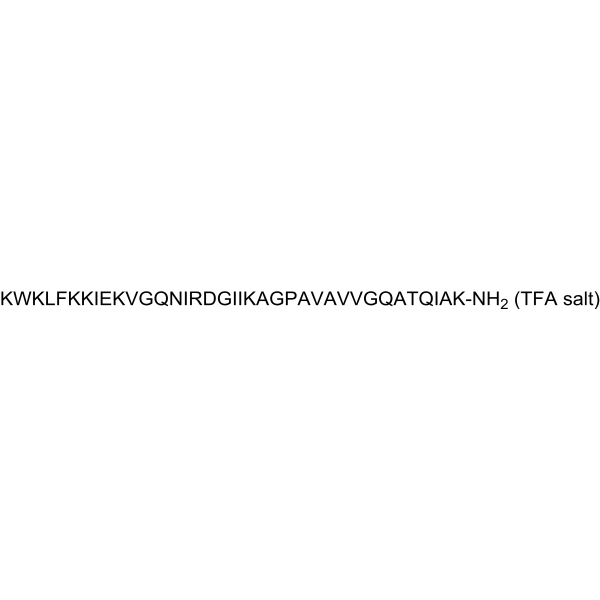
Lys-Trp-Lys-Leu-Phe-Lys-Lys-Ile-Glu-Lys-Val-Gly-Gln-Asn-Ile-Arg-Asp-Gly-Ile-Ile-Lys-Ala-Gly-Pro-Ala-Val-Ala-Val-Val-Gly-Gln-Ala-Thr-Gln-Ile-Ala-Lys-NH2
-
Sequence Shortening
KWKLFKKIEKVGQNIRDGIIKAGPAVAVVGQATQIAK-NH2
-
Initial Source
Hyalaphora cecropia
-
Shipping
Room temperature in continental US; may vary elsewhere.
-
Storage
Sealed storage, away from moisture
Powder -80°C 2 years -20°C 1 year * In solvent : -80°C, 6 months; -20°C, 1 month (sealed storage, away from moisture)


Publications (3)
-
Journal Impact Factor
-
Most Recent
-
Cell Rep
Barceloneic acid A enables Metarhizium robertsii to establish parasitism in insects and mutualism in plants by inhibiting farnesyltransferase. [Abstract]2026 May 28;45(6):117371. PMID: 42213785 -
Probiotics Antimicrob Proteins
The Efficacy of Cecropin Against Multidrug-Resistant Bacteria Is Linked to the Destabilization of Outer Membrane Structure LPS of Gram-Negative Bacteria. [Abstract]2024 Dec 21. PMID: 39708190 -


Purity & Documentation
-
Data Sheet (283 KB)
-
SDS (252 KB)
- English - EN (252 KB)
- Français - FR (252 KB)
- Deutsch - DE (252 KB)
- Norwegian - NO (252 KB)
- Español - ES (252 KB)
- Swedish - SV (252 KB)
- Italian - IT (252 KB)
- Korean - KR (252 KB)
- Portuguese - PT (252 KB)
-
Handling Instructions (2659 KB)
References
[1]. Cerón JM, et al. The antimicrobial peptide cecropin A induces caspase-independent cell death in human promyelocytic leukemia cells. Peptides. 2010 Aug;31(8):1494-503. [Content Brief]
[2]. Lee E, et al. Anti-inflammatory activities of cecropin A and its mechanism of action. Arch Insect Biochem Physiol. 2015 Jan;88(1):31-44. [Content Brief]

Calculators
Concentration (start) × Volume (start) = Concentration (final) × Volume (final)


Cecropin A TFA Related Classifications
HY-P1539A Related Classifications
 Powered by Bioz