



Kasugamycin hydrochloride hydrate
Based on 1 publication(s) in Google Scholar
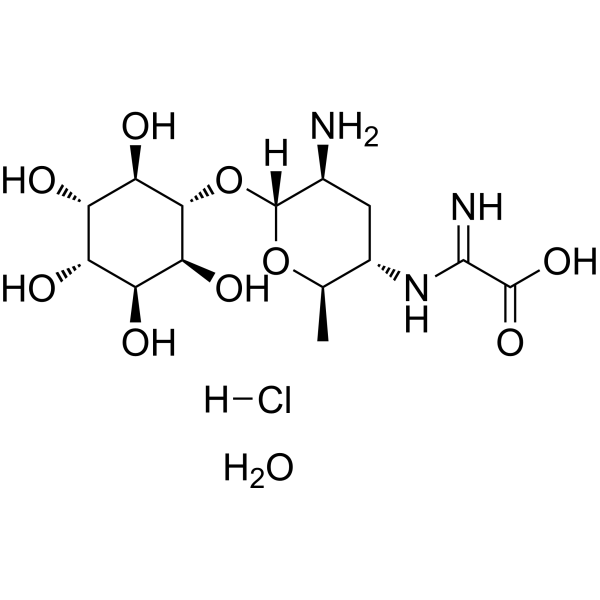
Kasugamycin (Ksg) hydrochloride hydrate is an aminoglycoside antibiotic (antibiotic) that binds to the bacterial 30S ribosomal subunit and inhibits canonical translation initiation. Kasugamycin hydrochloride hydrate binds to the P-site and E-site codon regions in the mRNA channel and interferes with mRNA-tRNA codon-anticodon interactions, thereby destabilizing initiator tRNA binding. Kasugamycin hydrochloride hydrate possesses anti-infective activity. Kasugamycin hydrochloride hydrate is used in research on bacterial translation and Pseudomonas infection.
For research use only. We do not sell to patients.
- Purity: 99.93%
- CAS No.: 200132-83-8
- Formula: C14H28ClN3O10
- Molecular Weight:433.84
-
Storage:
4°C, sealed storage, away from moisture
* In solvent : -80°C, 6 months; -20°C, 1 month (sealed storage, away from moisture)

To place orders, for customer services and technical support, please contact: MedChemExpress USA
Tel: 609-228-6898 E-mail: [email protected] [email protected]


-
 Biological Activity
-
Chemical Information
-
Solvent & Solubility
- Purity & Documentation
- References
-
 Help & FAQs


Publications Citing Use of MedChemExpress (MCE) Kasugamycin hydrochloride hydrate
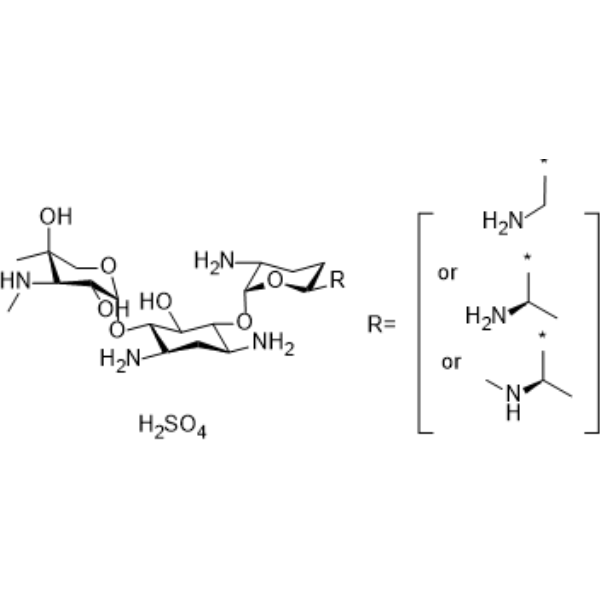
MoreAll Antibiotic Isoforms
More

Biological Activity
Description
In Vitro
Kasugamycin (Ksg) (100 mM) hydrochloride hydrate binds to the Thermus thermophilus 30S ribosomal subunit, forming two binding sites in the mRNA pathway; the primary binding site is located at the top of h44, between h24 and h28, and spans the P/E site region, while the secondary binding site is located adjacent to the E site and interacts with h23, h24 of 16S rRNA and ribosomal protein S7, with the Kasugamycin hydrochloride hydrate-30S complex structure determined at a resolution of 3.35 Å[2].
Kasugamycin (0-1 mM; 15 min; 37 °C) hydrochloride hydrate inhibits the binding of MVF-mRNA to Escherichia coli 30S ribosomal subunits and 70S ribosomes, with inhibition rates of 40% and 25% at 1 mM, respectively[2].
Kasugamycin (0-1 mM; 15 min; 37 °C) hydrochloride hydrate inhibits the binding of initiator fMet-tRNA to MVF-mRNA-programmed Escherichia coli 30S ribosomal subunits, with a maximum inhibition rate of 75% at 1 mM, while it has no significant effect on the binding of fMet-tRNA to 70S ribosomes[2].
Kasugamycin (500 μM; 15 min; 37 °C) hydrochloride hydrate inhibits the binding of leaderless mRNA and initiator fMet-tRNA to Escherichia coli 70S ribosomes by 29% and 13%, respectively, indicating that the 70S initiation complex formed by leaderless mRNA-fMet-tRNA is relatively insensitive to Kasugamycin hydrochloride hydrate[2].
Kasugamycin (12.5-50 μg/mL) hydrochloride hydrate inhibits 32 strains of Pseudomonas aeruginosa cultured in peptone water at pH 7.0, with 1 strain inhibited at 12.5 μg/mL, 19 strains inhibited at 25 μg/mL, and 12 strains inhibited at 50 μg/mL[4].
MedChemExpress (MCE) has not independently confirmed the accuracy of these methods. They are for reference only.
In Vivo
Kasugamycin (100 mg/kg; i.p.; single administration) hydrochloride hydrate achieves a 50% survival rate in mice infected intraperitoneally with mucin-containing Pseudomonas aeruginosa No. 87 (100 MLD)[4].
Kasugamycin (200 mg/kg; i.p.; single administration) hydrochloride hydrate achieves a 75% survival rate in mice infected intraperitoneally with mucin-containing Pseudomonas aeruginosa No. 87 (100 MLD)[4].
MedChemExpress (MCE) has not independently confirmed the accuracy of these methods. They are for reference only.
-
Animal Model:Mice were intraperitoneally inoculated with Pseudomonas aeruginosa No. 87 with mucin at 1 MLD.[4]
-
Dosage:200 mg/kg
-
Administration:i.p.; single injection
-
Result:Resulted in 100% survival.
-
Animal Model:Mice were intraperitoneally inoculated with Pseudomonas aeruginosa No. 87 with mucin at 1 MLD.[4]
-
Dosage:100 mg/kg
-
Administration:i.p.; single administration
-
Result:Resulted in 50% survival.
-
Animal Model:Mice were intraperitoneally inoculated with Pseudomonas aeruginosa No. 87 with mucin at 1 MLD.[4]
-
Dosage:200 mg/kg
-
Administration:i.p.; single administration
-
Result:Resulted in 75% survival.


Chemical Information
-
CAS No. 200132-83-8
-
Appearance Solid
-
Molecular Weight 433.84
-
Formula C14H28ClN3O10
-
Color Off-white to light brown
-
SMILES
OC(C(N[C@@H](C[C@@H]1N)[C@@H](C)O[C@]1([H])O[C@@H]2[C@@H](O)[C@@H](O)[C@H](O)[C@H](O)[C@H]2O)=N)=O.Cl.O
-
Synonyms
Ksg hydrochloride hydrate
-
Shipping
Room temperature in continental US; may vary elsewhere.
-
Storage
4°C, sealed storage, away from moisture
* In solvent : -80°C, 6 months; -20°C, 1 month (sealed storage, away from moisture)


Publications (1)
-
Journal Impact Factor
-
Most Recent
-
Front Mol Biosci
Discovery of Kasugamycin as a Potent Inhibitor of Glycoside Hydrolase Family 18 Chitinases. [Abstract]2021 Apr 7:8:640356. PMID: 33898519


Solvent & Solubility
In Vitro:
H2O : 25 mg/mL (57.62 mM; Need ultrasonic)
DMSO : 1.67 mg/mL (3.85 mM; ultrasonic and warming and heat to 80°C; Hygroscopic DMSO has a significant impact on the solubility of product, please use newly opened DMSO)
Please refer to the solubility information to select the appropriate solvent. Once prepared, please aliquot and store the solution to prevent product inactivation from repeated freeze-thaw cycles.
Storage method and period of stock solution: -80°C, 6 months; -20°C, 1 month (sealed storage, away from moisture). When stored at -80°C, please use it within 6 months. When stored at -20°C, please use it within 1 month.
* Note: If you choose water as the stock solution, please dilute it to the working solution, then filter and sterilize it with a 0.22 μm filter before use.
Please refer to the solubility information to select the appropriate solvent. Once prepared, please aliquot and store the solution to prevent product inactivation from repeated freeze-thaw cycles.
Storage method and period of stock solution: -80°C, 6 months; -20°C, 1 month (sealed storage, away from moisture). When stored at -80°C, please use it within 6 months. When stored at -20°C, please use it within 1 month.
* Note: If you choose water as the stock solution, please dilute it to the working solution, then filter and sterilize it with a 0.22 μm filter before use.
Concentration (start) × Volume (start) = Concentration (final) × Volume (final)
In Vivo:
For the following dissolution methods, please prepare the working solution directly:
It is recommended to prepare fresh solutions and use them promptly within a short period of time.
The percentages shown for the solvents indicate their volumetric ratio in the final prepared solution. If precipitation or phase separation occurs during preparation, heat and/or sonication can be used to aid dissolution.
Add each solvent one by one: PBS
Solubility: 8.33 mg/mL (19.20 mM); Clear solution; Need ultrasonic and warming and heat to 60°C


Purity & Documentation
-
Data Sheet (282 KB)
-
SDS (252 KB)
- English - EN (252 KB)
- Français - FR (252 KB)
- Deutsch - DE (252 KB)
- Norwegian - NO (252 KB)
- Español - ES (252 KB)
- Swedish - SV (252 KB)
- Italian - IT (252 KB)
- Korean - KR (252 KB)
- Portuguese - PT (252 KB)
-
Handling Instructions (2659 KB)
References
[1]. Zhang H, et al. Simultaneous determination of kasugamycin and validamycin-A residues in cereals by consecutive solid-phase extraction combined with liquid chromatography-tandem mass spectrometry. Food additives & contaminants. Part A, Chemistry, analysis, control, exposure & risk assessment. 2018 Mar;35(3):487-497. [Content Brief]
[2]. Schluenzen F, et al. The antibiotic kasugamycin mimics mRNA nucleotides to destabilize tRNA binding and inhibit canonical translation initiation. Nature structural & molecular biology. 2006 Oct;13(10):871-8. [Content Brief]
[3]. Kasuga K, et al. Heterologous production of kasugamycin, an aminoglycoside antibiotic from Streptomyces kasugaensis, in Streptomyces lividans and Rhodococcus erythropolis L-88 by constitutive expression of the biosynthetic gene cluster. Applied microbiology and biotechnology. 2017 May;101(10):4259-4268. [Content Brief]


Complete Stock Solution Preparation Table
Please refer to the solubility information to select the appropriate solvent. Once prepared, please aliquot and store the solution to prevent product inactivation from repeated freeze-thaw cycles.
Storage method and period of stock solution: -80°C, 6 months; -20°C, 1 month (sealed storage, away from moisture). When stored at -80°C, please use it within 6 months. When stored at -20°C, please use it within 1 month.
| Optional Solvent | Concentration Solvent Mass | 1 mg | 5 mg | 10 mg | 25 mg |
|---|---|---|---|---|---|
| DMSO / H2O | 1 mM | 2.3050 mL | 11.5250 mL | 23.0500 mL | 57.6249 mL |
| H2O | 5 mM | 0.4610 mL | 2.3050 mL | 4.6100 mL | 11.5250 mL |
| 10 mM | 0.2305 mL | 1.1525 mL | 2.3050 mL | 5.7625 mL | |
| 15 mM | 0.1537 mL | 0.7683 mL | 1.5367 mL | 3.8417 mL | |
| 20 mM | 0.1152 mL | 0.5762 mL | 1.1525 mL | 2.8812 mL | |
| 25 mM | 0.0922 mL | 0.4610 mL | 0.9220 mL | 2.3050 mL | |
| 30 mM | 0.0768 mL | 0.3842 mL | 0.7683 mL | 1.9208 mL | |
| 40 mM | 0.0576 mL | 0.2881 mL | 0.5762 mL | 1.4406 mL | |
| 50 mM | 0.0461 mL | 0.2305 mL | 0.4610 mL | 1.1525 mL |
* Note: If you choose water as the stock solution, please dilute it to the working solution, then filter and sterilize it with a 0.22 μm filter before use.


Kasugamycin hydrochloride hydrate Related Classifications
HY-B1864B Related Classifications
 Powered by Bioz
Keywords
- Kasugamycin hydrochloride
- 200132-83-8
- Ksg hydrochloride
- Antibiotic
- Bacterial
- aminoglycoside antibiotic
- Magnaporthe oryzae
- 30S ribosomal subunit
- rice blast disease
- 16S rRNA
- Rhizoctonia solani
- translation initiation inhibitor
- Pseudomonas aeruginosa
- Rhizoctonia cerealis
- Streptomyces kasugaensis
- Inhibitor
- inhibitor
- inhibit