



CDK3
Cyclin-dependent kinase 3 (CDK3) is a serine/threonine kinase that functions in cell-cycle control, particularly during the G0/G1 transition and early G1 phase progression[1][2]. CDK3 forms an active complex with cyclin C, and this complex phosphorylates retinoblastoma protein (pRB) at Ser807/811, thereby promoting Rb-dependent exit from cellular quiescence and facilitating re-entry into the proliferative cycle[1]. Mechanistically, CDK3 contributes to cell-cycle progression through regulation of the Rb-E2F signaling axis, a pathway that coordinates transcriptional programs required for G1 entry and subsequent DNA synthesis[1][2]. In disease models, aberrant CDK3 activity has been linked to oncogenic transformation through phosphorylation-dependent activation of transcription factors, including ATF1, c-Jun, and NFAT3, which enhance proliferation, anchorage-independent growth, and tumor development[3][4]. Elevated expression of CDK3 and its downstream signaling components has been reported in several cancer models, including skin cancer and nasopharyngeal carcinoma, supporting its relevance to tumor-associated cell-cycle deregulation[3][5]. Compared with closely related cell-cycle kinases such as CDK2, CDK3 exhibits distinct functions during G0 exit that cannot be fully compensated by CDK2, indicating nonredundant regulatory roles within the CDK family[5][6]. For experimental applications, CDK3 is frequently investigated as a regulator of quiescence-to-proliferation transitions and as a potential target for development of isoform-selective CDK inhibitors, although achieving kinase selectivity remains a major challenge because of structural similarities among CDK family members[2].
References:
- [1]. Ren S, et al. Cyclin C/cdk3 promotes Rb-dependent G0 exit. Cell. 2004 Apr 16;117(2):239-51. [Content Brief]
- [2]. Chohan TA, et al. An insight into the emerging role of cyclin-dependent kinase inhibitors as potential therapeutic agents for the treatment of advanced cancers. Biomed Pharmacother. 2018 Nov;107:1326-1341. [Content Brief]
- [3]. Xiao T, et al. Phosphorylation of NFAT3 by CDK3 induces cell transformation and promotes tumor growth in skin cancer. Oncogene. 2017 May 18;36(20):2835-2845. [Content Brief]
- [4]. Solomon DA, et al. Mutational inactivation of PTPRD in glioblastoma multiforme and malignant melanoma. Cancer Res. 2008 Dec 15;68(24):10300-6. [Content Brief]
- [5]. Wang L, et al. CDK3 expression and its clinical significance in human nasopharyngeal carcinoma. Mol Med Rep. 2014 Jun;9(6):2582-6. [Content Brief]
- [6]. Hofmann F, et al. Differential effects of cdk2 and cdk3 on the control of pRb and E2F function during G1 exit. Genes Dev. 1996 Apr 1;10(7):851-61. [Content Brief]
-
CDK3 Related Products (28)
Related Products (28)

-
Recombinant Proteins (6)
- 1
- 2

-
Cyproheptadine-d3
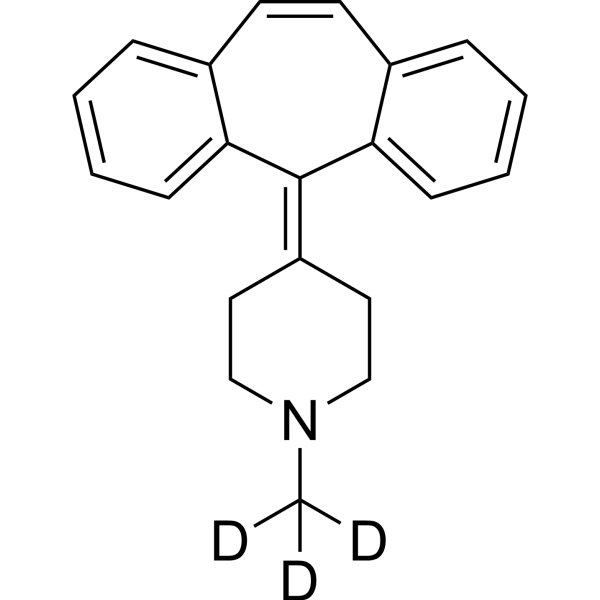 0 ImagesCat. No.: HY-B1622SCAS No.: 2712455-05-3Cyproheptadine-d3 is the d3-labeled Cyproheptadine (HY-B1622). Cyproheptadine acts as a p38 MAP kinase activator, CHK2 activator, histamine H1 receptor inhibitor and serotonin receptor inhibitor. Cyproheptadine mediates cell cycle arrest via G1 phase arrest, G1/S transition arrest, G0/G1 phase arrest, reduced expression of cyclins D1/D2/D3, upregulated expression of HBP1, p16, p21, p27, and decreased phosphorylation of retinoblastoma protein. Cyproheptadine induces Apoptosis by increasing PARP and cleaved PARP, as well as activating the mitochondrial caspase pathway. Cyproheptadine inhibits tumor growth with extremely low toxicity to normal cells. Cyproheptadine can be used in research related to hepatocellular carcinoma, multiple myeloma and acute myeloid leukemia.
-
Cyproheptadine hydrochloride (Standard)
 0 ImagesSynonyms: Cyproheptadine HCl (Standard)Cyproheptadine hydrochloride (Standard) (Cyproheptadine HCl (Standard)) is the analytical standard of Cyproheptadine hydrochloride (HY-B0366A). This product is intended for research and analytical applications. Cyproheptadine hydrochloride (Cyproheptadine HCl) acts as a p38 MAP kinase activator, CHK2 activator, histamine H1 receptor inhibitor and serotonin receptor inhibitor. Cyproheptadine hydrochloride mediates cell cycle arrest via G1 phase arrest, G1/S transition arrest, G0/G1 phase arrest, reduced expression of cyclins D1/D2/D3, upregulated expression of HBP1, p16, p21, p27, and decreased phosphorylation of retinoblastoma protein. Cyproheptadine hydrochloride induces Apoptosis by increasing PARP and cleaved PARP, as well as activating the mitochondrial caspase pathway. Cyproheptadine hydrochloride inhibits tumor growth with extremely low toxicity to normal cells. Cyproheptadine hydrochloride can be used in research related to hepatocellular carcinoma, multiple myeloma and acute myeloid leukemia.
-
CDK7-IN-20
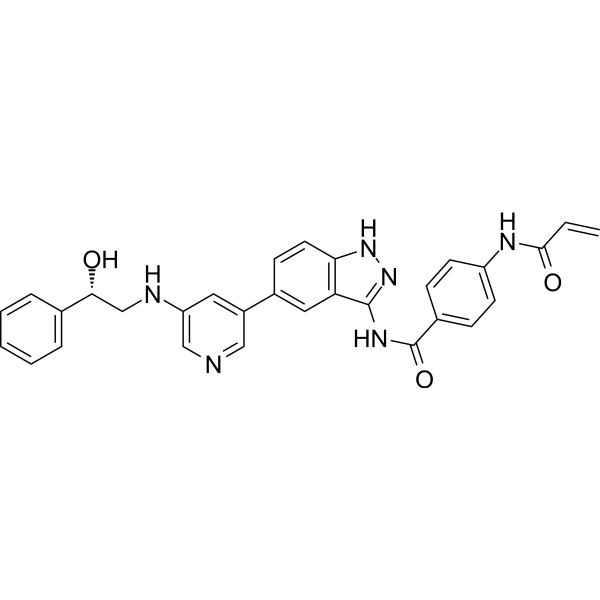 0 ImagesCat. No.: HY-151878CAS No.: 3034210-97-1
-
KB-0742 hydrochloride
 0 ImagesCat. No.: HY-137478B
-
Cyproheptadine hydrochloride-d3
 0 ImagesCat. No.: HY-W745430Synonyms: Cyproheptadine HCl-d3Cyproheptadine hydrochloride-d3 (Cyproheptadine HCl-d3) is the d3-labeled Cyproheptadine (hydrochloride) (HY-B0366A). Cyproheptadine hydrochloride (Cyproheptadine HCl) acts as a p38 MAP kinase activator, CHK2 activator, histamine H1 receptor inhibitor and serotonin receptor inhibitor. Cyproheptadine hydrochloride mediates cell cycle arrest via G1 phase arrest, G1/S transition arrest, G0/G1 phase arrest, reduced expression of cyclins D1/D2/D3, upregulated expression of HBP1, p16, p21, p27, and decreased phosphorylation of retinoblastoma protein. Cyproheptadine hydrochloride induces Apoptosis by increasing PARP and cleaved PARP, as well as activating the mitochondrial caspase pathway. Cyproheptadine hydrochloride inhibits tumor growth with extremely low toxicity to normal cells. Cyproheptadine hydrochloride can be used in research related to hepatocellular carcinoma, multiple myeloma and acute myeloid leukemia.
-
AG-012986 dihydrochloride
 0 ImagesCat. No.: HY-182470CAS No.: 486414-32-8AG-012986 (dihydrochloride) is a pan-CDK inhibitor with Ki values of 44 nM (CDK1), 9.2 nM (CDK4), 94 nM (CDK2), and IC50 values of 22 nM (CDK5), 4 nM (CDK9). AG-012986 (dihydrochloride) causes apoptosis of T-cells by targeting upstream kinases in the p38 Mitogen-activated protein kinase (MAPK) pathway and impairing cellular survival. AG-012986 (dihydrochloride) induces cell cycle arrest, retinoblastoma protein hypophosphorylation, and reduces Ki-67 expression. AG-012986 (dihydrochloride) exerts antiproliferative activity in tumor cells, demonstrates antitumor efficacy in human xenograft models, and causes retinal and peripheral neurotoxicity, plus immune cell toxicity. AG-012986 (dihydrochloride) can be used for the research of colon carcinoma, non-small cell lung carcinoma, lung carcinoma, breast carcinoma, ovarian tumor, pancreatic carcinoma, osteosarcoma, lymphoma, leukemia, retinotoxicity.
-
Cyproheptadine (Standard)
 0 ImagesCyproheptadine (Standard) is the analytical standard of Cyproheptadine (HY-B1622). This product is intended for research and analytical applications. Cyproheptadine acts as a p38 MAP kinase activator, CHK2 activator, histamine H1 receptor inhibitor and serotonin receptor inhibitor. Cyproheptadine mediates cell cycle arrest via G1 phase arrest, G1/S transition arrest, G0/G1 phase arrest, reduced expression of cyclins D1/D2/D3, upregulated expression of HBP1, p16, p21, p27, and decreased phosphorylation of retinoblastoma protein. Cyproheptadine induces Apoptosis by increasing PARP and cleaved PARP, as well as activating the mitochondrial caspase pathway. Cyproheptadine inhibits tumor growth with extremely low toxicity to normal cells. Cyproheptadine can be used in research related to hepatocellular carcinoma, multiple myeloma and acute myeloid leukemia.
- 1
- 2




