Fluorescent Dye
Fluorescence is a phenomenon of photoluminescence in luminescence. When an atom is irradiated by light, some electrons around the nucleus jump from their original orbitals to higher energy orbitals under the influence of light energy, i.e., from the ground state to the first or second excited single-line state, etc. Due to the instability of the first or second excited singlet state, the electron returns from the excited singlet state to the ground state accompanied by released energy, resulting in fluorescence.
Fluorescent dyes can be covalently bound or physically adsorbed in the structure of the substance. The fluorescence properties allow for the characterization, localization and quantitative analysis of the labeled object. Fluorescent dyes have shown great potential for the detection of proteins, nucleic acids, cells, and immunoassays, attributed to the advantages in non-radioactive contamination, simple experimental operation and easy observation.
Fluorescent dyes have penetrated many fields such as pharmacology, physiology, environmental science, and information science, as well as functional studies of proteins and drug screening.
All Product Categories
-
Fluorescent Dye Related Products (4894)
Related Products (4894)

-
Antibodies (4)
-
Coumarin hydrazine-d7
 0 ImagesCat. No.: HY-124197SCoumarin hydrazine-d7 is the deuterium labeled Coumarin hydrazine (HY-124197). Coumarin hydrazine is a fluorescent chemical probe (λex=420–450/λem=468nm) to label cellular protein- and lipid-bound carbonyls.
-
Cyanine 7 DBCO chloride
 0 ImagesCat. No.: HY-N16305CAS No.: 3091879-60-3
-
DiOC5(3) (solution)
 0 ImagesCat. No.: HY-DY1114CAS No.: 53213-81-3DiOC5(3) (solution) is a mitochondrial Fluorescent dye that alters membrane potential, and it also acts as an inhibitor of NADH-ubiquinone reductase (respiratory complex I). DiOC5(3) (solution) increases the NADH/NAD ratio and induces excessive production of ROS. DiOC5(3) (solution) induces Apoptosis. DiOC5(3) accumulates in the mitochondria of leukemia stem-like cells via organic anion-transporting polypeptides, specifically labels these cells, and inhibits their proliferation. DiOC5(3) (solution) enhances the cellular uptake of Hoechst 33342 (HY-15559), reduces Hoechst 33342-associated cytotoxicity, and improves the resolution of DNA content analysis by flow cytometry. DiOC5(3) (solution) shows no detectable fluorescence signal when excited in the 400-500 nm ultraviolet light range. DiOC5(3) (solution) is applicable to leukemia-related research.
Solvent and concentration: DMSO: 10 mM
-
MitoLumina 545
 0 ImagesCat. No.: HY-D3527MitoLumina 545 is a mitochondria-targeting fluorescent probe used to label mitochondria in live cells. MitoLumina 545 contains a chloromethyl group that allows for covalent binding to mitochondrial thiol-containing proteins. MitoLumina 545 is primarily used for mitochondrial imaging, live-cell mitochondrial tracking, and multicolor fluorescence microscopy (Ex/Em = 540/565 nm).
-
FITC-Polysucrose 50
 0 ImagesCat. No.: HY-179074BFITC-Polysucrose 50 is FITC-labeled Polysucrose 50. FITC-Polysucrose 50 is mainly used for permeability and microcirculation studies (Ex/Em = 488/525 nm).
-
Flubida-2
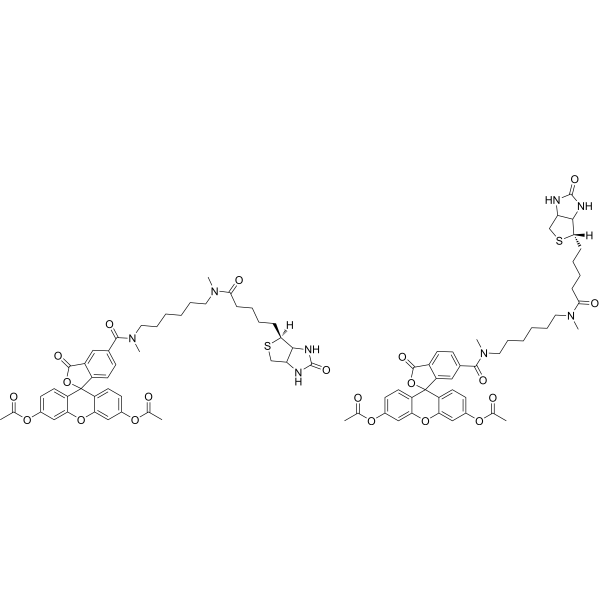 0 ImagesCat. No.: HY-D1688Flubida-2 is a cell permeable dye which can be hydrolyzed to Fubi-2 by endoesterases in cells (after hydrolysis, Ex=492 nm, Em=517 nm). Flubida-2 can be used to detect pH at a specific site in a cell organelle by directing the probe to where avidin fusion proteins are located.
-
Phaseolus Vulgaris Leucoagglutinin (Rhodamine)
 0 ImagesCat. No.: HY-NP147Phaseolus Vulgaris Leucoagglutinin Rhodamine is a plant lectin that can be used as a probe to specifically bind biomolecules (such as polysaccharides, peptides, etc.). Phaseolus Vulgaris Leucoagglutinin Rhodamine is a biological material or organic compound that can be used in life science research.
-
RB-PEG5000-FA
 0 ImagesCat. No.: HY-D2888ESynonyms: Rhodamine B-PEG5000-FARB-PEG5000-FA (Rhodamine B-PEG5000-FA) is a fluorescent dye composed of Rhodamine B (HY-Y0016), PEG and Folic acid (FA) (HY-16637). RB-PEG5000-FA can be used for cell imaging, folate receptor targeting and detection (Ex/Em=546/610 nm).
-
C12 NBD Galactosylceramide
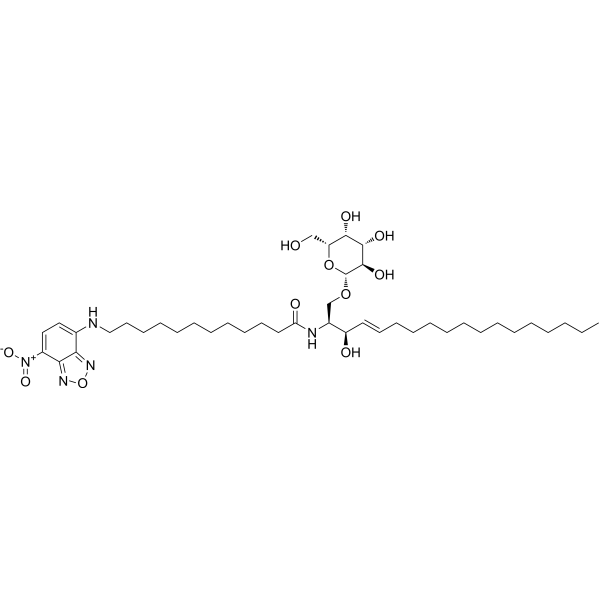 0 ImagesCat. No.: HY-145493CAS No.: 474942-98-8C12 NBD galactosylceramide, fluorescent dye, is a biologically active derivative of galactosylceramide that is tagged with a fluorescent C12 nitrobenzoxadiazole (C12 NBD) group. C12 NBD galactosylceramide can be used for the research of imaging.
-
Fluorescent Substrate for Pro-Specific Proteases
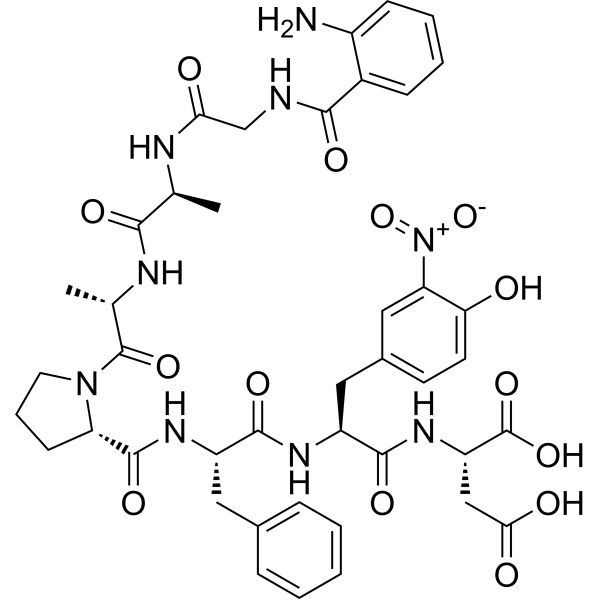 0 ImagesCat. No.: HY-P3948CAS No.: 142689-23-4Fluorescent Substrate for Pro-Specific Proteases is a fluorescent substrate of pro-specific proteases. Fluorescent Substrate for Pro-Specific Proteases can be used to detect the hydrolysis rate and activity of target enzyme.

-
Cy5-PEG5000-biotin
 0 ImagesCat. No.: HY-D2547Cy5-PEG5000-biotin is a polyethylene glycol derivative containing Cy5 (HY-D0821) fluorescent dye and polyethylene glycol (PEG) and a Biotin. Biotin can bind with high affinity to streptavidin or avidin. Cy5-PEG5000-biotin plays an important role in the specific capture and detection of biomolecules.
-
ARN14686
 0 ImagesCat. No.: HY-125384CAS No.: 1628345-10-7ARN14686 is an activity-based protein profiling (ABPP) probe. ARN14686 inhibits hNAAA with high potency (IC50=0.006 μM). ARN14686 interacts with NAAA via covalent binding to the N-terminal cysteine. ARN14686 binds only to the catalytically active form of NAAA, and may serve therefore as an efficient activity-based probe.
-
Biotin-V
 0 ImagesCat. No.: HY-D3118CAS No.: 2989973-69-3Biotin-V is a fluorescent probe targeting the biotin receptor (BiR), which can be used to detect changes in intracellular viscosity in cancer cells and tumor tissues. Biotin-V consists of a viscosity-responsive TICT (twisted internal charge transfer) fluorophore and a biotin-targeting moiety. In a high-viscosity environment, intramolecular rotation is restricted, which reduces non-radiative transitions and enhances fluorescence intensity and fluorescence lifetime. Biotin-V enters BiR-positive cancer cells via biotin receptor-mediated uptake, and mainly localizes to mitochondria, enabling dual-modal viscosity imaging (fluorescence intensity imaging and fluorescence lifetime imaging) (Ex/Em = 540/608 nm; cell imaging Ex/Em = 561/570-620 nm).

-
Suc-Ala-Leu-Pro-Phe-AMC
 0 ImagesCat. No.: HY-W719799CAS No.: 142997-31-7Suc-Ala-Leu-Pro-Phe-AMC is a PPIase fluorogenic substrate.
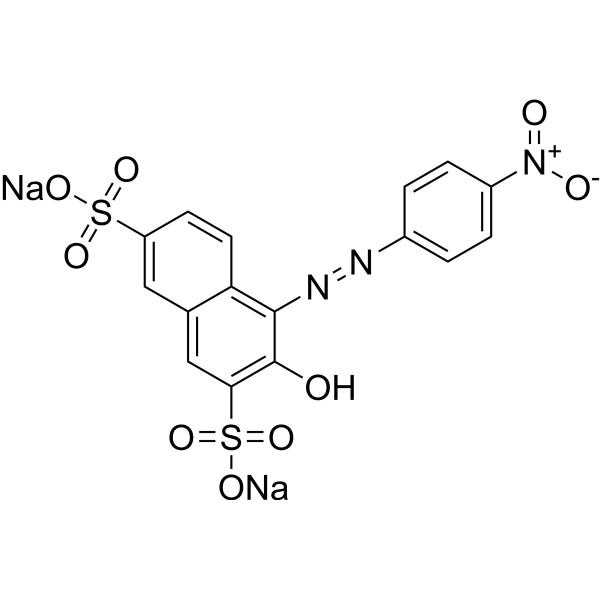
-
Sulfo-Cy3-Tetrazine
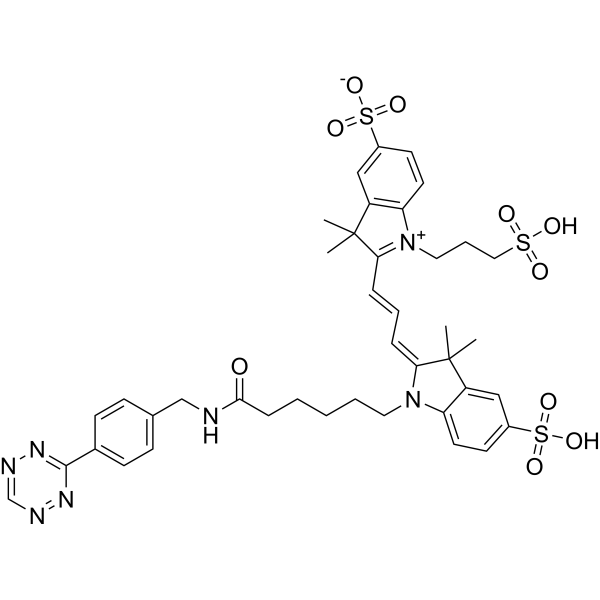 0 ImagesCat. No.: HY-151755CAS No.: 2055138-86-6
-
Br-5MP-Propargyl
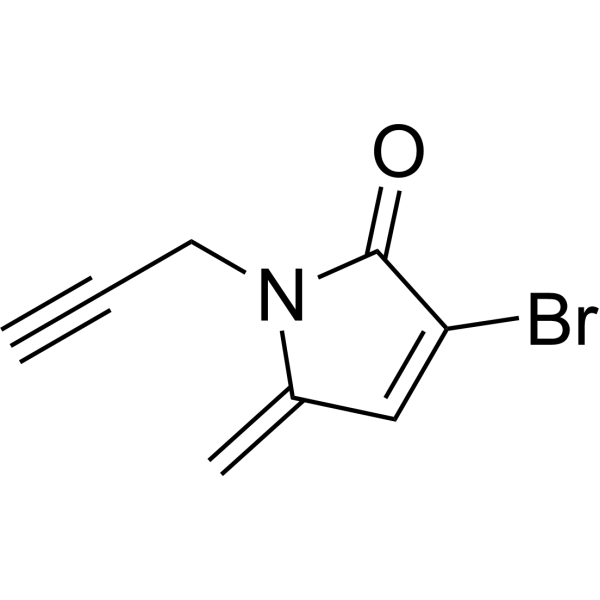 0 ImagesCat. No.: HY-D1407CAS No.: 2468100-37-8Br-5MP-Propargyl is the derivative of 5-Methylene pyrrolone (5MP). 5-Methylene pyrrolones (5MPs) are thiol-specific, reversible bioconjugation reagents for cysteine-specific protein modification, that are commonly used for protein bioconjugation. Br-5MP-Propargyl is a click chemistry reagent, it contains an Alkyne group and can undergo copper-catalyzed azide-alkyne cycloaddition (CuAAc) with molecules containing Azide groups.