



Fungal
An antifungal agent is a drug that selectively eliminates fungal pathogens from a host with minimal toxicity to the host.
Classes: 1. Polyene Antifungal Drugs: Amphotericin, nystatin, and pimaricin interact with sterols in the cell membrane (ergosterol in fungi, cholesterol in humans) to form channels through which small molecules leak from the inside of the fungal cell to the outside. 2. Azole Antifungal Drugs: Fluconazole, itraconazole, and ketoconazole inhibit cytochrome P450-dependent enzymes (particularly C14-demethylase) involved in the biosynthesis of ergosterol, which is required for fungal cell membrane structure and function. 3. Allylamine and Morpholine Antifungal Drugs: lylamines (naftifine, terbinafine) inhibit ergosterol biosynthesis at the level of squalene epoxidase. The morpholine drug, amorolfine, inhibits the same pathway at a later step. 4. Antimetabolite Antifungal Drugs: 5-Fluorocytosine acts as an inhibitor of both DNA and RNA synthesis via the intracytoplasmic conversion of 5-fluorocytosine to 5-fluorouracil.
All Product Categories
-
Fungal Related Products (2735)
Related Products (2735)

-
Antibodies (1)
-
Related Compound Screening Libraries (1)
-
Asulam potassium
 0 ImagesCat. No.: HY-B1838ACAS No.: 14089-43-1Asulam (potassium salt) is a chitin synthase inhibitor against plant pathogenic fungi. Asulam (potassium salt) interferes with the biosynthesis of chitin in the fungal cell wall to destroy the integrity and normal growth and reproduction of fungal cells, thereby exerting bacteriostatic activity. Asulam (potassium salt) is promising for research of fungal diseases such as downy mildew and gray mold in spinach, tulips, daffodils and lilies.
-
PPm
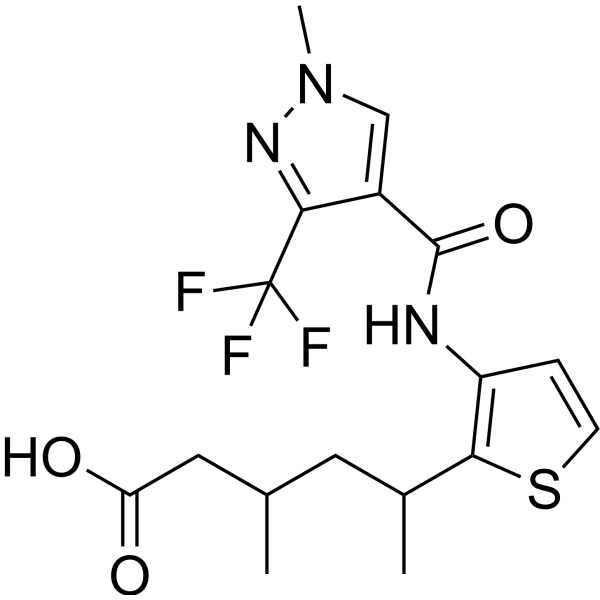 0 ImagesCat. No.: HY-157218CAS No.: 2101951-47-5PPm, a derivative of penthiopyrad and hapten, is a representative member of the succinate dehydrogenase inhibitors group of fungicides.
-
Candicidin D
 0 ImagesCat. No.: HY-125152CAS No.: 39372-30-0Synonyms: CndDCandicidin D (CndD) is an antibiotic, which exhibits antifungal activity through interaction with steroids in cell membranes. Candicidin D inhibits S. cerevisiae, Candida albicans and other Candida spp. with MIC of 0.25-1 μg/mL in RPMI-1640 medium.
-
Ascr#18 (Standard)
 0 ImagesCat. No.: HY-N8393RCAS No.: 1355681-10-5Ascr#18 (Standard) is the analytical standard of Ascr#18 (HY-N8393). This product is intended for research and analytical applications. Ascr#18, an ascaroside, is a hormone of nematodes. Ascr#18 is expressed during nematode development. Ascr#18 increases resistance in Arabidopsis, tomato, potato and barley to viral, bacterial, oomycete, fungal and nematode infections.
-
Olorofim (Standard)
 0 ImagesSynonyms: F901318 (Standard)Olorofim (Standard) is the analytical standard of Olorofim (HY-104029). This product is intended for research and analytical applications. Olorofim (F901318) selectively inhibits fungal dihydroorotate dehydrogenase (DHODH), a key enzyme in the pyrimidine biosynthesis pathway. Olorofim (F901318). Olorofim exhibits excellent activity against A. fumigatus and other Aspergillus spp..
-
Eupolauridine
 0 ImagesCat. No.: HY-N15319CAS No.: 58786-39-3Synonyms: CanangineEupolauridine (Canangine) is a selective DNA topoisomerase II inhibitor with IC50 values of 20 μM for fungal topoisomerase I and 33 μM for human topoisomerase I. Eupolauridine exerts antifungal activity by inhibiting the catalytic activity of topoisomerase II and stabilizing its cleavage complex with DNA, leading to DNA damage. Eupolauridine is promising for research of fungal infectious diseases.
-
SPK-843
 0 ImagesCat. No.: HY-109125CAS No.: 143483-67-4Synonyms: SPA-S-753 free baseSPK-843 is an antifungal agent. SPK-843 shows inhibitory activity against A. fumigatus MF-13, A. flavus TIMM 0057, and A. niger TIMM 2814 with MICs of 0.5 μg/mL, 0.25 μg/mL, and 0.0625 μg/mL, respectively. SPK-843 exhibits dose-dependent efficacy in murine models of pulmonary aspergillosis. SPK-843 can be used for the research of related fungal infections.
-
SDH-IN-32
 0 ImagesCat. No.: HY-178196SDH-IN-32 is a succinate dehydrogenase (SDH) inhibitor with an IC50 of 2.74 μM. SDH-IN-32 exhibits excellent antifungal activity. SDH-IN-32 can destroy the cell membrane structure and increase the permeability of the cell membrane. SDH-IN-32 can decrease the mitochondrial membrane potential (MMP), thereby inducing cell apoptosis and inhibiting the normal growth of mycelia. SDH-IN-32 can be used for the research of infection.
-
N-Decyl-N,N-dimethyldecan-1-aminium chloride (Standard)
 0 ImagesCat. No.: HY-W042181RCAS No.: 7173-51-5Synonyms: Didecyldimethylammonium chloride (Standard); DDAC (Standard)N-Decyl-N,N-dimethyldecan-1-aminium (chloride) (Standard) is the analytical standard of N-Decyl-N,N-dimethyldecan-1-aminium (chloride). This product is intended for research and analytical applications. N-Decyl-N,N-dimethyldecan-1-aminium chloride (Didecyldimethylammonium chloride) is a dialkyl-quaternary ammonium compound that is used in numerous products for its bactericidal, virucidal and fungicidal properties.
-
1,6-Dihydroxy-2-chlorophenazine
 0 ImagesCat. No.: HY-N14557CAS No.: 93768-40-21,6-Dihydroxy-2-chlorophenazine has weak anti-fungal and anti-yeast activity.
-
Pulvinamide
 0 ImagesCat. No.: HY-182488CAS No.: 31673-63-9Pulvinamide is a tetronic acid pigment, a pulvinic acid derivative, an Antibacterial agent and Antifungal agent. Pulvinamide can be isolated from lichens. Pulvinamide weakly inhibits the growth of Bacillus subtilis (ATCC 6633) with an MIC of 50 μg/mL. Pulvinamide weakly inhibits the growth of Candida albicans (ATCC 10231) and Saccharomyces cerevisiae (ATCC 9763), with MIC values of 200 μg/mL and 100 μg/mL, respectively.
-
Antifungal agent-164
 0 ImagesCat. No.: HY-181159Antifungal agent-164 is an exo-β-(1,3)-glucanase inhibitor that binds to the enzyme’s binding site. Antifungal agent-164 inhibits the growth of fungal. Antifungal agent-164 can be used for the research of candida infection.
-
Glidobactin C
 0 ImagesCat. No.: HY-N14020CAS No.: 108351-52-6Synonyms: GlbCGlidobactin C (GlbC) is an anti-tumor antibiotic. Glidobactin C (GlbC) has the activity against pathogenic fungi and yeast. Glidobactin C has anti-Candida albicans and Aspergillus fumigatus activity with a MIC of 0.8 μg/mL. Glidobactin C also extends the survival of mice inoculated with leukemia P388 cells.
-
5,6-Dihydroxyindole (Standard)
 0 ImagesCat. No.: HY-W018025RCAS No.: 3131-52-05,6-Dihydroxyindole (Standard) is the analytical standard of 5,6-Dihydroxyindole. This product is intended for research and analytical applications. 5,6-Dihydroxyindole, a melanin precursor, has a broad-spectrum antibacterial, antifungal, antiviral, antiparasitic activity. 5,6-Dihydroxyindole has cytotoxic effects and is strongly toxic against various pathogens.
-
O-Acetylbenzeneamidinocarboxylic acid
 0 ImagesCat. No.: HY-N14818CAS No.: 82744-16-9O-Acetylbenzeneamidinocarboxylic acid is a fungal metabolite that shows inhibitory to variety of plant pathogenic fungi.
-
4-Methyl-6,7-methylenedioxycoumarin
 0 ImagesCat. No.: HY-N8849CAS No.: 15071-04-2Synonyms: 4-Methylayapin4-Methyl-6,7-methylenedioxycoumarin (4-Methylayapin) is a Coumarin (HY-N0709) derivative. 4-Methyl-6,7-methylenedioxycoumarin exhibits antifungal activity against Pythium sp..
-
Antifungal agent 114
 0 ImagesCat. No.: HY-169119Antifungal agent 114 (Compound 19g) is an inhibitor for Cytochrome P450, that inhibits CYP1A2, CYP2C9, CYP2C19 CYP2D6 and CYP3A4 at 10 μM. Antifungal agent 114 exhibits antifungal activity against Cryptococcus neoformans, Candida and Aspergillus, with MIC <0.0625 μg/mL. Antifungal agent 114 exhibits good metabolic stability in human liver microsomes with a half-time of 107 minutes.
-
2-Hydroxymethylclavam
 0 ImagesCat. No.: HY-N15062CAS No.: 66036-39-32-Hydroxymethylclavam is a β-lactam antibiotic. 2-Hydroxymethylclavam has antifungal activity, especially for plant pathogenic fungi.
-
Pulegone (Standard)
 0 ImagesPulegone (Standard) is the analytical standard of Pulegone (HY-N1500). This product is intended for research and analytical applications. Pulegone is a monoterpene ketone compound widely present in the essential oils of many plants. Pulegone can also be used as a bird repellent. Pulegone has multiple activities such as anti-inflammatory, antibacterial, antifungal, and anti-hyperalgesic effects. Pulegone is particularly effective against bacteria of the Salmonella species.
-
Neosordarin
 0 ImagesCat. No.: HY-N14858CAS No.: 439665-94-8Neosordarin has antifungal activity and inhibits S. Cerevisia with the IC50 of 0.2~0.3 μg/mL.




