



Insecticide
Insecticide
Insecticides refer to any toxic substances used to kill insects, which exert toxic effects on pests through different mechanisms, thereby achieving the purpose of controlling pest populations and protecting crops and human health. Insecticides have both chemical and biological origins and can be classified into organochlorine insecticides, organophosphorus insecticides, carbamate insecticides, and mineral insecticides based on their chemical properties. Insecticides interact with different target and non-target sites, including receptors, enzymes, and many other known and unknown molecules. Most insecticides are neurotoxicants that target the nervous system, but they can also affect other organs and body systems. Insecticides are metabolized through different metabolic pathways and often serve as biomarkers of exposure in the form of their parent compounds or metabolites. The toxicity of insecticides can be acute, subacute, or chronic, depending on the duration of exposure and the dose involved. Therefore, selecting sensitive, accurate, and validated biomarkers of exposure, effects, and susceptibility appears to be a challenging task.
Insecticides are widely used in agriculture, horticulture, forestry, gardening, homes, offices, and other fields[1][2].
All Product Categories
-
Insecticide Related Products (529)
Related Products (529)

-
Methyl undecanoate
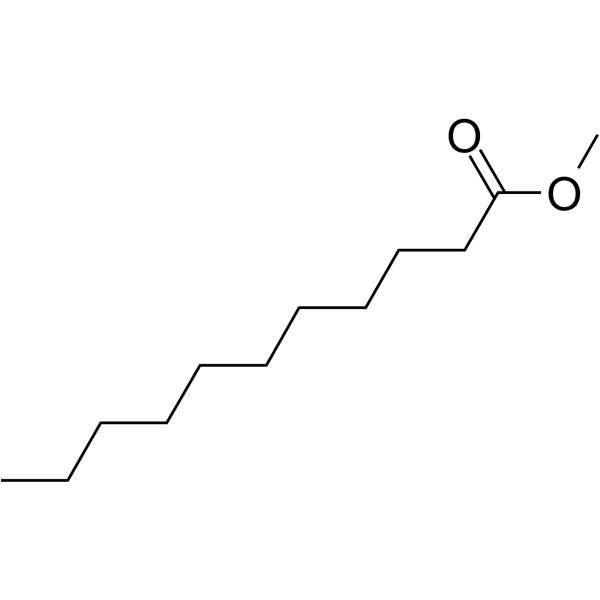 0 ImagesMethyl undecanoate is a synthetic undecanoic acid ester analog with biting deterrent and repellent activity against Aedes aegypti mosquitoes, with a biting deterrent index (BDI) of 0.88 and minimum effective dose (MED) of 25 µg/cm2. Methyl undecanoate can be used for the research of mosquito-borne diseases transmitted by Aedes aegypti.
-
Melicopine
 0 ImagesCat. No.: HY-W437569CAS No.: 568-01-4Melicopine is an alkaloid found in Z. simulans with antimalarial and anticancer activities. It exhibits inhibitory activity against chloroquine-sensitive 3D7 and chloroquine-resistant Dd2 strains of P. falciparum, with IC50 values of 29.7 and 33.7 µg/mL, respectively. Melicopine is cytotoxic to prostate cancer cells PC-3M and LNCaP (IC50 values of 47.9 and 37.8 µg/mL), but has no effect on non-cancerous HEK293 cells (IC50 greater than 100 µg/mL). Melicopine holds promise for research in anticancer and anti-infection fields.
-
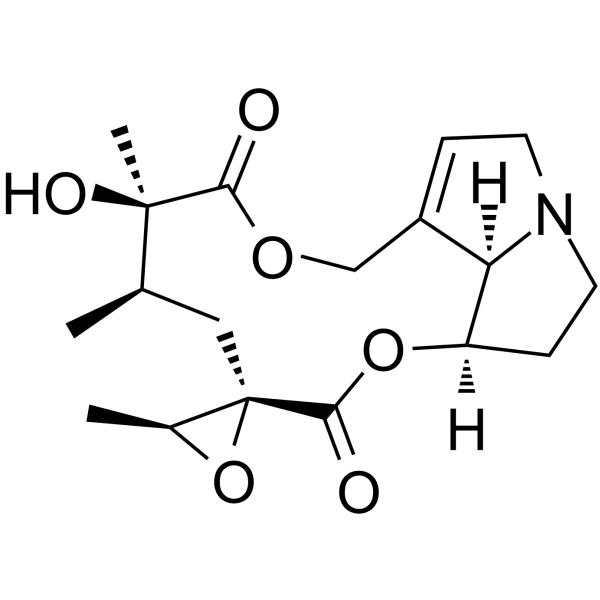
Thiamethoxam-d4
 0 ImagesCat. No.: HY-B0833SCAS No.: 1331642-98-8Thiamethoxam-d4 is the deuterium labeled Thiamethoxam (HY-B0833). Thiamethoxam is a broad spectrum neonicotinoid insecticide.
-
Anticopalic acid
 0 ImagesCat. No.: HY-N15634CAS No.: 24470-48-2Anticopalic acid is a labdane-type diterpenoid insect antifeedant that exhibits dose-dependent antifeedant activity against the fall armyworm (Spodoptera frugiperda). Anticopalic acid can be isolated from Vitex hemsleyi. Anticopalic acid may be involved in neuroreceptor-mediated insect taste regulation and could be used to develop environmentally friendly antifeedants targeting lepidopteran pests.
-
Alpha-Cypermethrin (Standard)
 0 ImagesSynonyms: FMC 45497 (Standard); Fendona (Standard); WL 85871 (Standard)Alpha-Cypermethrin (Standard) (FMC 45497 (Standard); Fendona (Standard); WL 85871 (Standard)) is the analytical standard of Alpha-Cypermethrin (HY-B0874). This product is intended for research and analytical applications. Alpha-Cypermethrin (FMC 45497; Fendona; WL 85871) is a type II pyrethroid insecticide. Alpha-Cypermethrin acts by delaying the inactivation of voltage-gated sodium channels, prolonging sodium tail currents, and triggering repetitive neural discharges. Alpha-Cypermethrin exhibits knockdown and lethal activity against target insects such as Musca domestica and Anopheles culicifacies. Alpha-Cypermethrin induces neurotoxicity in mammals, alters placental and fetal neurodevelopment, and causes acute mortality in fish. Alpha-Cypermethrin can be used in studies related to neurotoxicity, vector-borne diseases, and malaria.
-
Thiacloprid (Standard)
 0 ImagesCat. No.: HY-B1953RCAS No.: 111988-49-9Thiacloprid (Standard) is the analytical standard of Thiacloprid. This product is intended for research and analytical applications. Thiacloprid is an orally active neurotoxic insecticide and also a nAChR agonist. Thiacloprid reduces the viability of healthy cells, depletes reduced glutathione, and increases MDA levels, thereby inducing cytotoxicity and oxidative stress damage. In practical applications, Thiacloprid has lower acute toxicity to honeybees than other compounds of the same class such as Imidacloprid (HY-B0838), but it still significantly impairs the learning and memory function, immune capacity and survival status of honeybees. Thiacloprid induces intestinal microbial dysbiosis and reduces survival rate in middle-aged honeybees, increases the risk of premature collapse in bumblebee colonies, and significantly decreases the final colony weight and reproductive output. Thiacloprid is used in broad-spectrum agricultural pest control, often alone or in combination with Deltamethrin (HY-B1971), and meets the pest management needs of various crops including potatoes, cabbages, various fruits and vegetables, and nuts.
-
Chlorphoxim
 0 ImagesCat. No.: HY-W747601CAS No.: 14816-20-7Chlorphoxim is a broad-spectrum and highly efficient insecticide. Chlorphoxim kills pests by inhibiting AChE. Chlorphoxim inhibits the activities of SOD and CAT in zebrafish embryos. Chlorphoxim induces oxidative stress in zebrafish embryos by activating ROS. Chlorphoxim induces apoptosis by upregulating the expression levels of Bax, Bcl2 and p53 in zebrafish embryos. Chlorphoxim exhibits neurotoxicity and developmental toxicity. Chlorphoxim is used in agricultural research for the control of various pests.
-
Cyetpyrafen
 0 ImagesCat. No.: HY-W727481CAS No.: 1253429-01-4Cyetpyrafen is a pyrazole insecticide/acaricide with broad-spectrum insecticidal activity. Cyetpyrafen binds to DhelOBP4 (Ki = 4.95 μM) and DhelOBP21 (Ki = 5.51 μM) to mediate olfactory recognition in *Cryptolaemus montrouzieri*. Cyetpyrafen induces dose-dependent electroantennogram responses in *Cryptolaemus montrouzieri* and exhibits repellent effects on the species. Cyetpyrafen has bioaccumulative properties, is rapidly and passively absorbed by the roots of lettuce and rice, reaches a steady state within 24 h, preferentially accumulates in roots, and shows limited xylem/phloem translocation.
-
(Z)-8-Dodecen-1-ol
 0 ImagesSynonyms: cis-8-Dodecen-1-ol(Z)-8-Dodecen-1-ol (cis-8-Dodecen-1-ol) is an insect pheromone agonist and attractant active substance. (Z)-8-Dodecen-1-ol serves as the main component of the sex pheromone gland in female Cryptophlebia horii, exhibits stable attractant activity towards male moths, and induces significant electroantennogram signals. (Z)-8-Dodecen-1-ol can be used in studies related to male moth trapping and pest control.
-
(Z)-9-Dodecenyl acetate
 0 ImagesCat. No.: HY-134111CAS No.: 16974-11-1(Z)-9-Dodecenyl acetate is a monounsaturated dodecenyl acetate, an EAG stimulant and an attraction inhibitor. (Z)-9-Dodecenyl acetate is a component of moth sex pheromones. (Z)-9-Dodecenyl acetate elicits electroantennogram (EAG) responses in the antennae of male Choristoneura rosaceana. (Z)-9-Dodecenyl acetate can be used in studies related to pest control.
-
(E,Z)-3,13-Octadecadienyl acetate
 0 ImagesCat. No.: HY-W780787CAS No.: 53120-26-6Synonyms: E3,Z13-18:Ac(E,Z)-3,13-Octadecadienyl acetate (E3,Z13-18:Ac) is an insect sex pheromone that elicits attraction in male lesser peachtree borers (Lesser Peachtree Borer), which can be isolated from female lesser peachtree borers.
-
Emamectin-d3
 0 ImagesCat. No.: HY-W765182Emamectin-d3 is the deuterium labeled Emamectin. Emamectin is a macrocyclic lactone insecticide. Emamectin acts as agonist for GABA-gated chloride channels.
-
Demeton-S sulfoxide
 0 ImagesCat. No.: HY-W587665CAS No.: 2496-92-6Demeton-S sulfoxide is a systemic insecticide. When Demeton-S sulfoxide is topically applied to cotton stems, it is absorbed and transported to cotton leaves, whereas its penetration and diffusion capabilities are limited when it is topically applied to young lemon leaves.
-
Aspergillusidone F
 0 ImagesCat. No.: HY-N16403CAS No.: 1558007-47-8Aspergillusidone F is a Depsidone and antibacterial agent. Aspergillusidone F can be isolated from a marine fungus Aspergillus unguis. Aspergillusidone F potently inhibits Aromatase with an IC50 of 0.5 μM. Aspergillusidone F exhibits antibacterial activity against Pseudomonas aeruginosa and Methicillin (HY-121544)-resistant Staphylococcus aureus. Aspergillusidone F exhibits potent larvicidal activity against Artemia salina larvae, with an LC50 value of 12.8 μM. Aspergillusidone F exhibits anticancer activity against intrahepatic cholangiocarcinoma, non-small cell lung cancer, and acute lymphoblastic leukemia.
-
Chlorobenzuron (Standard)
 0 ImagesCat. No.: HY-B2063RCAS No.: 57160-47-1Chlorobenzuron (Standard) is the analytical standard of Chlorobenzuron (HY-B2063). This product is intended for research and analytical applications. Chlorobenzuron is a chitin synthetase inhibitor and insecticide. Chlorobenzuron inhibits larval development and pupation. Chlorobenzuron controls Prodenia liturd Fabricius and Prodenia liturd Fabricius.
-
(Rac)-Bifenthrin
 0 ImagesCat. No.: HY-W923487CAS No.: 99267-18-2(Rac)-Bifenthrin is a pyrethroid insecticide commonly utilized in both urban and agricultural settings.
-
Spinetoram J
 0 ImagesCat. No.: HY-W781976CAS No.: 187166-40-1Synonyms: XDE-175-JSpinetoram J (XDE-175-J) is the major component of Spinetoram. Spinetoram is a green, highly effective and broad-spectrum insecticide, which is friendly to the environment, humans and animals, and degradable.
-
Tetrachlorantraniliprole
 0 ImagesCat. No.: HY-W727480CAS No.: 1104384-14-6Tetrachlorantraniliprole is an anthranilic diamide insecticide that shows no significant affinity to the key odorant-binding proteins (DhelOBP4/DhelOBP21) of Dastarcus helophoroides.




