



PSMA
Prostate-specific membrane antigen
PSMA is a transmembrane protein that anchores to the cell membrane through its transmembrane region and is mainly expressed in prostate epithelial cells but also exists in other tissues. PSMA exhibits glutamate-preferring carboxypeptidase activity that hydrolyzes polyglutamylated folic acid to release folic acid monomers. PSMA mediates the endocytosis on the cell surface. PSMA acts as an angiogenesis marker in cancer cells. PSMA can be used as a diagnostic marker for prostate cancer, and for detection of invasiveness and metastatic ability of the tumor[1].
All Product Categories
-
PSMA Related Products (92)
Related Products (92)

-
Antibodies (1)
-
BQ7859
 0 ImagesCat. No.: HY-P10744BQ7859 is a probe targeting PSMA that contains a NOTA chelator and demonstrates excellent imaging performance. BQ7859 can be labeled with various radionuclides, such as 68Ga, 18F, 55Co, and 111In. In a mouse prostate cancer xenograft model, BQ7859 (labeled with 111In) efficiently accumulates in tumor regions in a PSMA-dependent manner and provides high-contrast tumor imaging. BQ7859 shows potential for research in prostate cancer imaging, particularly in positron emission tomography (PET) and single-photon emission computed tomography (SPECT). BQ7859 can be used for the synthesis/research of Radionuclide-Drug Conjugates (RDCs).
-
Lufefolastat Tetraxetan
 0 ImagesCat. No.: HY-P12132CAS No.: 2934667-10-2Lufefolastat Tetraxetan is a covalent conjugate of a PSMA-targeted peptide ligand and Tetraxetan (HY-W053583), a DOTA-class chelator. When labeled with 225Ac, Lufefolastat Tetraxetan is applicable to research on prostate-specific membrane antigen (PSMA)-positive metastatic prostate cancer.
-
PSMA binder-3
 0 ImagesCat. No.: HY-161626CAS No.: 3049900-51-5
-
PSMA-trillium
 0 ImagesCat. No.: HY-158119ACAS No.: 3036415-37-6Synonyms: Felivotide mopaxetanPSMA-trillium (Felivotide mopaxetan) is a PSMA-targeted molecule that contains a highly specific PSMA-binding motif, an albumin-binding domain optimized for tumor uptake and retention, and a Macropa chelator conjugated to the α-emitter 225Ac. PSMA-trillium binds to albumin to prolong plasma retention time and binds to PSMA via its specific motif. 225Ac-PSMA-Trillium exhibits dose-dependent inhibition of LNCaP tumor growth in mice. PSMA-trillium can be used in research related to prostate cancer and metastatic castration-resistant prostate cancer.
-
NH2-NODAGA TFA
 0 ImagesCat. No.: HY-164575ACAS No.: 3053227-80-5NH2-NODAGA TFA is an amino-modified NODAGA-type bifunctional chelator, specifically designed for amidation coupling with targeting ligands via squaric acid (SA), followed by coordination with radionuclides (e.g., 68Ga, 177Lu). NH2-NODAGA TFA can be coupled with diethyl squarate to form a PSMA inhibitor conjugate, which is used in prostate cancer research.
-
BQ0413
 0 ImagesCat. No.: HY-172366CAS No.: 3055338-52-5BQ0413 exhibits good affinity to PSMA with a KD of 89 pM. BQ0413 exhibits good uptake and internalization property with an internalization rate of 44% in PC3-pip cell. BQ0413 can be used as tumor imaging agent when labeled with 99mTc.
-
SC691
 0 ImagesCat. No.: HY-174808CAS No.: 2577994-10-4SC691 is a PSMA inhibitor. SC691 can be labeled with 68Ga(III). SC691 can be used for imaging diagnosis of prostate cancer.
-
CTT2274
 0 ImagesCat. No.: HY-168913CTT2274 is a prodrug of MMAE (HY-15162). CTT2274 is composed of a prostate-specific membrane antigen (PSMA)-binding scaffold, a biphenyl motif, a pH-sensitive phosphoramidate linker, and MMAE payload. CTT2274 shows selective binding to PSMA and delivers MMAE. CTT2274 inhibits prostate cancer.
-
HYNIC-iPSMA
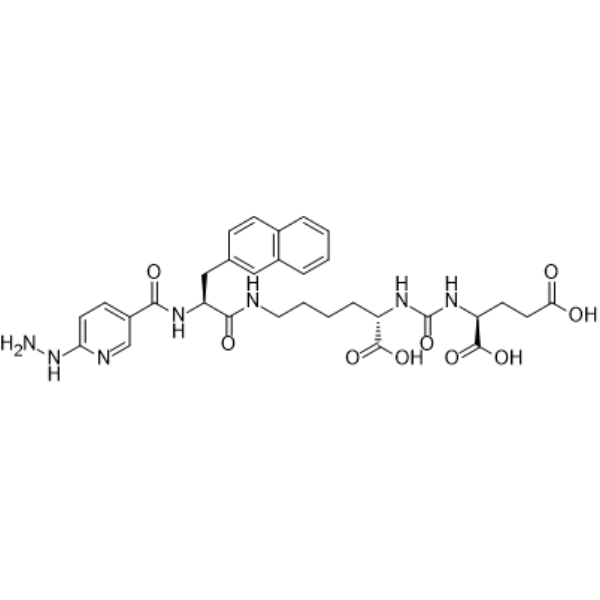 0 ImagesCat. No.: HY-P5292CAS No.: 2192215-74-8HYNIC-iPSMA is a PSMA-targeted ligand for tumor molecular imaging, with a Ki value of 3.11 nM. HYNIC-iPSMA consists of two components: HYNIC (6-hydrazinonicotinamide) and iPSMA (Inhibitor of Prostate-Specific Membrane Antigen). HYNIC acts as a chelating moiety to link radionuclides to the targeting molecule; iPSMA is a specific inhibitor that targets Prostate-Specific Membrane Antigen (PSMA). 68Ga-labeled iPSMA is used for prostate cancer detection via PET imaging, while the further developed 99mTc-EDDA/HYNIC-iPSMA TFA exhibits excellent specificity and sensitivity. HYNIC-iPSMA can be used for the synthesis and research of radionuclide-conjugated drugs (RDC).
-
5GluAF-2MeTG
 0 ImagesCat. No.: HY-D3189CAS No.: 2370825-44-65GluAF-2MeTG is an activatable fluorescent probe targeting the glutamate carboxypeptidase (CP) activity of PSMA (Ex/Em=490/500-600 nm). After being hydrolyzed by PSMA, 5GluAF-2MeTG releases a cell membrane-permeable fluorescent product, and achieves fluorescence activation by disrupting donor-excited photoinduced electron transfer (d-PeT). 5GluAF-2MeTG enables fluorescence imaging of live PSMA-expressing prostate cancer cells in vitro and visualizes the carboxypeptidase activity of PSMA. 5GluAF-2MeTG can be used to detect prostate cancer regions in preclinical excised tissue specimens.
-
BWD
 0 ImagesCat. No.: HY-174440BWD is a PSMA ligand (IC50 = 35.86). BWD exhibits excellent in vitro stability and high affinity. BWD can enhance tumor uptake and retention. BWD can inhibit tumor growth in vivo. BWD can be studied in anticancer research.
-
Ctx-L3
 0 ImagesCat. No.: HY-181829Ctx-L3 is a selective EGFR PTAC (PSMA-targeted chimera) degrader (DC50: 4.3 pM in LNCaP cells) and LYTAC. Ctx-L3 recruits prostate-specific membrane antigen (PSMA) and mediates lysosomal degradation of EGFR in PSMA-positive prostate cancer cells. Ctx-L3 exhibits degrading activity against EGFR in prostate cancer cells. Ctx-L3 is applicable to related research on prostate cancer.
-
PSMA-N5
 0 ImagesCat. No.: HY-P11598CAS No.: 3092260-02-8PSMA-N5 (Compound 15) is a PSMA ligand with a Ki value of 0.71 nM. PSMA-N5 acts as a PET radiotracer for prostate cancer imaging. PSMA-N5 is applicable to the research of prostate cancer and other related cancers.
-
PSMA-IN-2
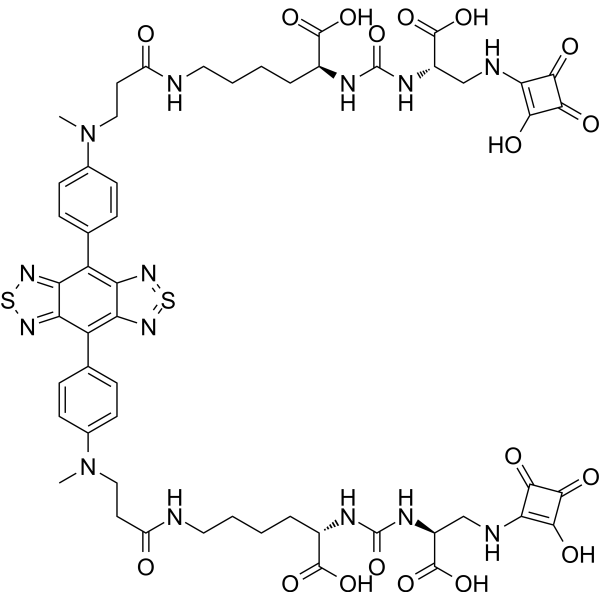 0 ImagesCat. No.: HY-149298CAS No.: 2946600-14-0PSMA-IN-2 is an inhibitor of PSMA with a Ki value of 1.07 nM. PSMA-IN-2 displays favorable in vivo NIR imaging (λEM = 1088 nm, λex = 808 nm), and can be used for NIRII image-guided tumor resection surgery in PSMA-positive tumor-bearing mice.
-
MDX1201
 0 ImagesCat. No.: HY-P991650MDX1201 is a humanized monoclonal antibody targeting PSMA1/7. MDX1201 conjugated with a fluorescent dye AlexaTM488 can be used as a probe for near-infrared fluorescence imaging (NIRF) imaging of prostate cancer.
-
PSMA-DIM
 0 ImagesCat. No.: HY-175248PSMA-DIM is a dimeric PSMA ligand with a Kd of 37.09 nM for LNCaP cells. PSMA-DIM can be radiolabeled with [68Ga]Ga to form [68Ga]Ga-PSMA-DIM. [68Ga]Ga-PSMA-DIM can effectively distinguish between cells and animal models with different expression levels of PSMA. [68Ga]Ga-PSMA-DIM exhibits high LNCaP cells uptake and tumor uptake peak values. PSMA-DIM can be used for the study of prostate cancer (PCa).
-
NOTA-SP2A-PSMAL
 0 ImagesCat. No.: HY-181853NOTA-SP₂A-PSMAL is a ligand targeting prostate-specific membrane antigen (PSMA), which competitively binds to PSMA with high binding affinity and an IC50 value of 0.26 nM. 18F-labeled NOTA-SP2A-PSMAL can be used as a PET tracer for positron emission tomography imaging of prostate cancer. NOTA-SP2A-PSMAL can be used for the synthesis and research of radionuclide conjugates (RDCs).
-
(S)-NH2-NODAGA hydrochloride
 0 ImagesCat. No.: HY-164575CPurity: 99.91%(S)-NH2-NODAGA hydrochloride is the S isomer of NH2-NODAGA hydrochloride (HY-164575B). NH2-NODAGA hydrochloride is an amino-modified NODAGA-type bifunctional chelator, specifically designed for amidation coupling with targeting ligands via squaric acid (SA), followed by coordination with radionuclides (e.g., 68Ga, 177Lu). NH2-NODAGA hydrochloride can be coupled with diethyl squarate to form a PSMA inhibitor conjugate, which is used in prostate cancer research.
-
Psa-AR
 0 ImagesCat. No.: HY-179056Psa-AR is a PROTAC degrader targeting PSMA, with a Kd of 7.2 nM. Psa-AR exhibits strong degradation capabilities for AR, AR-V7, and HSP90, and induces cell apoptosis. Psa-AR demonstrates potent tumor suppressive activity in the 22Rv1 xenograft tumor model. Psa-AR can be used in the research of castration-resistant prostate cancer.
-
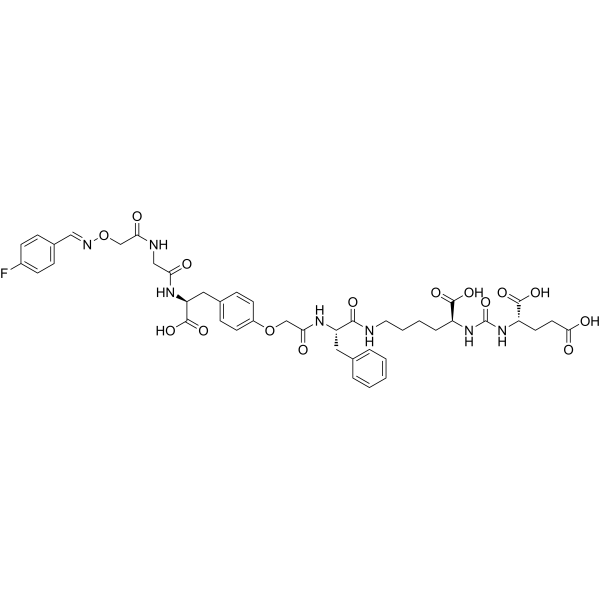
PSMA-IN-3
 0 ImagesCat. No.: HY-149869CAS No.: 2941187-68-2PSMA-IN-3 (compound 17) is a novel high-affinity PSMA inhibitor with an IC50 value of 13 nM. PSMA-IN-3 is suitable for developing an 18F-labeled radioligand for PET imaging of PSMA in prostate cancer.




