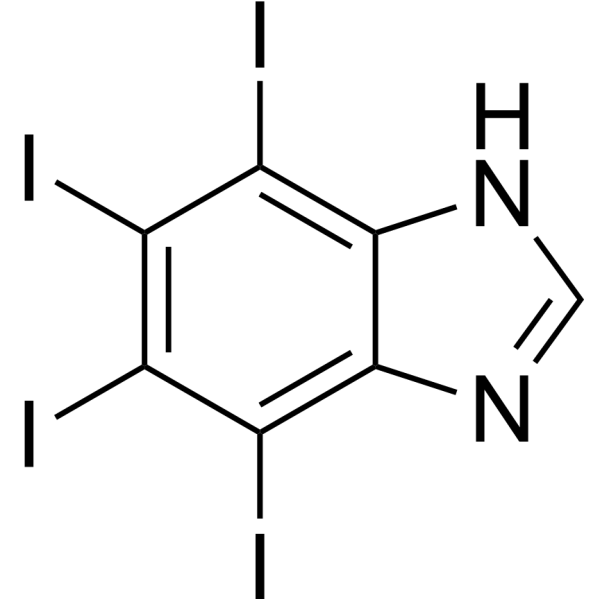
RIOK1
RIOK1 (RIO kinase 1) is an atypical serine/threonine kinase belonging to the evolutionarily conserved RIO kinase family, a group of proteins required for ribosome biogenesis and cell-cycle progression[1]. Mechanistically, RIOK1 participates in late-stage maturation of the small ribosomal subunit and contributes to the production of functional 40S ribosomes, linking protein synthesis capacity to cellular growth control[1][2]. Because ribosome assembly is tightly coupled to proliferation, dysregulation of RIOK1 has attracted attention in cancer biology[2]. In experimental cancer models, RIOK1 depletion strongly impairs proliferation and invasiveness in colon, breast, and lung cancer cells, with particularly pronounced effects in RAS-driven settings[3]. RIOK1 also promotes cell-cycle progression and activates NF-κB signaling, providing a mechanistic connection between ribosome-associated regulation and oncogenic signaling networks[3]. Consistent with these observations, elevated RIOK1 expression has been associated with tumor progression in non-small cell lung cancer, where RIOK1 supports proliferation, migration, invasion, and cell survival[4]. Compared with the related family members RIOK2 and RIOK3, RIOK1 displays distinct functional behavior in several experimental systems; RIOK1 knockdown impairs tumor-cell growth whereas equivalent suppression of RIOK2 or RIOK3 does not reproduce the same phenotype in RAS-mutant cancer models[3]. Therefore, RIOK1 represents a biologically distinct RIO kinase with value for studies of ribosome maturation, cancer signaling, and target-validation research[1][3].
Références:
- [1]. LaRonde-LeBlanc N, et al. The RIO kinases: an atypical protein kinase family required for ribosome biogenesis and cell cycle progression. Biochim Biophys Acta. 2005 Dec 30;1754(1-2):14-24. [Content Brief]
- [2]. Plassart L, et al. The final step of 40S ribosomal subunit maturation is controlled by a dual key lock. Elife. 2021 Apr 28;10:e61254. [Content Brief]
- [3]. Weinberg F, et al. The Atypical Kinase RIOK1 Promotes Tumor Growth and Invasive Behavior. EBioMedicine. 2017 Jun;20:79-97. [Content Brief]
- [4]. Wang R, et al. RIOK1 is associated with non-small cell lung cancer clinical characters and contributes to cancer progression. J Cancer. 2022 Jan 31;13(4):1289-1298. [Content Brief]
All Product Categories
-
RIOK1 Produits associés (1)
Produits associés (1)