



Anti-Mouse OX40L/CD134L Antibody (RM134L)

Based on 1 Customer Validation
Anti-Mouse OX40L/CD134L Antibody (RM134L) is an anti-mouse OX40L/CD134L IgG2b monoclonal antibody. Anti-Mouse OX40L/CD134L Antibody (RM134L) reduces immune response by inhibiting the OX40/OX40L signaling pathway. Anti-Mouse OX40L/CD134L Antibody (RM134L) can inhibit plasma cell differentiation and antibody secretion. Anti-Mouse OX40L/CD134L Antibody (RM134L) can prolong the survival time of cell transplantation by inhibiting CD4+ T cells. Anti-Mouse OX40L/CD134L Antibody (RM134L) can be used for researches on inflammation and cancer such as graft versus host disease (GVHD), allergic reaction, lupus nephritis and hepatocellular carcinoma (HCC).
For research use only. We do not sell to patients.
- Purity : 95.00%
- Molecular Weight:150 kDa
-
Storage:
Please store the product under the recommended conditions in the Certificate of Analysis.

To place orders, for customer services and technical support, please contact: MedChemExpress USA
Tel: 609-228-6898 E-mail: [email protected] [email protected]


-
 Biological Activity
-
Chemical Information
- Purity & Documentation
- References
-
 Help & FAQs


All Orexin Receptor (OX Receptor) Isoforms
More

Biological Activity
Description
Isotype
Rat IgG2b kappa
Recommend Isotype Controls
Species Reactivity
Mouse
IC50 & Target
OX40L/CD134L
In Vitro
Anti-Mouse OX40L/CD134L Antibody (RM134L) (5 μg/mL) significantly inhibits the activation effect of tumor-associated macrophages (TAMs) on CD8+ T cells[3].
Anti-Mouse OX40L/CD134L Antibody (RM134L) (1-100 μg/mL, 3 days) dose dependently inhibits Th1 and Tfh cells differentiation and promotes Treg cells differentiation[4].
Anti-Mouse OX40L/CD134L Antibody (RM134L) (1-100 μg/mL, 72 h) inhibits the differentiation of plasma derived cells and the secretion of antibodies (IgG2b, IgG3, IgA, IgM), downregulates the expression of BLIMP1 and XBP1, and upregulates the expression of SPIB in B cells[4].
MedChemExpress (MCE) has not independently confirmed the accuracy of these methods. They are for reference only.
-
Cell Line:B cells
-
Concentration:1, 10 and 100 μg/mL
-
Incubation Time:72 h
-
Result:Reduced the level of BLIMP1 and XBP1 and increased the level of SPIB.
In Vivo
Anti-Mouse OX40L/CD134L Antibody (RM134L) (200 μg, i.p., once daily until day 5, then three times a week until day 28) significantly prolongs survival period in B10.BR/SgSnJ (H2k) mice with a graft versus host disease (GVHD) model[2].
Anti-Mouse OX40L/CD134L Antibody (RM134L) (250 μg, i.p., once every 3 days, on day -2 until the endpoint) significantly reverses the anti-tumor effect of C12-iE-DAP in C57BL/6 mice bearing Hepa 1-6, B16F10 or MC38 tumors[3].
Anti-Mouse OX40L/CD134L Antibody (RM134L) (100 μg, i.p., twice weekly, for 10 weeks) relieves lupus nephritis in female MRL/Lpr mice with a spontaneous lupus model[4].
Anti-Mouse OX40L/CD134L Antibody (RM134L) (100 μg, i.p., once daily, for 3 weeks) reduces autoimmune response in female C57BL/6J mice injected with keyhole limpet hemocyanin (KLH)[4].
MedChemExpress (MCE) has not independently confirmed the accuracy of these methods. They are for reference only.
-
Animal Model:Phl p 5 (5 μg) injected female BALB/c mice (6-12 weeks)[1]
-
Dosage:0.5 mg, combined with CD40L mAb (1 mg) and CTLA4Ig (0.5 mg)
-
Administration:Intraperitoneal injection (i.p.), on day 0, 2, 4 and 8 for early stage, on day 21, 23, 25 and 29 for late stage
-
Result:Delayed antibody production.
Had no significant effect on the humoral and effector cell levels of allergic reactions, only slightly inhibiting T cell responses when OX40L mAb is used alone.
-
Animal Model:T cells injected B10.BR/SgSnJ (H2k) mice (8-10 weeks)[2]
-
Dosage:200 μg
-
Administration:Intraperitoneal injection (i.p.), once daily until day 5, then three times a week until day 28
-
Result:Increased the long-term survival rate from 0 % to 35 %.
Inhibited CD4+ T cell-mediated GVHD.
-
Animal Model:5×10⁶ Hepa 1-6 or B16F10 or 1×10⁶ MC38 cells injected C57BL/6 mice (6-8 weeks)[3]
-
Dosage:250 μg
-
Administration:Intraperitoneal injection (i.p.), once every 3 days, on day -2 until the endpoint
-
Result:Weakened tumor growth inhibition.
-
Animal Model:Female MRL/Lpr mice (11 weeks)[4]
-
Dosage:100 μg
-
Administration:Intraperitoneal injection (i.p.), twice weekly, for 10 weeks
-
Result:Reduced anti dsDNA antibodies and proteinuria.
Reduced renal IgG and C3 deposition.
Reduced the proportion of Th1 and Tfh cells in the spleen.
-
Animal Model:KLH (0.5 mg/mL) injected female C57BL/6J mice (8 weeks)[4]
-
Dosage:100 μg
-
Administration:Intraperitoneal injection (i.p.), once daily, for 3 weeks
-
Result:Reduced serum IgG1, IgG2b, IgG3, IgA, IgM levels.
Reduced the number and area of hair growth centers (GC).
Inhibited the proportion of plasma derived cells and Tfh cells in the spleen and lymph nodes.
Gene ID
Accession
Conjugated
Unconjugated
Reconsititution
The product can be reconstituted/diluted with sterile PBS or saline.
Format
-
Product Image
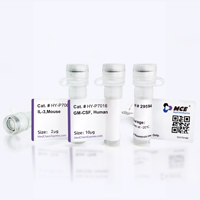
Application
in vivo blocking of OX40/OX40L signaling; in vitro OX40L neutralization


Chemical Information
-
Appearance Liquid
-
Molecular Weight 150 kDa
-
Color Colorless to light yellow
-
SMILES
[Anti-Mouse OX40L/CD134L Antibody (RM134L)]
-
Formulation
Please refer to the lot-specific COA for specific buffer information.
-
Storage
Please store the product under the recommended conditions in the Certificate of Analysis.


Purity & Documentation
-
Data Sheet (267 KB)
-
SDS (251 KB)
- English - EN (251 KB)
- Français - FR (251 KB)
- Deutsch - DE (251 KB)
- Norwegian - NO (251 KB)
- Español - ES (251 KB)
- Swedish - SV (251 KB)
- Italian - IT (251 KB)
- Korean - KR (251 KB)
- Portuguese - PT (251 KB)
-
Inhibitory Antibodies User Guide (603 KB)
References
[1]. Gattringer M, et al. Anti-OX40L alone or in combination with anti-CD40L and CTLA4Ig does not inhibit the humoral and cellular response to a major grass pollen allergen. Clin Exp Allergy. 2016 Feb;46(2):354-64. [Content Brief]
[2]. Blazar BR, et al. Ligation of OX40 (CD134) regulates graft-versus-host disease (GVHD) and graft rejection in allogeneic bone marrow transplant recipients. Blood. 2003 May 1;101(9):3741-8. [Content Brief]
[3]. Zhang F, et al. Activation of NOD1 on tumor-associated macrophages augments CD8+ T cell-mediated antitumor immunity in hepatocellular carcinoma. Sci Adv. 2024 Oct 4;10(40):eadp8266. [Content Brief]
[4]. Zhao J, et al. Blockade of OX40/OX40L signaling using anti-OX40L alleviates murine lupus nephritis. Eur J Immunol. 2024 Aug;54(8):e2350915. [Content Brief]

Calculators
Concentration (start) × Volume (start) = Concentration (final) × Volume (final)


Anti-Mouse OX40L/CD134L Antibody (RM134L) Related Classifications
HY-P990175 Related Classifications
 Powered by Bioz