



Antibacterial agent 210
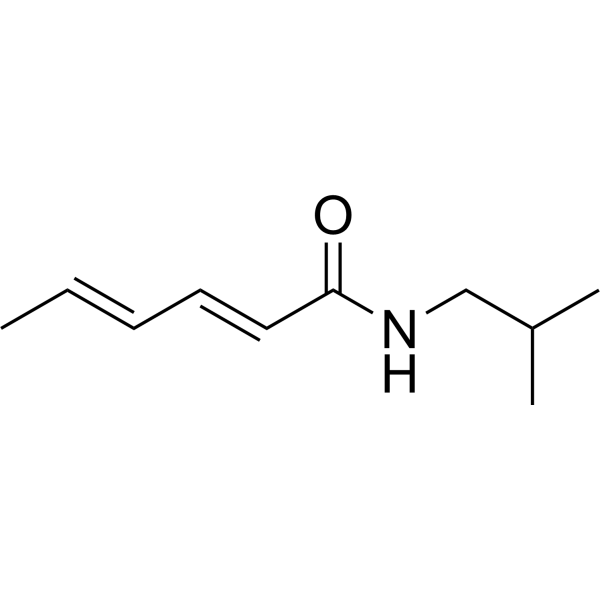
Antibacterial agent 210 (compound A9), an amide derivative, is a Pseudomonas aeruginosa quorum sensing inhibitor (QSI). Antibacterial agent 210 inhibits the quorum sensing systems by binding with LasR and PqsR, especially PqsR.
Para uso exclusivo en investigación. No vendemos a pacientes.
- Fòrmula: C10H17NO
- Peso molecular:167.25
-
Almacenamiento:
Please store the product under the recommended conditions in the Certificate of Analysis.

To place orders, for customer services and technical support, please contact: MedChemExpress USA
Tel: 609-228-6898 E-mail: [email protected] [email protected]


-
 Actividad biológica
-
Chemical Information
- Protocolo
- Pureza y Documentación
- Referencias
-
 Help & FAQs




Actividad biológica
Descripciòn
In Vitro
Antibacterial agent 210 (compound A9; 160 μg/mL) inhibits the virulence factors of P. aeruginosa. Antibacterial agent 210 significantly reduces the production of PAO1 biofilms. Antibacterial agent 210 inhibits the swarming motility of P. aeruginosa. Antibacterial agent 210 also inhibits the expression of genes related to the QS systems in P. aeruginosa[1].
MedChemExpress (MCE) has not independently confirmed the accuracy of these methods. They are for reference only.


Chemical Information
-
Peso molecular 167.25
-
Fòrmula C10H17NO
-
SMILES
C/C=C/C=C/C(NCC(C)C)=O
-
Envío
Room temperature in continental US; may vary elsewhere.
-
Almacenamiento
Please store the product under the recommended conditions in the Certificate of Analysis.


Pureza y Documentación
Referencias

Calculators
Concentration (start) × Volume (start) = Concentration (final) × Volume (final)


Antibacterial agent 210 Related Classifications
HY-163508 Related Classifications
 Powered by Bioz