



IL18 Antibody (YA344)
(Synonyms: IL-18; IL18; IGIF; IL-1g; IL1F4; interleukin-18)Based on 1 publication(s) in Google Scholar
IL18 Antibody (YA344) is a Rabbit-derived and non-conjugated IgG monoclonal antibody, targeting to IL18.
-
Host:
Rabbit
-
Isotype:
IgG
-
Application:
WB, IHC-P
-
Reactivity :
Human
-
Formulation:
Supplied in 50 mM Tris-Glycine (pH 7.4), 0.15 M NaCl, 40% Glycerol and 0.05% BSA. Preservative: 0.01% Sodium azide
-
Conjugation:
Non-conjugated


To place orders, for customer services and technical support, please contact: MedChemExpress USA
Tel: 609-228-6898 E-mail: [email protected] [email protected]



Publications Citing Use of MedChemExpress (MCE) IL18 Antibody (YA344)
More

Applications
| Application |
WB

WB: Western Blot
|
IHC-P
IHC-P: Immunohistochemistry-Paraffin
|
|---|---|---|
| Dilution Ratio | 1:500-1:1000 | 1:50-1:100 |


Product Details
IL18 Antibody (YA344) is a Rabbit-derived and non-conjugated IgG monoclonal antibody, targeting to IL18.
-
Host Rabbit

-
Clonality Recombinant,Monoclonal

-
Species ReactivityHuman
-
Observed Molecular WeightObserved band size: 17 kDa
Note: Due to possible protein modifications or aggregation, the molecular weight should be confirmed by actual measurement, and the predicted value is for reference only.

-
Calculated Molecular Weight Predicted band size: 22 kDa

Synthetic peptide corresponding to Human IL18.The exact sequence is proprietary to MCE.
Endogenous
affinity purified
Non-conjugated
Unmodified
IgG


Product Properties
-
Appearance
Solution
-
Formulation
Supplied in 50 mM Tris-Glycine (pH 7.4), 0.15 M NaCl, 40% Glycerol and 0.05% BSA. Preservative: 0.01% Sodium azide
-
Concentration
Batch-dependent, Please check the COA for the concentration of each lot. Check Lot Concentration
-
Storage & Stability
Stored at -20°C for 1 year. Avoid repeated freeze / thaw cycles.
-
Shipping
Shipping with blue ice.


Publications (1)
-
Journal Impact Factor
-
Most Recent
-
Phytomedicine
Gelsevirine ameliorates sepsis-associated encephalopathy by inhibiting the STING signalling-mediated pyroptosis pathway in microglia. [Abstract]2024 Dec:135:156071. PMID: 39326131


Verification Images
-
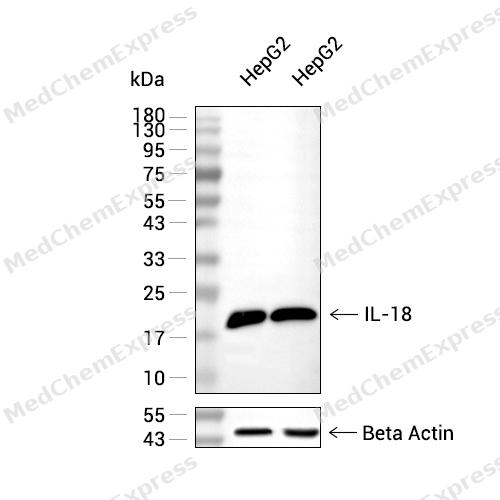 Western blot analysis of extracts from HepG2 (lane 2(20μg) , HepG2 (lane 3(40μg),using IL-18 Antibody (HY-P80721). Proteins were transferred to a PVDF membrane and blocked with 5% BSA in TBST for 2 hour at room temperature. The primary antibody and Loading control antibody (Beta Actin, HY-P80438, 1/3000) was used in 5% BSA in TBST at 4°C overnight. Goat Anti-Mouse/Rabbit IgG-HRP Sec-ondary Antibody (HY-P8004/HY-P8001, 1/10,000) was used for 1 hour at room tem-perature.


Background
-
Function
Interleukin-18 (IL-18) is a proinflammatory cytokine of the IL-1 family that induces IFN-γ production and activates both innate and adaptive immune cells[1][2]. Mechanistically, IL-18 is synthesized as an inactive precursor and requires cleavage by caspase-1 to become biologically active, engaging the IL-18 receptor complex composed of IL-18Rα and IL-18Rβ subunits[3][4]. IL-18 signaling activates downstream pathways including MyD88, IRAK, TRAF-6, and NF-κB, leading to the transcription of proinflammatory genes and chemokines[5][6]. Compared with related IL-1 family members, IL-18 exhibits distinct kinetics and cell-type specificity, sustaining Th1 responses without necessarily inducing persistent high IFN-γ levels[7][8]. In disease models, IL-18 contributes to rheumatoid arthritis by promoting GM-CSF, TNF-α, and matrix metalloproteinase production in synovial tissue and accelerates atherosclerosis through IFN-γ-mediated macrophage activation[9][10][11]. IL-18 is implicated in autoinflammatory syndromes, cardiovascular hypertrophy, liver injury, and dermatological inflammation, where dysregulation of IL-18 drives pathology[12][13][14]. Endogenous IL-18-binding protein (IL-18BP) serves as a high-affinity antagonist that neutralizes IL-18, preventing excessive inflammation and providing a therapeutic avenue for intervention[15][12][5]. Agonist or recombinant IL-18 therapies can enhance cytotoxic lymphocyte function in cancer models, whereas IL-18BP or Tadekinig alfa administration effectively mitigates systemic inflammatory responses[8][7][4].
-
Subcellular Localization
Cytoplasm, cytosol; Secreted
-
Expression
Tissue_specificity:It is expressed in ovarian cancer but undetectable in normal ovarian epithelial cells. It is resistant to proteolytic activation by caspase-1 and -4.
Induction:In macrophages, release is increased by endocannabinoid anandamide/AEA -
Isoforms & Post-Translational Modification
Q14116 has 2 isomers: Q14116-1: 22326 Da (predicted); Q14116-2: 21896 Da (predicted).
The pro-IL-18 precursor is processed by CASP1, CASP4 or CASP5 to yield its mature, active form (PubMed:15326478, PubMed:25261253, PubMed:37993712, PubMed:37993714, PubMed:9334240). The pro-IL-18 precursor features autoinhibitory interactions between the propeptide and the post-cleavage-site region, preventing recognition by the IL18R1 receptor (PubMed:37993714). Processing by CASP1, CASP4 or CASP5 induces conformational changes to generate critical receptor-binding sites (PubMed:37993714). The mature form is then secreted and released in the extracellular milieu by passing through the gasdermin-D (GSDMD) pore (PubMed:33883744, PubMed:37993714). In contrast, cleavage by CASP3 inactivates IL18 (PubMed:37993714, PubMed:9334240) -
Subunit
Forms a ternary complex with ligand-binding receptor subunit IL18R1 and signaling receptor subunit IL18RAP at the plasma membrane (PubMed:14528293, PubMed:25261253, PubMed:25500532, PubMed:37993714). Mature IL18 first binds to IL18R1 forming a low affinity binary complex, which then interacts with IL18RAP to form a high affinity ternary complex that signals inside the cell (PubMed:14528293, PubMed:25261253, PubMed:25500532). Interacts with cargo receptor TMED10; the interaction mediates the translocation from the cytoplasm into the ERGIC (endoplasmic reticulum-Golgi intermediate compartment) and thereby secretion (PubMed:32272059)
-
SwissProt ID
-
Synonyms
IL-18; IL18; IGIF; IL-1g; IL1F4; interleukin-18
-
Research Field
Immunology
Documentation
-
Data Sheet (263 KB)
-
SDS (251 KB)
- English - EN (251 KB)
- Français - FR (251 KB)
- Deutsch - DE (251 KB)
- Norwegian - NO (251 KB)
- Español - ES (251 KB)
- Swedish - SV (251 KB)
- Italian - IT (251 KB)
- Korean - KR (251 KB)
- Portuguese - PT (251 KB)
-
User Guide for Antibodies (1077 KB)
References
[1]. Arend WP, et al. IL-1, IL-18, and IL-33 families of cytokines. Immunol Rev. 2008 Jun;223:20-38. [Content Brief]
[2]. LaRivière WB, et al. Using the Extremes of Human Inflammation to Understand the Transcriptional Control of IL-18. Am J Respir Crit Care Med. 2020 Mar 1;201(5):503-504. [Content Brief]
[3]. Dayer JM. Interleukin-18, et al. Interleukin-18, rheumatoid arthritis, and tissue destruction. J Clin Invest. 1999 Nov;104(10):1337-9. [Content Brief]
[4]. Tsutsui H, et al. Immunotherapeutic applications of IL-18. Immunotherapy. 2012 Dec;4(12):1883-94. [Content Brief]
[5]. Wang X, et al. Interleukin-18 and IL-18BP in inflammatory dermatological diseases. Front Immunol. 2023 Jan 18;14:955369. [Content Brief]
[6]. Bhat O, et al. Role of IL-18 and its signaling in atherosclerosis. 2015 Mar 24.
[7]. Novick D. IL-18 and IL-18BP: A Unique Dyad in Health and Disease. Int J Mol Sci. 2024 Dec 17;25(24):13505. doi: 10.3390/ijms252413505. PMID: 39769266; PMCID: PMC11727785. et al. IL-18 and IL-18BP: A Unique Dyad in Health and Disease. Int J Mol Sci. 2024 Dec 17;25(24):13505. [Content Brief]
[8]. Landy E, et al. Biological and clinical roles of IL-18 in inflammatory diseases. Nat Rev Rheumatol. 2024 Jan;20(1):33-47. [Content Brief]
[9]. Yoshida T, et al. Pressure overload induces IL-18 and IL-18R expression, but markedly suppresses IL-18BP expression in a rabbit model. IL-18 potentiates TNF-α-induced cardiomyocyte death. J Mol Cell Cardiol. 2014 Oct;75:141-51. [Content Brief]
[10]. Murray DR, et al. β2 adrenergic activation induces the expression of IL-18 binding protein, a potent inhibitor of isoproterenol induced cardiomyocyte hypertrophy in vitro and myocardial hypertrophy in vivo. J Mol Cell Cardiol. 2012 Jan;52(1):206-18. [Content Brief]
[11]. Braddock M, et al. Therapeutic potential of targeting IL-1 and IL-18 in inflammation. Expert Opin Biol Ther. 2004 Jun;4(6):847-60. [Content Brief]
[12]. Faggioni R, et al. IL-18-binding protein protects against lipopolysaccharide- induced lethality and prevents the development of Fas/Fas ligand-mediated models of liver disease in mice. J Immunol. 2001 Nov 15;167(10):5913-20. [Content Brief]
[13]. Mühl H, et al. IL-18/IL-18BP and IL-22/IL-22BP: Two interrelated couples with therapeutic potential. Cell Signal. 2019 Nov;63:109388. [Content Brief]
[14]. Sugiura K, et al. The role of interleukin-36 in health and disease states. J Eur Acad Dermatol Venereol. 2024 Oct;38(10):1910-1925. [Content Brief]
[15]. Mikhailova V, et al. Transcriptional Profile Change of NK-92 Cells in Presence of Cytokines, TGFβ Signaling Pathway Inhibitor and CDK7/12/13 Kinase Inhibitor. Int J Mol Sci. 2026 Apr 17;27(8):3599. [Content Brief]

 Powered by Bioz
