



Gontivimab

Based on 1 Customer Validation
Gontivimab (ALX-0171; VR-465) is a poent anti-RSV prefusion F protein nanobody with a KD value of 0.113 nM. Gontivimab shows antiviral activity. Gontivimab reduces the RSV load in the nose and lung.
Nur für Forschungszwecke. Wir verkaufen nicht an Patienten.
- Reinheit : 95.11%
- CAS. Nr.: 1257358-38-5
- Molecular Weight:43.12 kDa
-
Speicherung:
Please store the product under the recommended conditions in the Certificate of Analysis.

To place orders, for customer services and technical support, please contact: MedChemExpress USA
Tel: 609-228-6898 E-mail: [email protected] [email protected]


-
 Biologische Aktivität
-
Chemical Information
- Protokoll
- Reinheit & Dokumentation
- Verweise
-
 Help & FAQs




Biologische Aktivität
Beschreibung
Isotype
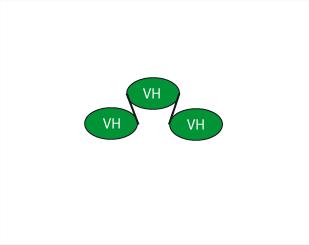
VH-VH-VH
Species Reactivity
Human
IC50 & Target
RSV-F
In Vitro
In Vivo
MedChemExpress (MCE) has not independently confirmed the accuracy of these methods. They are for reference only.
-
Animal Model:Rats (RSV Tracy)[1]
-
Dosage:1-68 mg/kg
-
Administration:Intranasal administration or nebulization; once (day 2 or day 3) or twice (day 2 and day 3)
-
Result:Resulted in significant viral load reductions in the lungs ranging.
Clinical Trial
| NCT Number | Sponsor | Condition | Start Date |
Phase

|
|---|---|---|---|---|
| NCT01329991 | Plexxikon| | 2011-05 | PHASE1 |
Accession
A0A0X8XRK2
Conjugated
Unconjugated
Reconsititution
The product can be reconstituted/diluted with sterile PBS or saline.
Format
-
VH-VH-VH
Anwendung
ELISA, FACS, Functional assay


Chemical Information
-
CAS. Nr. 1257358-38-5
-
Appearance Liquid
-
Molecular Weight 43.12 kDa
-
Color Colorless to light yellow
-
SMILES
[Gontivimab]
-
Synonyms
ALX-0171; VR-465
-
Versand
Shipping with dry ice.
-
Formulation
Please refer to the lot-specific COA for specific buffer information.
-
Speicherung
Please store the product under the recommended conditions in the Certificate of Analysis.


Reinheit & Dokumentation
-
Data Sheet (257 KB)
-
SDS (252 KB)
- English - EN (252 KB)
- Français - FR (252 KB)
- Deutsch - DE (252 KB)
- Norwegian - NO (252 KB)
- Español - ES (252 KB)
- Swedish - SV (252 KB)
- Italian - IT (252 KB)
- Korean - KR (252 KB)
- Portuguese - PT (252 KB)
-
Inhibitory Antibodies User Guide (603 KB)
Verweise

Calculators
Konzentration (Stammlösung) × Volumen (Stammlösung) = Konzentration (Ziellösung) × Volumen (Ziellösung)


Gontivimab Related Classifications
HY-P99647 Related Classifications
 Powered by Bioz