



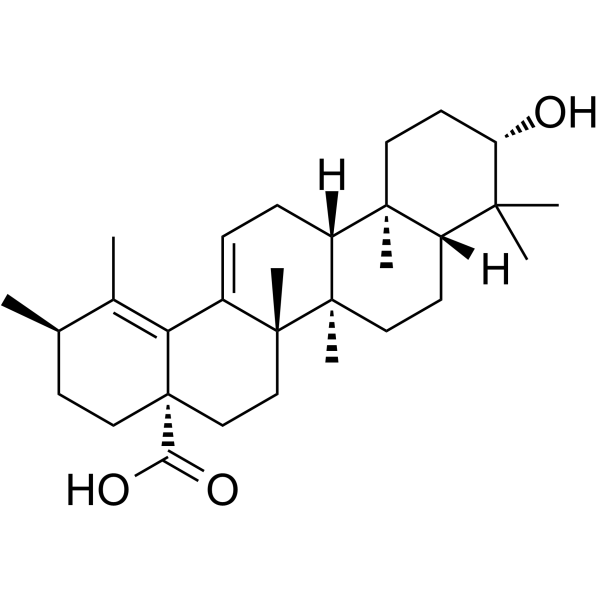
Randialic acid B

Based on 1 Customer Validation
Randialic acid B, a triterpenoid compound, is a formyl peptide receptor 1 (FPR1) antagonist. Randialic acid B blocks FPR1 in human neutrophils and attenuates psoriasis-like inflammation in vivo.
Nur für Forschungszwecke. Wir verkaufen nicht an Patienten.
- Reinheit : 99.94%
- CAS. Nr.: 14021-14-8
- Formel: C30H46O3
- Molecular Weight:454.68
-
Speicherung:
4°C, protect from light
* In solvent : -80°C, 6 months; -20°C, 1 month (protect from light)

To place orders, for customer services and technical support, please contact: MedChemExpress USA
Tel: 609-228-6898 E-mail: [email protected] [email protected]


-
 Biologische Aktivität
-
Chemical Information
-
Lösungsmittel & Löslichkeit
- Protokoll
- Reinheit & Dokumentation
- Verweise
-
 Help & FAQs




Biologische Aktivität
Beschreibung
In Vitro
Randialic acid B (0.1-3 μM; for 5 min) selectively inhibits reactive oxygen species production, elastase release, and CD11b expression in human neutrophils activated by FPR1. Randialic acid B inhibits the binding of N-formyl peptide to FPR1 in human neutrophils, neutrophil-like THP-1 cells, and hFPR1-transfected HEK293 cells, indicating FPR1 antagonism[1].
Randialic acid B acts competitively for its binding to the FPR1 receptor. The FPR1-downstream signaling such as Ca2+ mobilisation and activation of Akt and MAPKs is also competitively inhibited[1].
Randialic acid B shows significant cell-protective effects against H2O2-induced H9c2 cardiomyocyte injury[2].
MedChemExpress (MCE) has not independently confirmed the accuracy of these methods. They are for reference only. Further protocols information, click here.
In Vivo
MedChemExpress (MCE) has not independently confirmed the accuracy of these methods. They are for reference only.
-
Animal Model:BALB/c white female mice (20 g weight; 7-week-old) treated with Imiquimod[1]
-
Dosage:10 mg/kg
-
Administration:i.v.; every other day; for 5 days
-
Result:Significantly reduced Imiquimod-induced psoriasis-like symptoms.


Chemical Information
-
CAS. Nr. 14021-14-8
-
Appearance Solid
-
Molecular Weight 454.68
-
Formel C30H46O3
-
Color White to off-white
-
SMILES
OC([C@](CC[C@]12C)(CC[C@H]3C)C(C1=CC[C@@]4([H])[C@]2(CC[C@](C(C)5C)([H])[C@@]4(CC[C@@H]5O)C)C)=C3C)=O
-
Structure Classification
-
Initial Source
-
Versand
Room temperature in continental US; may vary elsewhere.
-
Speicherung
4°C, protect from light
* In solvent : -80°C, 6 months; -20°C, 1 month (protect from light)


Lösungsmittel & Löslichkeit
In Vitro:
DMSO : 100 mg/mL (219.93 mM; ultrasonic and warming and heat to 60°C; Hygroscopic DMSO has a significant impact on the solubility of product, please use newly opened DMSO)
Please refer to the solubility information to select the appropriate solvent. Once prepared, please aliquot and store the solution to prevent product inactivation from repeated freeze-thaw cycles.
Storage method and period of stock solution: -80°C, 6 months; -20°C, 1 month (protect from light). When stored at -80°C, please use it within 6 months. When stored at -20°C, please use it within 1 month.
Please refer to the solubility information to select the appropriate solvent. Once prepared, please aliquot and store the solution to prevent product inactivation from repeated freeze-thaw cycles.
Storage method and period of stock solution: -80°C, 6 months; -20°C, 1 month (protect from light). When stored at -80°C, please use it within 6 months. When stored at -20°C, please use it within 1 month.
Konzentration (Stammlösung) × Volumen (Stammlösung) = Konzentration (Ziellösung) × Volumen (Ziellösung)

Protokoll
-
Imiquimod-Induced Psoriasiform Dermatitis
Imiquimod (IMQ)-induced psoriasiform dermatitis is a widely used murine model in which topical application of IMQ, a Toll-like receptor 7 (TLR7) agonist, triggers innate immune activation in the skin and induces a psoriasis-like inflammatory cascade characterized by epidermal hyperplasia, immune cell infiltration, and cytokine production dominated by the IL-23/IL-17 axis. This inflammatory response is mediated through activation of dendritic cells and downstream induction of IL-23, IL-17A, IL-22, and related pro-inflammatory mediators, recapitulating key features of human plaque psoriasis and enabling mechanistic and therapeutic studies. The model is commonly induced using Aldara (5% IMQ cream) applied topically to murine skin, resulting in rapid onset of erythema, scaling, and thickening that can be quantified as disease severity indices and validated histologically.
-
Research Protocol for Inflammation-related Diseases
The NLRP3 inflammasome is a cytosolic innate immune signaling platform that integrates priming signals and danger-signal activation to promote caspase-1 activation, maturation of IL-1β and IL-18, and gasdermin D-mediated pyroptotic cell death. The core experimental logic is to determine whether inflammatory disease phenotypes are driven by increased NLRP3 expression, ASC-containing inflammasome assembly, caspase-1 cleavage, GSDMD cleavage, and extracellular release of IL-1β/IL-18 rather than by nonspecific cell injury alone. The pathway is strongly linked to inflammation-related disease phenotypes because monosodium urate crystals activate NALP3/NLRP3 inflammasome signaling in gout-like crystal inflammation, cholesterol crystals activate NLRP3 inflammasomes in atherogenesis models, and DSS-induced intestinal inflammation has been reported to involve NLRP3 inflammasome activity. However, experimental colitis studies also show context-dependent protective effects of NLRP3 inflammasome co


Reinheit & Dokumentation
-
Data Sheet (276 KB)
-
SDS (252 KB)
- English - EN (252 KB)
- Français - FR (252 KB)
- Deutsch - DE (252 KB)
- Norwegian - NO (252 KB)
- Español - ES (252 KB)
- Swedish - SV (252 KB)
- Italian - IT (252 KB)
- Korean - KR (252 KB)
- Portuguese - PT (252 KB)
-
Handling Instructions (2659 KB)
Verweise
[1]. Michal Korinek, et al. Randialic acid B and tomentosolic acid block formyl peptide receptor 1 in human neutrophils and attenuate psoriasis-like inflammation in vivo. Biochem Pharmacol. 2021 Aug;190:114596. [Content Brief]
[2]. Shan-Shan Li, et al. Three new triterpenoids isolated from the aerial parts of Ilex cornuta and protective effects against H 2 O 2-induced myocardial cell injury. Chin J Nat Med. 2017 Feb;15(2):115-120. [Content Brief]


Complete Stock Solution Preparation Table
Please refer to the solubility information to select the appropriate solvent. Once prepared, please aliquot and store the solution to prevent product inactivation from repeated freeze-thaw cycles.
Storage method and period of stock solution: -80°C, 6 months; -20°C, 1 month (protect from light). When stored at -80°C, please use it within 6 months. When stored at -20°C, please use it within 1 month.
| Optional Solvent | Concentration Solvent Mass | 1 mg | 5 mg | 10 mg | 25 mg |
|---|---|---|---|---|---|
| DMSO | 1 mM | 2.1993 mL | 10.9967 mL | 21.9935 mL | 54.9837 mL |
| 5 mM | 0.4399 mL | 2.1993 mL | 4.3987 mL | 10.9967 mL | |
| 10 mM | 0.2199 mL | 1.0997 mL | 2.1993 mL | 5.4984 mL | |
| 15 mM | 0.1466 mL | 0.7331 mL | 1.4662 mL | 3.6656 mL | |
| 20 mM | 0.1100 mL | 0.5498 mL | 1.0997 mL | 2.7492 mL | |
| 25 mM | 0.0880 mL | 0.4399 mL | 0.8797 mL | 2.1993 mL | |
| 30 mM | 0.0733 mL | 0.3666 mL | 0.7331 mL | 1.8328 mL | |
| 40 mM | 0.0550 mL | 0.2749 mL | 0.5498 mL | 1.3746 mL | |
| 50 mM | 0.0440 mL | 0.2199 mL | 0.4399 mL | 1.0997 mL | |
| 60 mM | 0.0367 mL | 0.1833 mL | 0.3666 mL | 0.9164 mL | |
| 80 mM | 0.0275 mL | 0.1375 mL | 0.2749 mL | 0.6873 mL | |
| 100 mM | 0.0220 mL | 0.1100 mL | 0.2199 mL | 0.5498 mL |


Randialic acid B Related Classifications
HY-N8152 Related Classifications
 Powered by Bioz