



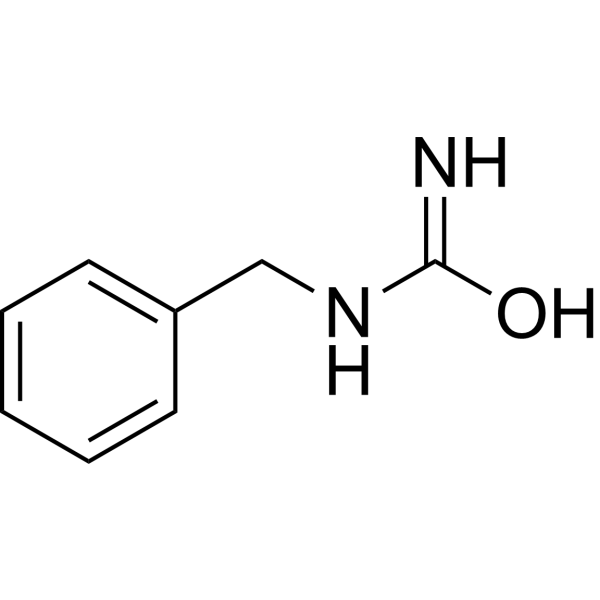
Benzylurea

Based on 1 Customer Validation
Benzylurea is an anti-inflammatory agent. Benzylurea inhibits LPS (HY-D1056)-induced upregulation of MTCH2 expression and regulates pathways associated with mitochondrial function, inflammation and cell survival. Benzylurea alleviates LPS-induced proliferation inhibition and apoptosis of periodontal ligament fibroblasts, as well as the release of proinflammatory cytokines. Benzylurea can be used in studies related to periodontitis.
Nos produits utilisent uniquement pour la recherche. Nous ne vendons pas aux patients.
- Pureté : 99.94%
- CAS No.: 538-32-9
- Formule: C8H10N2O
- Masse moléculaire:150.18
-
Stockage:Powder -20°C, 3 years , 4°C, 2 years ; In solvent -80°C, 6 months , -20°C, 1 month

To place orders, for customer services and technical support, please contact: MedChemExpress USA
Tel: 609-228-6898 E-mail: [email protected] [email protected]


-
 Activité biologique
-
Chemical Information
-
Solvant et solubilité
- Protocole
- Pureté et documentation
- Références
-
 Help & FAQs


-
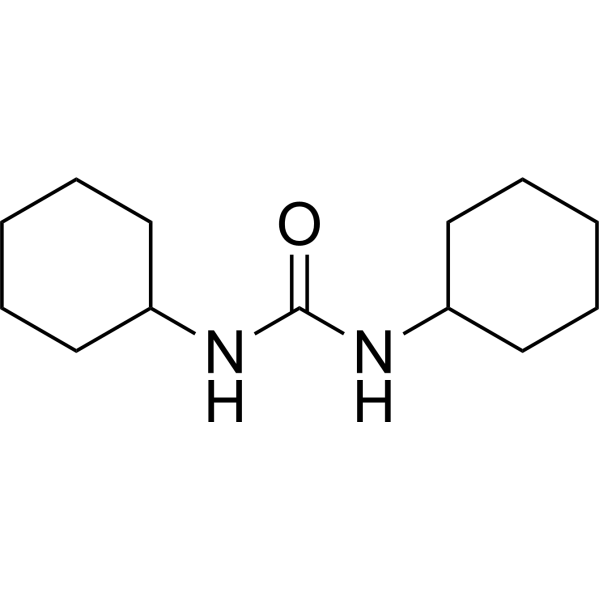
HY-W013989R
1,3-Dicyclohexylurea (Standard)sEH Inhibitor -
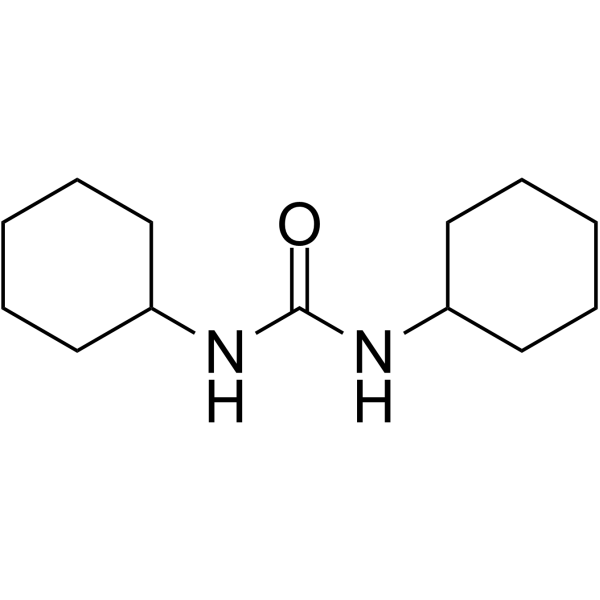
HY-W013989
1,3-DicyclohexylureasEH Inhibitor -

HY-W010253R
Benzylurea (Standard)Standard -
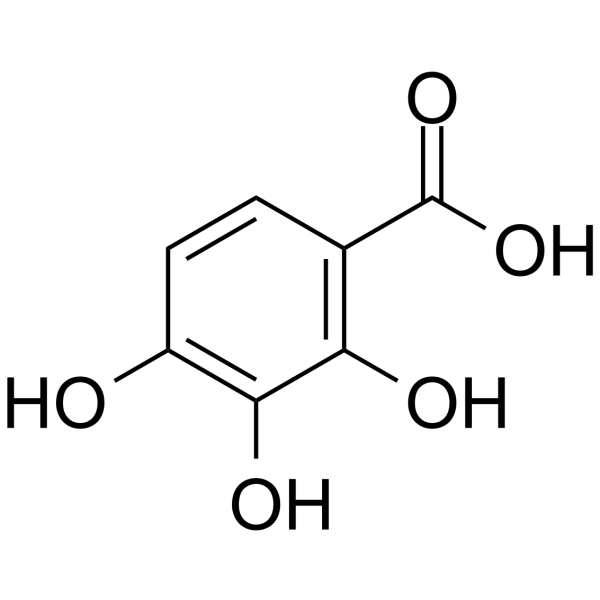
HY-W016993
2,3,4-Trihydroxybenzoic acidα-amylase Inhibitor -

HY-W010542
Azepan-2-oneSeven-Membered Lactam Scaffold -

HY-W016993R
2,3,4-Trihydroxybenzoic acid (Standard)Standard of 2,3,4-Trihydroxybenzoic acid -

HY-W010542R
Azepan-2-one (Standard)Reference Standard


Activité biologique
Description
IC50 & Target
[1]|
IL-1β |
IL-6 |
NLRP3 |
In Vitro
Benzylurea (0-120 μM; 24 h) protects human periodontal ligament fibroblasts (hPDLFs) against LPS (HY-D1056)-induced loss of viability, and exhibits low intrinsic cytotoxicity to hPDLFs at the concentration of 10 μM; whereas higher concentrations (20-120 μM; 24 h) reduce the viability of hPDLFs in a dose-dependent manner[1].
Benzylurea (10 μM; 24 h) inhibits the secretion of IL-1β, IL-6 and TNF-α induced by LPS in human periodontal ligament fibroblasts (hPDLFs), and blocks the nuclear translocation of NF-κB p65[1].
Benzylurea (10 μM; 24 h) restores the mitochondrial membrane potential of human periodontal ligament fibroblasts (hPDLFs) damaged by LPS and inhibits the production of ROS[1].
Benzylurea (10 μM; 24 h) can restructure and restore the F-actin cytoskeleton in human periodontal ligament fibroblasts (hPDLFs) damaged by LPS[1].
Benzylurea (10 μM; 24 h) regulates protein expression in hPDLFs by reducing LPS-induced levels of MTCH2, NF-κB p65, Bax, IL-1β, IL-8 and NLRP3, while increasing the LPS-suppressed levels of CYB5B and BCL2[1].
MedChemExpress (MCE) has not independently confirmed the accuracy of these methods. They are for reference only.
-
Cell Line:human periodontal ligament fibroblasts (hPDLFs)
-
Concentration:10 μM
-
Incubation Time:24 h
-
Result:Significantly inhibited the LPS-induced elevation of IL-1β, IL-6, and TNF-α levels in hPDLF culture supernatants.
- RNA extraction experimental
- Mitochondrial membrane-potential fluorescent assay
- Detection of Apoptosis
- TUNEL staining for apoptotic DNA fragmentation
- Cell Cytotoxicity Assay
- Mammalian live/dead viability and cytotoxicity staining
- Annexin V plus membrane-impermeant dye apoptosis staining
- Mitochondrial membrane-potential and mitochondrial mass staining
- Apoptosis Solutions
- Research Protocol for Inflammation-related Diseases
- Cell Viability Determination by MTT Colorimetric Assay


Chemical Information
-
CAS No. 538-32-9
-
Appearance Solid
-
Masse moléculaire 150.18
-
Formule C8H10N2O
-
Color White to off-white
-
SMILES
O=C(N)NCC1=CC=CC=C1
-
Structure Classification
-
Initial Source
-
Livraison
Room temperature in continental US; may vary elsewhere.
-
Stockage
Powder -20°C 3 years 4°C 2 years In solvent -80°C 6 months -20°C 1 month


Solvant et solubilité
In Vitro:
DMSO : 100 mg/mL (665.87 mM; Need ultrasonic; Hygroscopic DMSO has a significant impact on the solubility of product, please use newly opened DMSO)
Please refer to the solubility information to select the appropriate solvent. Once prepared, please aliquot and store the solution to prevent product inactivation from repeated freeze-thaw cycles.
Storage method and period of stock solution: -80°C, 6 months; -20°C, 1 month. When stored at -80°C, please use it within 6 months. When stored at -20°C, please use it within 1 month.
Please refer to the solubility information to select the appropriate solvent. Once prepared, please aliquot and store the solution to prevent product inactivation from repeated freeze-thaw cycles.
Storage method and period of stock solution: -80°C, 6 months; -20°C, 1 month. When stored at -80°C, please use it within 6 months. When stored at -20°C, please use it within 1 month.
Concentration (start) × Volume (start) = Concentration (final) × Volume (final)
In Vivo:
Select the appropriate dissolution method based on your experimental animal and administration route.
- For the following dissolution methods, please ensure to first prepare a clear stock solution using an In Vitro approach and then sequentially add co-solvents:
- To ensure reliable experimental results, the clarified stock solution can be appropriately stored based on storage conditions. As for the working solution for In Vivo experiments, it is recommended to prepare freshly and use it on the same day.
- The percentages shown for the solvents indicate their volumetric ratio in the final prepared solution. If precipitation or phase separation occurs during preparation, heat and/or sonication can be used to aid dissolution.
Add each solvent one by one: 10% DMSO 40% PEG300 5% Tween-80 45% Saline
Solubility: ≥ 2.5 mg/mL (16.65 mM); Clear solution
This protocol yields a clear solution of ≥ 2.5 mg/mL (saturation unknown).
Taking 1 mL working solution as an example, add 100 μL DMSO stock solution (25.0 mg/mL) to 400 μL PEG300, and mix evenly; then add 50 μL Tween-80 and mix evenly; then add 450 μL Saline to adjust the volume to 1 mL.
Preparation of Saline: Dissolve 0.9 g sodium chloride in ddH₂O and dilute to 100 mL to obtain a clear Saline solution.
Add each solvent one by one: 10% DMSO 90% (20% SBE-β-CD in Saline)
Solubility: ≥ 2.5 mg/mL (16.65 mM); Clear solution
This protocol yields a clear solution of ≥ 2.5 mg/mL (saturation unknown).
Taking 1 mL working solution as an example, add 100 μL DMSO stock solution (25.0 mg/mL) to 900 μL 20% SBE-β-CD in Saline, and mix evenly.
Preparation of 20% SBE-β-CD in Saline (4°C, storage for one week): 2 g SBE-β-CD powder is dissolved in 10 mL Saline, completely dissolve until clear.
In Vivo Dissolution Calculator
Please enter the basic information of animal experiments:
-
-
-
-
Recommended: Prepare an additional quantity of animals to account for potential losses during experiments.
Please enter your animal formula composition:
-
%DMSO +
Recommended: Keep the proportion of DMSO in working solution below 2% if your animal is weak.
-
%+
-
+%Tween-80 + +
-
%Saline +
The co-solvents required include: DMSO, . All of co-solvents are available by MedChemExpress (MCE). , Tween 80. All of co-solvents are available by MedChemExpress (MCE).
Working solution concentration: 0.22 mg/mL
Method for preparing stock solution: mg drug dissolved in μL DMSO. Stock solution concentration: mg/mL.
1. Take μL DMSO stock solution;
2. Add μL .
μL , mix evenly;
3. Then add μL Tween 80, mix evenly;
4. Then add μL
Please ensure that the stock solution in the first step is dissolved to a clear state, and add co-solvents in sequence. You can use ultrasonic heating (ultrasonic cleaner, recommended frequency 20-40 kHz), vortexing, etc. to assist dissolution.


Pureté et documentation
-
Fiche technique (273 KB)
-
SDS (396 KB)
- English - EN (396 KB)
- Français - FR (396 KB)
- Deutsch - DE (396 KB)
- Norwegian - NO (396 KB)
- Español - ES (396 KB)
- Swedish - SV (396 KB)
- Italian - IT (396 KB)
- Korean - KR (396 KB)
- Portuguese - PT (396 KB)
-
Instruction de manipulation (2659 KB)
Références


Complete Stock Solution Preparation Table
Please refer to the solubility information to select the appropriate solvent. Once prepared, please aliquot and store the solution to prevent product inactivation from repeated freeze-thaw cycles.
Storage method and period of stock solution: -80°C, 6 months; -20°C, 1 month. When stored at -80°C, please use it within 6 months. When stored at -20°C, please use it within 1 month.
| Optional Solvent | Concentration Solvent Mass | 1 mg | 5 mg | 10 mg | 25 mg |
|---|---|---|---|---|---|
| DMSO | 1 mM | 6.6587 mL | 33.2934 mL | 66.5868 mL | 166.4669 mL |
| 5 mM | 1.3317 mL | 6.6587 mL | 13.3174 mL | 33.2934 mL | |
| 10 mM | 0.6659 mL | 3.3293 mL | 6.6587 mL | 16.6467 mL | |
| 15 mM | 0.4439 mL | 2.2196 mL | 4.4391 mL | 11.0978 mL | |
| 20 mM | 0.3329 mL | 1.6647 mL | 3.3293 mL | 8.3233 mL | |
| 25 mM | 0.2663 mL | 1.3317 mL | 2.6635 mL | 6.6587 mL | |
| 30 mM | 0.2220 mL | 1.1098 mL | 2.2196 mL | 5.5489 mL | |
| 40 mM | 0.1665 mL | 0.8323 mL | 1.6647 mL | 4.1617 mL | |
| 50 mM | 0.1332 mL | 0.6659 mL | 1.3317 mL | 3.3293 mL | |
| 60 mM | 0.1110 mL | 0.5549 mL | 1.1098 mL | 2.7744 mL | |
| 80 mM | 0.0832 mL | 0.4162 mL | 0.8323 mL | 2.0808 mL | |
| 100 mM | 0.0666 mL | 0.3329 mL | 0.6659 mL | 1.6647 mL |


Benzylurea Related Classifications
HY-W010253 Related Classifications
 Powered by Bioz
Keywords
- Benzylurea
- 538-32-9
- Apoptosis
- Interleukin Related
- NF-κB
- Reactive Oxygen Species (ROS)
- Bcl-2 Family
- NOD-like Receptor (NLR)
- Cytochrome P450
- periodontitis
- CYB5B
- hPDLFs
- Salvadora persica
- periodontal ligament fibroblasts
- mitochondrial membrane potential
- mitochondrial permeability transition pore
- mitochondrial carrier homolog 2 (MTCH2)
- LPS
- Inhibitor
- inhibitor
- inhibit