



Bisphenol B
Based on 3 publication(s) in Google Scholar
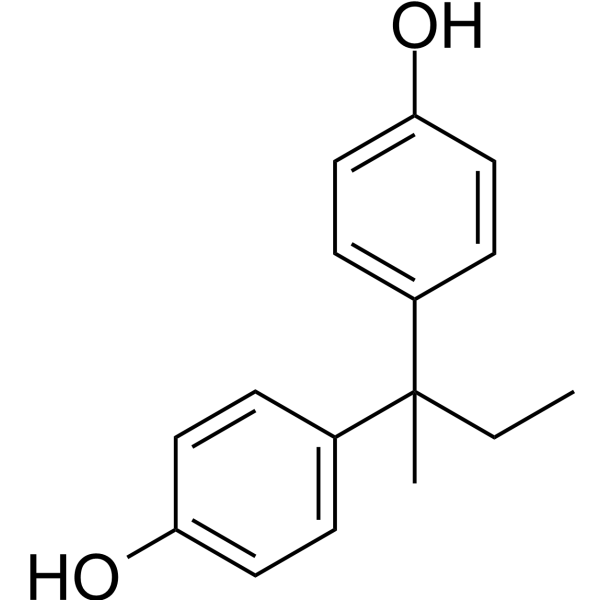
Bisphenol B is a close structural analog of Bisphenol A (BPA) (HY-18260). Bisphenol B is a potent, orally active endocrine disruptor (ED). Bisphenol B binds to G protein-coupled estrogen receptor (GPER) (IC50 = 3.3 μM) with higher affinity and agonistic activity than BPA. Bisphenol B promotes GPER mediated cell migration. Bisphenol B exerts estrogenic effects via GPER pathway at nanomolar concentration. Bisphenol B is used in the manufacture of polycarbonate resin with ED properties.
Nos produits utilisent uniquement pour la recherche. Nous ne vendons pas aux patients.
- Pureté : 99.34%
- CAS No.: 77-40-7
- Formule: C16H18O2
- Masse moléculaire:242.31
-
Stockage:Powder -20°C, 3 years , 4°C, 2 years ; In solvent -80°C, 6 months , -20°C, 1 month

To place orders, for customer services and technical support, please contact: MedChemExpress USA
Tel: 609-228-6898 E-mail: [email protected] [email protected]


-
 Activité biologique
-
Chemical Information
-
Solvant et solubilité
- Protocole
- Pureté et documentation
- Références
-
 Help & FAQs


-
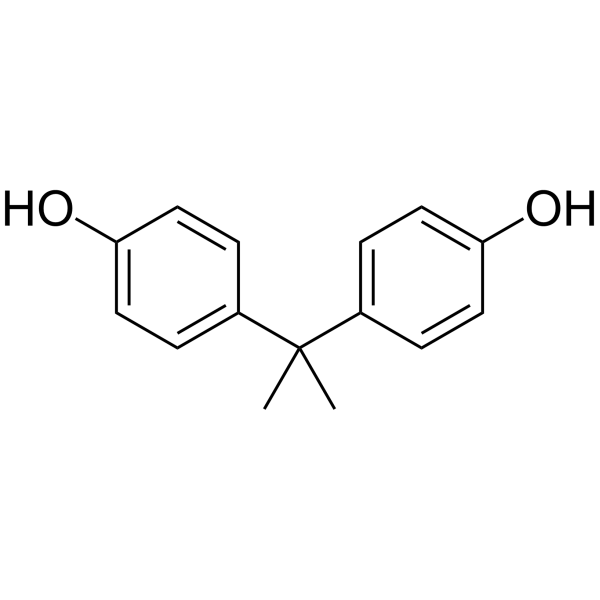
HY-18260
Bisphenol AEndocrine-Disrupting Compound -

HY-W013935R
Bisphenol B (Standard)Bisphenol A Analog -

HY-W015451
2,7-DihydroxynaphthaleneAromatic Substrate -
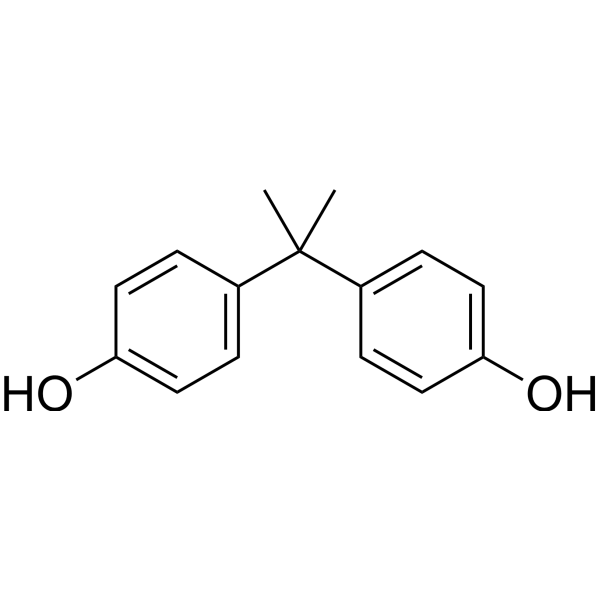
HY-18260R
Bisphenol A (Standard)EDC -
![Benz[a]anthracene](https://file.medchemexpress.com/product_pic/hy-w012278.gif)
HY-W012278
Benz[a]anthraceneAHR2 Ligand -

HY-Y0825R
1,5-Dihydroxynaphthalene (Standard) -

HY-W015451R
2,7-Dihydroxynaphthalene (Standard)Standard of 2,7-Dihydroxynaphthalene
Publications Citing Use of MedChemExpress (MCE) Bisphenol B
MoreVoir tous les produits spécifiques à Isoform Endogenous Metabolite
More

Activité biologique
Description
In Vitro
Bisphenol B (Compound BPB) presents much stronger binding affinity to GPER (IC50 = 3.3 μM) than BPA (IC50 = 25.3 μM) in SKBR3 cells[3].
Bisphenol B has an EC50 of 1.7 μM for calcium mobilization, suggesting a stronger agonistic activity than BPA (EC50 = 7.5 μM)[3].
Bisphenol B (1 μM) shows higher potency in activating GPER subsequent signaling pathways than BPA in SKBR3 cells[3].
Bisphenol B (1 μM) induces SKBR3 cell migration in a concentration-dependent manner[3].
Bisphenol B (0.1 nM-10 μM) stimulates the increase of calcium mobilization and cAMP production in a concentration-dependent manner with the lowest effective concentration of 10 nM[3].
Bisphenol B (0-100 ng/mL, 2 h in CO2 incubator) significantly increases the ROS levels at 10 ng/mL and decreases the testosterone levels in testicular slices[4].
MedChemExpress (MCE) has not independently confirmed the accuracy of these methods. They are for reference only.
In Vivo
Bisphenol B (5-50 μg/L, in drinking water, 48 d) results in higher body weight of male rats compared to the control group[5].
MedChemExpress (MCE) has not independently confirmed the accuracy of these methods. They are for reference only.
-
Animal Model:Adult male Sprague-Dawley rats (70-80 days old)[4]
-
Dosage:5, 25, 50 mg/kg
-
Administration:Oral gavage (p.o.), 28 d
-
Result:Reduced POD activity significantly.
Caused a significant reduction in catalase (CAT) activity in testicular tissues at 25 mg/kg.
Reduced LPO content significantly at 50 mg/kg dose.
Increased the total ROS level significantly at 50 mg/kg dose.
Significantly reduced the protein concentration in the 5 and 50 mg/kg group.
Reduced intratesticular testosterone concentration at all doses.
Significantly reduced the epithelial height in the 50 mg/kg group.
-
Animal Model:Male healthy rats (30-40 g)[5]
-
Dosage:5, 25, 50 μg/L
-
Administration:Oral gavage (p.o.) in drinking water, 48 d
-
Result:Reduced the gonadosomatic index (GSI) at 50 μg/L.
Resulted in statistically significant lower relative weight of the testis, epididymis, and the seminal vesicle.
- Scratch/Wound-Healing Migration Assay
- Cell migration
- Zigmond Chamber Chemotaxis Assay
- Research Protocol for Endocrine Diseases
- Under-Agarose Cell Migration Assay
- Neural Crest/Neuronal Cell Migration Explant Assay
- Transwell/Boyden Chamber Migration Assay
- 3D Collagen/Hydrogel Matrix Migration Assay
- Cell-Exclusion Zone Migration Assay
- Dunn/Insall Chamber Chemotaxis Assay


Chemical Information
-
CAS No. 77-40-7
-
Appearance Solid
-
Masse moléculaire 242.31
-
Formule C16H18O2
-
Color White to off-white
-
SMILES
CCC(C1=CC=C(O)C=C1)(C2=CC=C(O)C=C2)C
-
Structure Classification
-
Initial Source
-
Livraison
Room temperature in continental US; may vary elsewhere.
-
Stockage
Powder -20°C 3 years 4°C 2 years In solvent -80°C 6 months -20°C 1 month


Publications (3)
-
Journal Impact Factor
-
Most Recent
-
-
Regul Toxicol Pharmacol
In vitro assessment of human dermal exposure to emerging bisphenols: Bisphenol E (BPE) and Bisphenol B (BPB). [Abstract]2026 Jun 5:171:106158. PMID: 42250751 -


Solvant et solubilité
In Vitro:
DMSO : 100 mg/mL (412.69 mM; Need ultrasonic; Hygroscopic DMSO has a significant impact on the solubility of product, please use newly opened DMSO)
Please refer to the solubility information to select the appropriate solvent. Once prepared, please aliquot and store the solution to prevent product inactivation from repeated freeze-thaw cycles.
Storage method and period of stock solution: -80°C, 6 months; -20°C, 1 month. When stored at -80°C, please use it within 6 months. When stored at -20°C, please use it within 1 month.
Please refer to the solubility information to select the appropriate solvent. Once prepared, please aliquot and store the solution to prevent product inactivation from repeated freeze-thaw cycles.
Storage method and period of stock solution: -80°C, 6 months; -20°C, 1 month. When stored at -80°C, please use it within 6 months. When stored at -20°C, please use it within 1 month.
Concentration (start) × Volume (start) = Concentration (final) × Volume (final)
In Vivo:
Select the appropriate dissolution method based on your experimental animal and administration route.
- For the following dissolution methods, please ensure to first prepare a clear stock solution using an In Vitro approach and then sequentially add co-solvents:
- To ensure reliable experimental results, the clarified stock solution can be appropriately stored based on storage conditions. As for the working solution for In Vivo experiments, it is recommended to prepare freshly and use it on the same day.
- The percentages shown for the solvents indicate their volumetric ratio in the final prepared solution. If precipitation or phase separation occurs during preparation, heat and/or sonication can be used to aid dissolution.
Add each solvent one by one: 10% DMSO 40% PEG300 5% Tween-80 45% Saline
Solubility: ≥ 2.5 mg/mL (10.32 mM); Clear solution
This protocol yields a clear solution of ≥ 2.5 mg/mL (saturation unknown).
Taking 1 mL working solution as an example, add 100 μL DMSO stock solution (25.0 mg/mL) to 400 μL PEG300, and mix evenly; then add 50 μL Tween-80 and mix evenly; then add 450 μL Saline to adjust the volume to 1 mL.
Preparation of Saline: Dissolve 0.9 g sodium chloride in ddH₂O and dilute to 100 mL to obtain a clear Saline solution.
Add each solvent one by one: 10% DMSO 90% (20% SBE-β-CD in Saline)
Solubility: ≥ 2.5 mg/mL (10.32 mM); Clear solution
This protocol yields a clear solution of ≥ 2.5 mg/mL (saturation unknown).
Taking 1 mL working solution as an example, add 100 μL DMSO stock solution (25.0 mg/mL) to 900 μL 20% SBE-β-CD in Saline, and mix evenly.
Preparation of 20% SBE-β-CD in Saline (4°C, storage for one week): 2 g SBE-β-CD powder is dissolved in 10 mL Saline, completely dissolve until clear.
In Vivo Dissolution Calculator
Please enter the basic information of animal experiments:
-
-
-
-
Recommended: Prepare an additional quantity of animals to account for potential losses during experiments.
Please enter your animal formula composition:
-
%DMSO +
Recommended: Keep the proportion of DMSO in working solution below 2% if your animal is weak.
-
%+
-
+%Tween-80 + +
-
%Saline +
The co-solvents required include: DMSO, . All of co-solvents are available by MedChemExpress (MCE). , Tween 80. All of co-solvents are available by MedChemExpress (MCE).
Working solution concentration: 0.22 mg/mL
Method for preparing stock solution: mg drug dissolved in μL DMSO. Stock solution concentration: mg/mL.
1. Take μL DMSO stock solution;
2. Add μL .
μL , mix evenly;
3. Then add μL Tween 80, mix evenly;
4. Then add μL
Please ensure that the stock solution in the first step is dissolved to a clear state, and add co-solvents in sequence. You can use ultrasonic heating (ultrasonic cleaner, recommended frequency 20-40 kHz), vortexing, etc. to assist dissolution.


Pureté et documentation
-
Fiche technique (281 KB)
-
SDS (393 KB)
- English - EN (393 KB)
- Français - FR (393 KB)
- Deutsch - DE (393 KB)
- Norwegian - NO (393 KB)
- Español - ES (393 KB)
- Swedish - SV (393 KB)
- Italian - IT (393 KB)
- Korean - KR (393 KB)
- Portuguese - PT (393 KB)
-
Instruction de manipulation (2659 KB)
Références
[1]. Serra H, et al. Evidence for Bisphenol B Endocrine Properties: Scientific and Regulatory Perspectives. Environ Health Perspect. 2019 Oct;127(10):106001. [Content Brief]
[2]. Grumetto, L., et al., (2008). Determination of bisphenol a and bisphenol B residues in canned peeled tomatoes by reversed-phase liquid chromatography. Journal of agricultural and food chemistry, 56(22), 10633–10637. [Content Brief]
[3]. Cao, L. Y., et al., (2017). Bisphenol AF and Bisphenol B Exert Higher Estrogenic Effects than Bisphenol A via G Protein-Coupled Estrogen Receptor Pathway. Environmental science & technology, 51(19), 11423–11430. [Content Brief]
[4]. Ullah, A., (2018). Bisphenol A and its analogs bisphenol B, bisphenol F, and bisphenol S: Comparative in vitro and in vivo studies on the sperms and testicular tissues of rats. Chemosphere, 209, 508–516. [Content Brief]
[5]. Ullah, A., et al., (2018). Impact of low-dose chronic exposure to bisphenol A and its analogue bisphenol B, bisphenol F and bisphenol S on hypothalamo-pituitary-testicular activities in adult rats: A focus on the possible hormonal mode of action. Food and chemical toxicology : an international journal published for the British Industrial Biological Research Association, 121, 24-36. [Content Brief]


Complete Stock Solution Preparation Table
Please refer to the solubility information to select the appropriate solvent. Once prepared, please aliquot and store the solution to prevent product inactivation from repeated freeze-thaw cycles.
Storage method and period of stock solution: -80°C, 6 months; -20°C, 1 month. When stored at -80°C, please use it within 6 months. When stored at -20°C, please use it within 1 month.
| Optional Solvent | Concentration Solvent Mass | 1 mg | 5 mg | 10 mg | 25 mg |
|---|---|---|---|---|---|
| DMSO | 1 mM | 4.1269 mL | 20.6347 mL | 41.2694 mL | 103.1736 mL |
| 5 mM | 0.8254 mL | 4.1269 mL | 8.2539 mL | 20.6347 mL | |
| 10 mM | 0.4127 mL | 2.0635 mL | 4.1269 mL | 10.3174 mL | |
| 15 mM | 0.2751 mL | 1.3756 mL | 2.7513 mL | 6.8782 mL | |
| 20 mM | 0.2063 mL | 1.0317 mL | 2.0635 mL | 5.1587 mL | |
| 25 mM | 0.1651 mL | 0.8254 mL | 1.6508 mL | 4.1269 mL | |
| 30 mM | 0.1376 mL | 0.6878 mL | 1.3756 mL | 3.4391 mL | |
| 40 mM | 0.1032 mL | 0.5159 mL | 1.0317 mL | 2.5793 mL | |
| 50 mM | 0.0825 mL | 0.4127 mL | 0.8254 mL | 2.0635 mL | |
| 60 mM | 0.0688 mL | 0.3439 mL | 0.6878 mL | 1.7196 mL | |
| 80 mM | 0.0516 mL | 0.2579 mL | 0.5159 mL | 1.2897 mL | |
| 100 mM | 0.0413 mL | 0.2063 mL | 0.4127 mL | 1.0317 mL |


Bisphenol B Related Classifications
HY-W013935 Related Classifications
 Powered by Bioz