



Polycaprolactone
Based on 1 publication(s) in Google Scholar
Polycaprolactone is a biodegradable polyester commonly used in various biomedical and industrial applications. It is a white waxy polymer that can be molded into various shapes and forms. Polycaprolactone has various properties suitable for these applications, including low melting point, high flexibility and slow biodegradation rate. It can be used as a raw material for the production of tissue engineering scaffolds, drug delivery systems, and medical implants. In addition, it is used as a binder in the production of adhesives, coatings and paints.
Nos produits utilisent uniquement pour la recherche. Nous ne vendons pas aux patients.
- CAS No.: 24980-41-4
- Formule: C6H10O2
- Masse moléculaire:Mn=45000-50000
-
Stockage:
Store at room temperature 3 years.
In solvent -80°C, 2 years , -20°C, 1 year


To place orders, for customer services and technical support, please contact: MedChemExpress USA
Tel: 609-228-6898 E-mail: [email protected] [email protected]


-
 Activité biologique
-
Chemical Information
-
Solvant et solubilité
- Protocole
- Pureté et documentation
- Références
-
 Help & FAQs


-
HY-13259
MG-132Proteasome Inhibitor -
HY-Y0703
Sodium carboxymethyl cellulose (Viscosity:800-1200 mPa.s)Biochemical Assay Reagent -
HY-Y0703C
Sodium carboxymethyl cellulose (Viscosity:300-800mpa.s)Biochemical Assay Reagent -
HY-Y1889A
Sodium carboxymethyl cellulose (MW 250000)Anti-adhesion agent -
HY-Y0703A
Sodium carboxymethyl cellulose (Viscosity:1200-1400 mPa.s)Biochemical Assay Reagent -
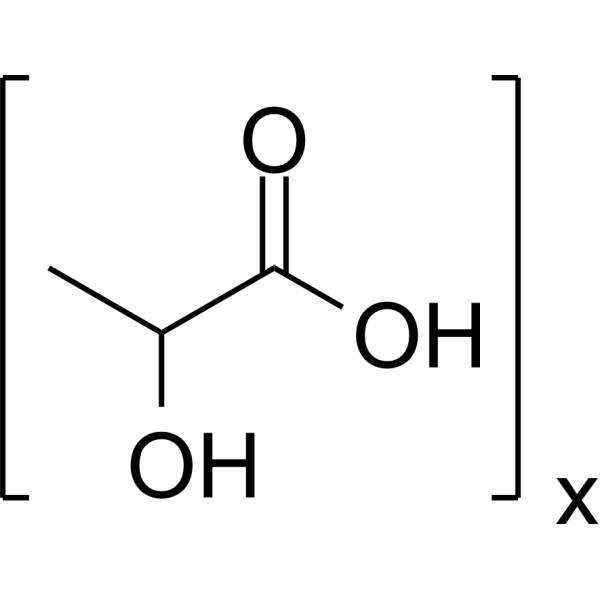
HY-W250313
Polylactic acidBiochemical Assay Reagent -
HY-Y0703D
Sodium carboxymethyl cellulose (average Mw 90000)Biochemical Assay Reagent -
HY-Y1889
Sodium carboxymethyl cellulose (Viscosity:5000-15000 mPa.s) -

HY-B2221B1
Hydroxyethyl cellulose, Viscosity(2%):150mPa.sBiochemical Assay Reagents -
HY-D1005
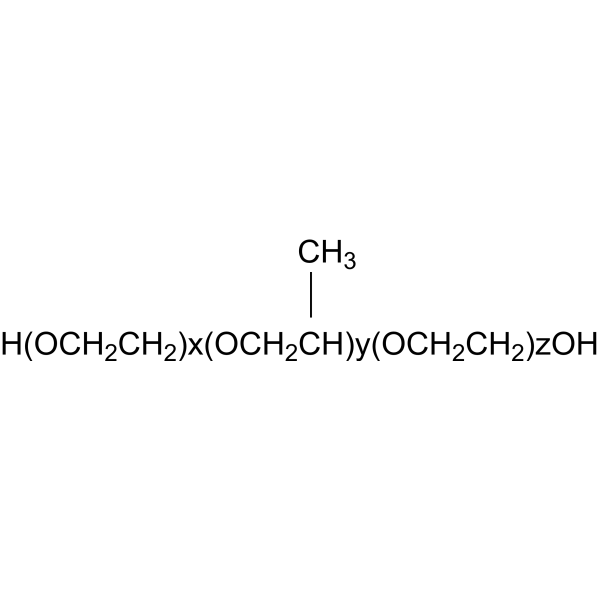
Poloxamer 407 (F127)LPL Receptor Inhibitor -
HY-D1005A
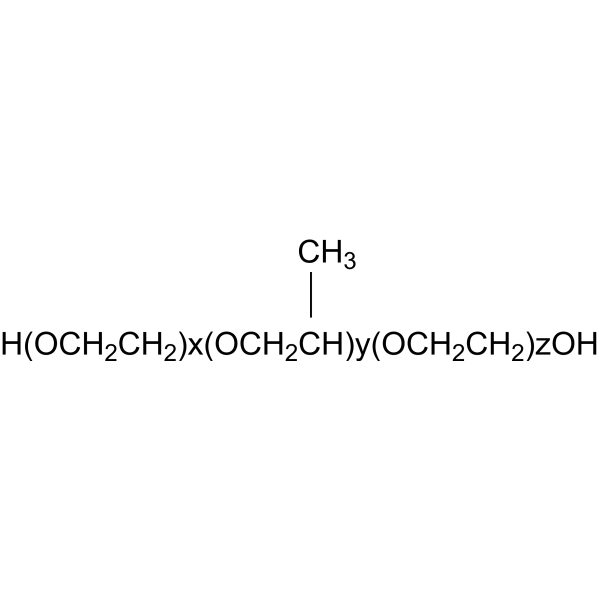
Poloxamer 188Linear Copolymer -
HY-D1005H
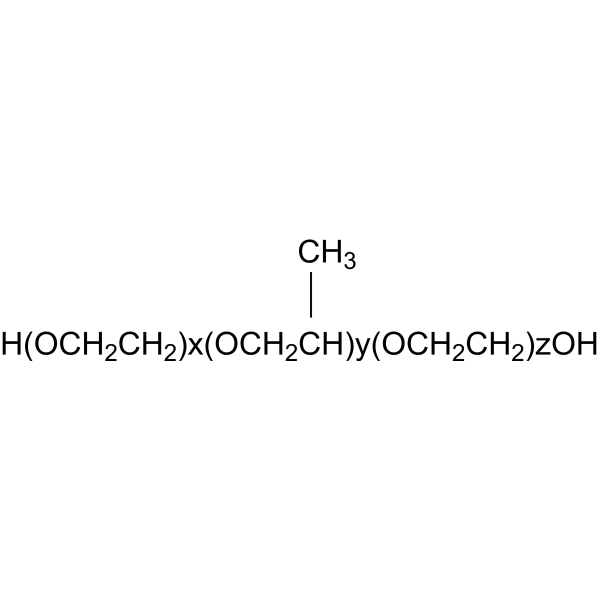
Poloxamer 188 (F68)Nonionic Linear Copolymer
Publications Citing Use of MedChemExpress (MCE) Polycaprolactone
More

Activité biologique
Description
In Vitro
Polycaprolactone is a biochemical reagent that can be used as a biological material or organic compound for life science related research.
MedChemExpress (MCE) has not independently confirmed the accuracy of these methods. They are for reference only.
Essai clinique
| NCT Number | Sponsor | Condition | Start Date |
Phase

|
|---|---|---|---|---|
| NCT01329991 | 2011-05 | PHASE1 |


Chemical Information
-
CAS No. 24980-41-4
-
Appearance Solid
-
Masse moléculaire Mn=45000-50000
-
Formule C6H10O2
-
Color White to off-white
-
SMILES
O=C1OCCCCC1.[x]
-
Livraison
Room temperature in continental US; may vary elsewhere.
-
Stockage
Store at room temperature 3 years
In solvent -80°C 2 years -20°C 1 year


Publications (1)
-
Journal Impact Factor
-
Most Recent


Solvant et solubilité
In Vitro:
DMSO : 10 mg/mL (ultrasonic and warming and heat to 60°C; Hygroscopic DMSO has a significant impact on the solubility of product, please use newly opened DMSO)


Pureté et documentation
-
Fiche technique (270 KB)
-
SDS (393 KB)
- English - EN (393 KB)
- Français - FR (393 KB)
- Deutsch - DE (393 KB)
- Norwegian - NO (393 KB)
- Español - ES (393 KB)
- Swedish - SV (393 KB)
- Italian - IT (393 KB)
- Korean - KR (393 KB)
- Portuguese - PT (393 KB)
-
Instruction de manipulation (2659 KB)
Références

Calculators
Concentration (start) × Volume (start) = Concentration (final) × Volume (final)


Polycaprolactone Related Classifications
HY-W250312 Related Classifications
 Powered by Bioz