



Sp-cGMPS
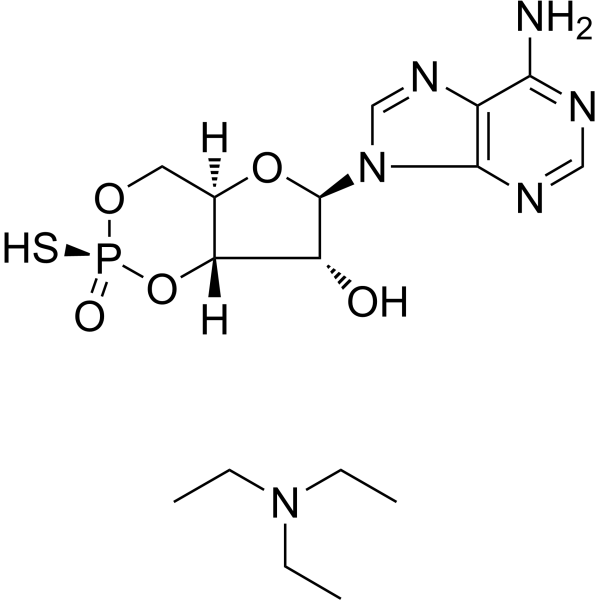
Sp-cGMPS is an activator of cGMP-dependent protein kinases (PKGs). Sp-cGMPS can be used in cardiovascular disease-related research.
Nos produits utilisent uniquement pour la recherche. Nous ne vendons pas aux patients.
- CAS No.: 86562-10-9
- Formule: C10H12N5O6PS
- Masse moléculaire:361.27
-
Stockage:
Please store the product under the recommended conditions in the Certificate of Analysis.


To place orders, for customer services and technical support, please contact: MedChemExpress USA
Tel: 609-228-6898 E-mail: [email protected] [email protected]


-
 Activité biologique
-
Chemical Information
- Protocole
- Pureté et documentation
- Références
-
 Help & FAQs




Activité biologique
Description


Chemical Information
-
CAS No. 86562-10-9
-
Masse moléculaire 361.27
-
Formule C10H12N5O6PS
-
SMILES
O=C1C2=C(NC(N)=N1)N([C@@](O[C@@](CO3)([H])[C@@]4([H])O[P@]3(S)=O)([H])[C@@H]4O)C=N2
-
Livraison
Room temperature in continental US; may vary elsewhere.
-
Stockage
Please store the product under the recommended conditions in the Certificate of Analysis.


Pureté et documentation
Références
[1]. Archer SL,et al. Nitric oxide and cGMP cause vasorelaxation by activation of a charybdotoxin-sensitive K channel by cGMP-dependent protein kinase. Proc Natl Acad Sci U S A. 1994 Aug 2;91(16):7583-7. [Content Brief]
[2]. Butt E, et al. Inhibition of cyclic GMP-dependent protein kinase-mediated effects by (Rp)-8-bromo-PET-cyclic GMPS. Br J Pharmacol. 1995 Dec;116(8):3110-6. [Content Brief]

Calculators
Concentration (start) × Volume (start) = Concentration (final) × Volume (final)


Sp-cGMPS Related Classifications
HY-137622 Related Classifications
 Powered by Bioz