



FTO-IN-1
Based on 1 publication(s) in Google Scholar
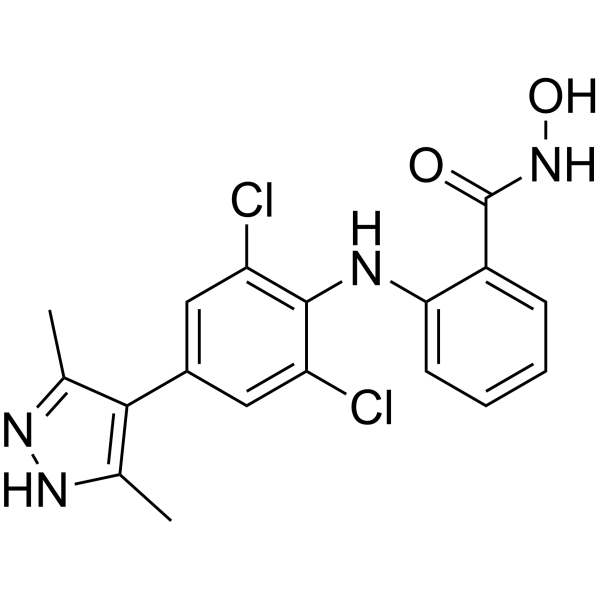
FTO-IN-1 is a fat mass and obesity-associated enzyme (FTO) inhibitor extracted from patent WO2018157843A1, compound 32, with an IC50 of <1 μM. FTO-IN-1 can be used for the research of cancer.
Nur für Forschungszwecke. Wir verkaufen nicht an Patienten.
- CAS. Nr.: 2243944-92-3
- Formel: C18H16Cl2N4O2
- Molecular Weight:391.25
-
Speicherung:
Please store the product under the recommended conditions in the Certificate of Analysis.

To place orders, for customer services and technical support, please contact: MedChemExpress USA
Tel: 609-228-6898 E-mail: [email protected] [email protected]


-
 Biologische Aktivität
-
Chemical Information
- Protokoll
- Reinheit & Dokumentation
- Verweise
-
 Help & FAQs


Publications Citing Use of MedChemExpress (MCE) FTO-IN-1
More

Biologische Aktivität
Beschreibung
IC50 & Target
IC50: <1 μM (FTO)[1]
In Vitro
FTO-IN-1 (50 μM) inhibits FTO enzyme activity by 62% in vitro[1].
FTO-IN-1 (50 μM) inhibits the viability of SCLC-21H, RH30 and KP3 cells, with IC50s of 2.1 μM, 5.3 μM, and 5.6 μM, respectively[1].
MedChemExpress (MCE) has not independently confirmed the accuracy of these methods. They are for reference only. Further protocols information, click here.


Chemical Information
-
CAS. Nr. 2243944-92-3
-
Molecular Weight 391.25
-
Formel C18H16Cl2N4O2
-
SMILES
O=C(NO)C1=CC=CC=C1NC2=C(Cl)C=C(C3=C(C)NN=C3C)C=C2Cl
-
Versand
Room temperature in continental US; may vary elsewhere.
-
Speicherung
Please store the product under the recommended conditions in the Certificate of Analysis.


Publications (1)
-
Journal Impact Factor
-
Most Recent
-
Free Radic Biol Med
Hyperactivation of the m6A demethylase FTO to down-regulate SLC7A11/xCT-mediated redox homeostasis and epigenetic remodeling in facial infiltrating lipomatosis. [Abstract]2025 Nov:239:432-448. PMID: 40769313

Protokoll
-
Cell Cytotoxicity Assay
Cytotoxicity assays are usually based on the assessment of cell membrane damage, which can also be indirectly detected by measuring cell viability. Detection methods include MTT assay, CKK-8 assay, LDH assay and ATP assay, etc.
-
Research Protocol for Metabolic Diseases
AMP-activated protein kinase, AMPK, is a conserved cellular energy sensor that responds to reduced cellular energy status and coordinates metabolism by increasing ATP-generating catabolic pathways while suppressing ATP-consuming anabolic processes. In metabolic disease research, the AMPK pathway is experimentally relevant because it regulates hepatic lipid synthesis, fatty acid oxidation, glucose production, skeletal-muscle glucose disposal, mTORC1-linked biosynthesis, autophagy, mitochondrial homeostasis, and whole-body energy balance. The central pathway logic is that energy stress, metformin, exercise-like stimulation, or direct AMPK activators increase AMPKα Thr172 phosphorylation and downstream substrate phosphorylation, including ACC and RAPTOR. Phosphorylation of ACC suppresses lipogenesis and supports fatty acid oxidation, whereas phosphorylation of RAPTOR suppresses mTORC1 signaling and links cellular energy status to growth and protein synthesis control. The pathway is linked


Reinheit & Dokumentation
Verweise

Calculators
Konzentration (Stammlösung) × Volumen (Stammlösung) = Konzentration (Ziellösung) × Volumen (Ziellösung)


FTO-IN-1 Related Classifications
HY-138843 Related Classifications
 Powered by Bioz