



Plantanone B

Based on 1 Customer Validation
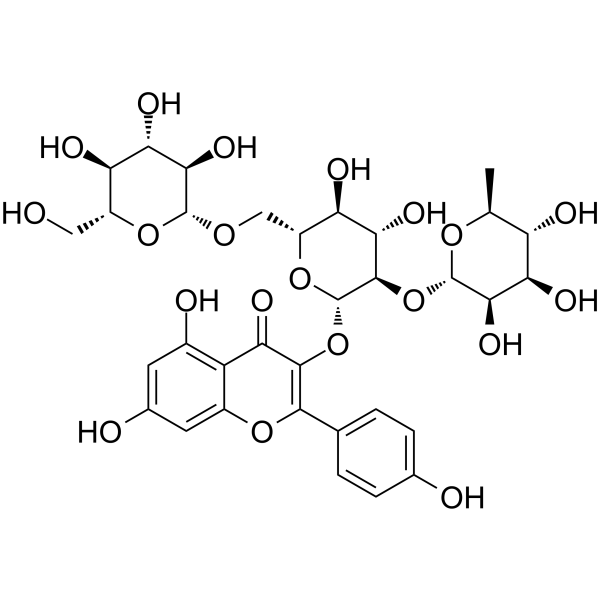
Plantanone B is a moderate antioxidant-agent with an IC50 of 169.8±5.2 μM. Plantanone B shows significant ovine COX-1 and moderate COX-2 inhibitory activities. Plantanone B has the potential for inflammation-related diseases research.
Nur für Forschungszwecke. Wir verkaufen nicht an Patienten.
- Reinheit : 99.16%
- CAS. Nr.: 55780-30-8
- Formel: C33H40O20
- Molecular Weight:756.66
-
Speicherung:
4°C, sealed storage, away from moisture and light
* In solvent : -80°C, 6 months; -20°C, 1 month (sealed storage, away from moisture and light)

To place orders, for customer services and technical support, please contact: MedChemExpress USA
Tel: 609-228-6898 E-mail: [email protected] [email protected]


-
 Biologische Aktivität
-
Chemical Information
-
Lösungsmittel & Löslichkeit
- Protokoll
- Reinheit & Dokumentation
- Verweise
-
 Help & FAQs




Biologische Aktivität
Beschreibung
IC50 & Target
[1]|
Ovine COX-1 21.78±0.2 μM (IC50) |
Ovine COX-2 44.01±0.42 μM (IC50) |
In Vitro
The antioxidant activity of Plantanone B is measured by the DPPH method. Plantanone B exhibits a moderate antioxidant activity, with an IC50 value of 169.8±5.2 μM[1].Plantanone B inhibits COX-1 preferentially over COX-2 with selectivity index (SI) value of 0.49. It shows significant inhibitory activities against ovine COX-1 and COX-2 at concentration of 50 μM, with the inhibition of 76.18% and 21.78%, respectively[1]..Plantanone B shows significant COX-1 and moderate COX-2 inhibitory activities with IC50 values of 21.78±0.20 μM for COX-1, as well as 44.01±0.42 μM for COX-2, respectively[1].
MedChemExpress (MCE) has not independently confirmed the accuracy of these methods. They are for reference only. Further protocols information, click here.


Chemical Information
-
CAS. Nr. 55780-30-8
-
Appearance Solid
-
Molecular Weight 756.66
-
Formel C33H40O20
-
Color Off-white to light yellow
-
SMILES
O=C1C(O[C@H](O[C@@H]2CO[C@@H]([C@@H]([C@H]3O)O)O[C@@H]([C@H]3O)CO)[C@@H]([C@H]([C@@H]2O)O)O[C@H](O[C@H]4C)[C@@H]([C@@H]([C@H]4O)O)O)=C(C(C=C5)=CC=C5O)OC6=CC(O)=CC(O)=C16
-
Synonyms
Kaempferol 3-O-rhamnosylgentiobioside
-
Structure Classification
-
Initial Source
-
Versand
Room temperature in continental US; may vary elsewhere.
-
Speicherung
4°C, sealed storage, away from moisture and light
* In solvent : -80°C, 6 months; -20°C, 1 month (sealed storage, away from moisture and light)


Lösungsmittel & Löslichkeit
In Vitro:
DMSO : 7.6 mg/mL (10.04 mM; Need ultrasonic and warming; Hygroscopic DMSO has a significant impact on the solubility of product, please use newly opened DMSO)
Please refer to the solubility information to select the appropriate solvent. Once prepared, please aliquot and store the solution to prevent product inactivation from repeated freeze-thaw cycles.
Storage method and period of stock solution: -80°C, 6 months; -20°C, 1 month (sealed storage, away from moisture and light). When stored at -80°C, please use it within 6 months. When stored at -20°C, please use it within 1 month.
Please refer to the solubility information to select the appropriate solvent. Once prepared, please aliquot and store the solution to prevent product inactivation from repeated freeze-thaw cycles.
Storage method and period of stock solution: -80°C, 6 months; -20°C, 1 month (sealed storage, away from moisture and light). When stored at -80°C, please use it within 6 months. When stored at -20°C, please use it within 1 month.
Konzentration (Stammlösung) × Volumen (Stammlösung) = Konzentration (Ziellösung) × Volumen (Ziellösung)

Protokoll
-
Cell Cytotoxicity Assay
Cytotoxicity assays are usually based on the assessment of cell membrane damage, which can also be indirectly detected by measuring cell viability. Detection methods include MTT assay, CKK-8 assay, LDH assay and ATP assay, etc.
-
Research Protocol for Inflammation-related Diseases
The NLRP3 inflammasome is a cytosolic innate immune signaling platform that integrates priming signals and danger-signal activation to promote caspase-1 activation, maturation of IL-1β and IL-18, and gasdermin D-mediated pyroptotic cell death. The core experimental logic is to determine whether inflammatory disease phenotypes are driven by increased NLRP3 expression, ASC-containing inflammasome assembly, caspase-1 cleavage, GSDMD cleavage, and extracellular release of IL-1β/IL-18 rather than by nonspecific cell injury alone. The pathway is strongly linked to inflammation-related disease phenotypes because monosodium urate crystals activate NALP3/NLRP3 inflammasome signaling in gout-like crystal inflammation, cholesterol crystals activate NLRP3 inflammasomes in atherogenesis models, and DSS-induced intestinal inflammation has been reported to involve NLRP3 inflammasome activity. However, experimental colitis studies also show context-dependent protective effects of NLRP3 inflammasome co


Reinheit & Dokumentation
-
Data Sheet (292 KB)
-
SDS (254 KB)
- English - EN (254 KB)
- Français - FR (254 KB)
- Deutsch - DE (254 KB)
- Norwegian - NO (254 KB)
- Español - ES (254 KB)
- Swedish - SV (254 KB)
- Italian - IT (254 KB)
- Korean - KR (254 KB)
- Portuguese - PT (254 KB)
-
Handling Instructions (2659 KB)
Verweise


Complete Stock Solution Preparation Table
Please refer to the solubility information to select the appropriate solvent. Once prepared, please aliquot and store the solution to prevent product inactivation from repeated freeze-thaw cycles.
Storage method and period of stock solution: -80°C, 6 months; -20°C, 1 month (sealed storage, away from moisture and light). When stored at -80°C, please use it within 6 months. When stored at -20°C, please use it within 1 month.
| Optional Solvent | Concentration Solvent Mass | 1 mg | 5 mg | 10 mg | 25 mg |
|---|---|---|---|---|---|
| DMSO | 1 mM | 1.3216 mL | 6.6080 mL | 13.2160 mL | 33.0399 mL |
| 5 mM | 0.2643 mL | 1.3216 mL | 2.6432 mL | 6.6080 mL | |
| 10 mM | 0.1322 mL | 0.6608 mL | 1.3216 mL | 3.3040 mL |


Plantanone B Related Classifications
HY-N8167 Related Classifications
 Powered by Bioz