



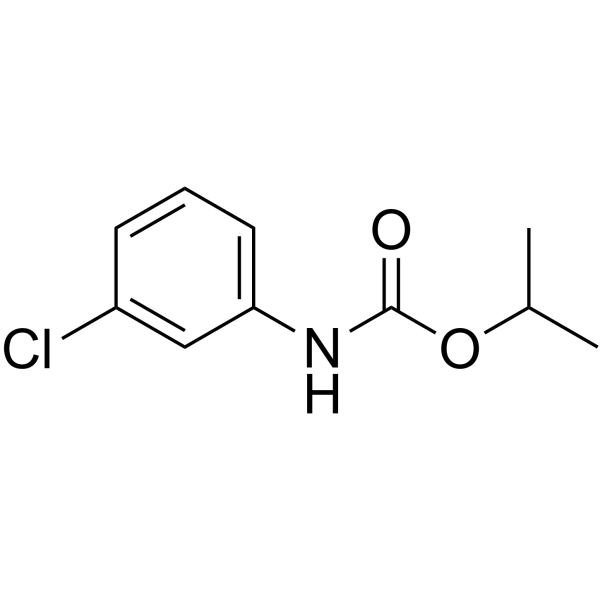
Chlorpropham
Based on 1 publication(s) in Google Scholar
Chlorpropham is a carbamate herbicide and plant growth regulator. Chlorpropham inhibits mitosis and cell division by interfering with the organisation of the spindle microtubules.
For research use only. We do not sell to patients.
- Purity : 98.13%
- CAS No.: 101-21-3
- Formula: C10H12ClNO2
- Molecular Weight:213.66
-
Storage:Powder -20°C, 3 years , 4°C, 2 years ; In solvent -80°C, 6 months , -20°C, 1 month

To place orders, for customer services and technical support, please contact: MedChemExpress USA
Tel: 609-228-6898 E-mail: [email protected] [email protected]


-
 Biological Activity
-
Chemical Information
-
Solvent & Solubility
- Protocols
- Purity & Documentation
- References
-
 Help & FAQs



Publications Citing Use of MedChemExpress (MCE) Chlorpropham
More

Biological Activity
Description
In Vitro


Chemical Information
-
CAS No. 101-21-3
-
Appearance Solid
-
Molecular Weight 213.66
-
Formula C10H12ClNO2
-
Color White to off-white
-
SMILES
O=C(NC1=CC=CC(Cl)=C1)OC(C)C
-
Shipping
Room temperature in continental US; may vary elsewhere.
-
Storage
Powder -20°C 3 years 4°C 2 years In solvent -80°C 6 months -20°C 1 month


Publications (1)
-
Journal Impact Factor
-
Most Recent
-
Anal Chem
Exposome-Scale Investigation of Cl-/Br-Containing Chemicals Using High-Resolution Mass Spectrometry, Multistage Machine Learning, and Cloud Computing. [Abstract]2025 Jun 3;97(21):11099-11109. PMID: 40401576


Solvent & Solubility
In Vitro:
DMSO : ≥ 100 mg/mL (468.03 mM; Hygroscopic DMSO has a significant impact on the solubility of product, please use newly opened DMSO)
* "≥" means soluble, but saturation unknown.
Please refer to the solubility information to select the appropriate solvent. Once prepared, please aliquot and store the solution to prevent product inactivation from repeated freeze-thaw cycles.
Storage method and period of stock solution: -80°C, 6 months; -20°C, 1 month. When stored at -80°C, please use it within 6 months. When stored at -20°C, please use it within 1 month.
Please refer to the solubility information to select the appropriate solvent. Once prepared, please aliquot and store the solution to prevent product inactivation from repeated freeze-thaw cycles.
Storage method and period of stock solution: -80°C, 6 months; -20°C, 1 month. When stored at -80°C, please use it within 6 months. When stored at -20°C, please use it within 1 month.
Concentration (start) × Volume (start) = Concentration (final) × Volume (final)


Purity & Documentation
-
Data Sheet (270 KB)
-
SDS (761 KB)
- English - EN (761 KB)
- Français - FR (761 KB)
- Deutsch - DE (761 KB)
- Norwegian - NO (761 KB)
- Español - ES (761 KB)
- Swedish - SV (761 KB)
- Italian - IT (761 KB)
- Korean - KR (761 KB)
- Portuguese - PT (761 KB)
-
Handling Instructions (2659 KB)
References


Complete Stock Solution Preparation Table
Please refer to the solubility information to select the appropriate solvent. Once prepared, please aliquot and store the solution to prevent product inactivation from repeated freeze-thaw cycles.
Storage method and period of stock solution: -80°C, 6 months; -20°C, 1 month. When stored at -80°C, please use it within 6 months. When stored at -20°C, please use it within 1 month.
| Optional Solvent | Concentration Solvent Mass | 1 mg | 5 mg | 10 mg | 25 mg |
|---|---|---|---|---|---|
| DMSO | 1 mM | 4.6803 mL | 23.4017 mL | 46.8033 mL | 117.0083 mL |
| 5 mM | 0.9361 mL | 4.6803 mL | 9.3607 mL | 23.4017 mL | |
| 10 mM | 0.4680 mL | 2.3402 mL | 4.6803 mL | 11.7008 mL | |
| 15 mM | 0.3120 mL | 1.5601 mL | 3.1202 mL | 7.8006 mL | |
| 20 mM | 0.2340 mL | 1.1701 mL | 2.3402 mL | 5.8504 mL | |
| 25 mM | 0.1872 mL | 0.9361 mL | 1.8721 mL | 4.6803 mL | |
| 30 mM | 0.1560 mL | 0.7801 mL | 1.5601 mL | 3.9003 mL | |
| 40 mM | 0.1170 mL | 0.5850 mL | 1.1701 mL | 2.9252 mL | |
| 50 mM | 0.0936 mL | 0.4680 mL | 0.9361 mL | 2.3402 mL | |
| 60 mM | 0.0780 mL | 0.3900 mL | 0.7801 mL | 1.9501 mL | |
| 80 mM | 0.0585 mL | 0.2925 mL | 0.5850 mL | 1.4626 mL | |
| 100 mM | 0.0468 mL | 0.2340 mL | 0.4680 mL | 1.1701 mL |


Chlorpropham Related Classifications
HY-W014240 Related Classifications
 Powered by Bioz