



Dipropylenetriamine NONOate

Based on 1 Customer Validation
Dipropylenetriamine NONOate (DPTA-NO) is a NO donor, which spontaneously dissociates in a pH-dependent, first-order process with a half-life of three hours and five hours at 37°C and 22-25°C, pH 7.4, respectively.
For research use only. We do not sell to patients.
- Purity : 98%
- CAS No.: 146724-95-0
- Formula: C6H17N5O2
- Molecular Weight:191.23
-
Storage:
Please store the product under the recommended conditions in the Certificate of Analysis.


To place orders, for customer services and technical support, please contact: MedChemExpress USA
Tel: 609-228-6898 E-mail: [email protected] [email protected]


-
 Biological Activity
-
Chemical Information
-
Solvent & Solubility
- Protocols
- Purity & Documentation
- References
-
 Help & FAQs


-
HY-134216
MAHMA NONOateNO Donor -

HY-120374
V-PYRRO/NO -
HY-131925
Diethylamine NONOate diethylammonium saltAntimicrobial Agent -

HY-135226
PROLI NONOate -
HY-126193
JS-KNO Donor -

HY-W739302
Sodium Oxyhyponitrite -

HY-155224
Sulpho NONOateNegative Control -
HY-126166
NOC-5NO Donor -

HY-110057
FR 409Vascular Relaxant Agent -
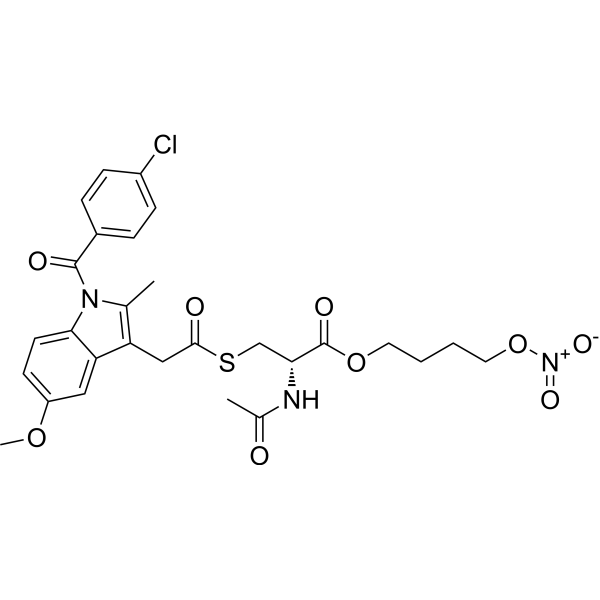
HY-120966
NCX 2121Anti-inflammatory Agent


Biological Activity
Description


Chemical Information
-
CAS No. 146724-95-0
-
Appearance Solid
-
Molecular Weight 191.23
-
Formula C6H17N5O2
-
Color White to off-white
-
SMILES
C(CN)CN(CCCN)/[N+](=N/O)/[O-]
-
Synonyms
DPTA-NO
-
Shipping
Shipping with dry ice.
-
Storage
Please store the product under the recommended conditions in the Certificate of Analysis.


Solvent & Solubility
In Vitro:
H2O : ≥ 125 mg/mL (653.66 mM)
* "≥" means soluble, but saturation unknown.
Please refer to the solubility information to select the appropriate solvent. The compound is unstable in solutions, freshly prepared is recommended.
* Note: If you choose water as the stock solution, please dilute it to the working solution, then filter and sterilize it with a 0.22 μm filter before use.
Please refer to the solubility information to select the appropriate solvent. The compound is unstable in solutions, freshly prepared is recommended.
* Note: If you choose water as the stock solution, please dilute it to the working solution, then filter and sterilize it with a 0.22 μm filter before use.
Concentration (start) × Volume (start) = Concentration (final) × Volume (final)

Protocols
-
Protocol for Pharmacokinetic Study
Pharmacokinetic studies quantify how an organism handles a drug over time through absorption, distribution, metabolism, and excretion, and the core experimental readout is the concentration-time profile of parent drug and, when relevant, metabolites in biological matrices such as plasma, whole blood, urine, bile, or tissue. Pharmacokinetic analysis links dose, route, exposure, clearance, half-life, distribution, bioavailability, and systemic exposure to drug efficacy and toxicity hypotheses rather than measuring a signaling pathway directly. The literature links pharmacokinetics to drug-development phenotypes by showing that drug metabolism and pharmacokinetics influence compound progression, exposure-response interpretation, safety margins, dosing strategy, and failure risk during discovery and development. DMPK science contributes to compound optimization by integrating physicochemical properties, in vitro metabolism, transporter behavior, in vivo exposure, and pharmacodynamic contex


Purity & Documentation
-
Data Sheet (266 KB)
-
SDS (394 KB)
- English - EN (394 KB)
- Français - FR (394 KB)
- Deutsch - DE (394 KB)
- Norwegian - NO (394 KB)
- Español - ES (394 KB)
- Swedish - SV (394 KB)
- Italian - IT (394 KB)
- Korean - KR (394 KB)
- Portuguese - PT (394 KB)
-
Handling Instructions (2659 KB)
References


Complete Stock Solution Preparation Table
Please refer to the solubility information to select the appropriate solvent. The compound is unstable in solutions, freshly prepared is recommended.
| Optional Solvent | Concentration Solvent Mass | 1 mg | 5 mg | 10 mg | 25 mg |
|---|---|---|---|---|---|
| H2O | 1 mM | 5.2293 mL | 26.1465 mL | 52.2931 mL | 130.7326 mL |
| 5 mM | 1.0459 mL | 5.2293 mL | 10.4586 mL | 26.1465 mL | |
| 10 mM | 0.5229 mL | 2.6147 mL | 5.2293 mL | 13.0733 mL | |
| 15 mM | 0.3486 mL | 1.7431 mL | 3.4862 mL | 8.7155 mL | |
| 20 mM | 0.2615 mL | 1.3073 mL | 2.6147 mL | 6.5366 mL | |
| 25 mM | 0.2092 mL | 1.0459 mL | 2.0917 mL | 5.2293 mL | |
| 30 mM | 0.1743 mL | 0.8716 mL | 1.7431 mL | 4.3578 mL | |
| 40 mM | 0.1307 mL | 0.6537 mL | 1.3073 mL | 3.2683 mL | |
| 50 mM | 0.1046 mL | 0.5229 mL | 1.0459 mL | 2.6147 mL | |
| 60 mM | 0.0872 mL | 0.4358 mL | 0.8716 mL | 2.1789 mL | |
| 80 mM | 0.0654 mL | 0.3268 mL | 0.6537 mL | 1.6342 mL | |
| 100 mM | 0.0523 mL | 0.2615 mL | 0.5229 mL | 1.3073 mL |
* Note: If you choose water as the stock solution, please dilute it to the working solution, then filter and sterilize it with a 0.22 μm filter before use.


Dipropylenetriamine NONOate Related Classifications
HY-W507393 Related Classifications
 Powered by Bioz