



Murrayanol
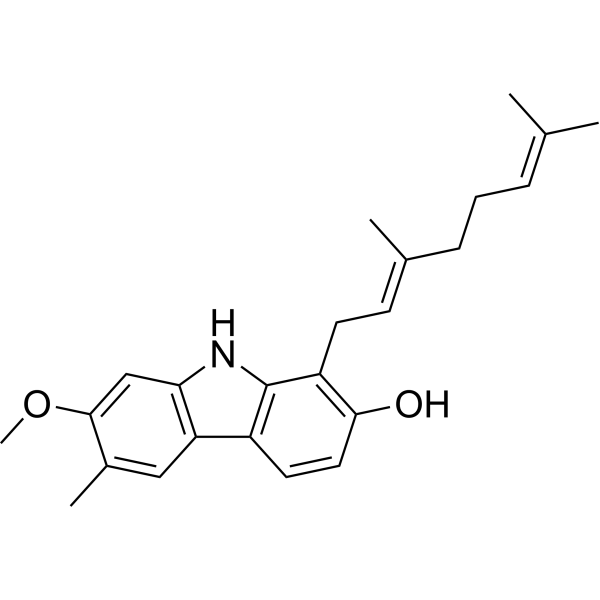
Murrayanol is a natural carbazole alkaloid with a variety of biological activities. Murrayanol shows anti-inflammatory, topoisomerase I and topoisomerase II (Topoisomerase) inhibition activities. Murrayanol also as a mosquitocidal and antimicrobial.
For research use only. We do not sell to patients.
- CAS No.: 144525-81-5
- Formula: C24H29NO2
- Molecular Weight:363.49
-
Storage:
Please store the product under the recommended conditions in the Certificate of Analysis.

To place orders, for customer services and technical support, please contact: MedChemExpress USA
Tel: 609-228-6898 E-mail: [email protected] [email protected]


-
 Biological Activity
-
Chemical Information
- Protocols
- Purity & Documentation
- References
-
 Help & FAQs


All Topoisomerase Isoforms
More

Biological Activity
Description
In Vitro
Murrayanol (Compound 2) shows an IC50 of 109 μg/mL against human prostaglandin H synthase isozyme 1 (hPGHS-1) and an IC50 of 218 μg/mL against hPGHS-2 in anti-inflammatory assays[1].
Murrayanol (Compound 2) shows 100% mortality at 12.5 µg/mL concentrations for Aedes aegyptii[1].
Murrayanol (Compound 2) completely inhibits topoisomerase I and II activity at 50 µg/mL concentrations when tested on S. cerevisiae mutant strains[1].
Murrayanol (Compound 2) shows an MIC100 of 100 µg/mL against C. kruseii and E. coli but give an MIC100 against S. aureus and S. pyogenes at 25 µg/mL[1].
MedChemExpress (MCE) has not independently confirmed the accuracy of these methods. They are for reference only. Further protocols information, click here.


Chemical Information
-
CAS No. 144525-81-5
-
Molecular Weight 363.49
-
Formula C24H29NO2
-
SMILES
OC1=C(C/C=C(C)/CC/C=C(C)\C)C(NC2=C3C=C(C)C(OC)=C2)=C3C=C1
-
Structure Classification
-
Initial Source
-
Shipping
Room temperature in continental US; may vary elsewhere.
-
Storage
Please store the product under the recommended conditions in the Certificate of Analysis.

Protocols
-
Research Protocol for Infectious Diseases
Infectious-disease experiments test how pathogens interact with host barriers, innate immune receptors, inflammatory signaling, pathogen replication, and tissue injury; pattern-recognition receptors such as TLRs, RIG-I-like receptors, NOD-like receptors, and inflammasomes detect microbial molecules and activate NF-κB, interferon, and cytokine responses. The central hypothesis is that infection severity reflects the balance between pathogen burden and host response: protective inflammation restricts pathogen growth, whereas excessive or mislocalized inflammation contributes to tissue damage and disease phenotype. Unresolved questions include which host pathways are protective versus pathogenic, why some infection models fail to translate to human disease, and which combined readouts best predict clinically relevant infection outcomes.
-
Research Protocol for Inflammation-related Diseases
The NLRP3 inflammasome is a cytosolic innate immune signaling platform that integrates priming signals and danger-signal activation to promote caspase-1 activation, maturation of IL-1β and IL-18, and gasdermin D-mediated pyroptotic cell death. The core experimental logic is to determine whether inflammatory disease phenotypes are driven by increased NLRP3 expression, ASC-containing inflammasome assembly, caspase-1 cleavage, GSDMD cleavage, and extracellular release of IL-1β/IL-18 rather than by nonspecific cell injury alone. The pathway is strongly linked to inflammation-related disease phenotypes because monosodium urate crystals activate NALP3/NLRP3 inflammasome signaling in gout-like crystal inflammation, cholesterol crystals activate NLRP3 inflammasomes in atherogenesis models, and DSS-induced intestinal inflammation has been reported to involve NLRP3 inflammasome activity. However, experimental colitis studies also show context-dependent protective effects of NLRP3 inflammasome co


Purity & Documentation
References

Calculators
Concentration (start) × Volume (start) = Concentration (final) × Volume (final)


Murrayanol Related Classifications
HY-116933 Related Classifications
 Powered by Bioz