



Endocytosis and pinocytosis Dyes
- 1
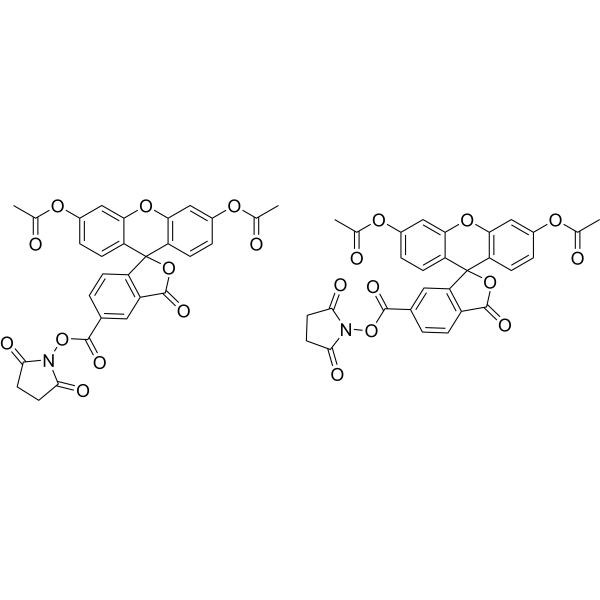
- Formula: C29H19NO11
- Molecular Weight: 557.46
CFDA-SE is a fluorescent dye that can penetrate the cell membrane. It can react with the free amine group in the cytoskeleton protein inside the cell, and finally form a protein complex with fluorescence. After entering the cell, CFDA-SE locates in the cell membrane, cytoplasm and nucleus, and the fluorescence staining is strongest in the nucleus. CFDA-SE dye can be uniformly inherited by the cells with cell division and proliferation, and its attenuation is proportional to the number of cell divisions. This phenomenon can be detected and analyzed by flow cytometry under the excitation light of 488 nm, and can be used to detect the proliferation of cells.
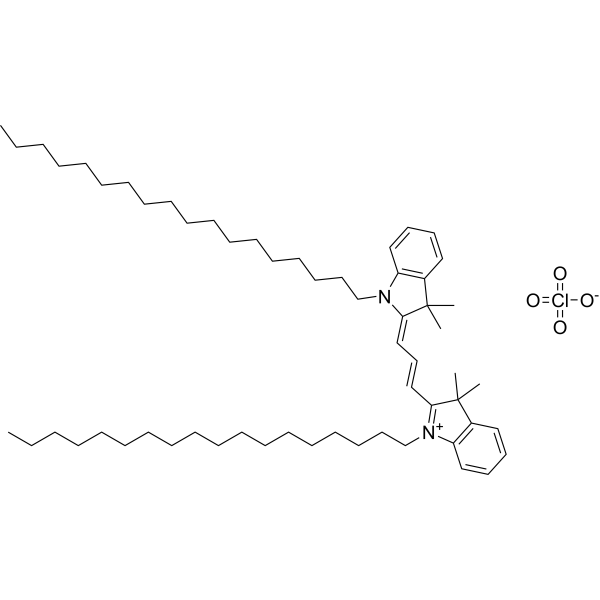
- Formula: C59H97ClN2O4
- Molecular Weight: 933.87
DiI is a long-chain carbocyanine dye. Carbocyanine dyes are widely used as Di to label cells, organelles, liposomes, viruses and lipoproteins.
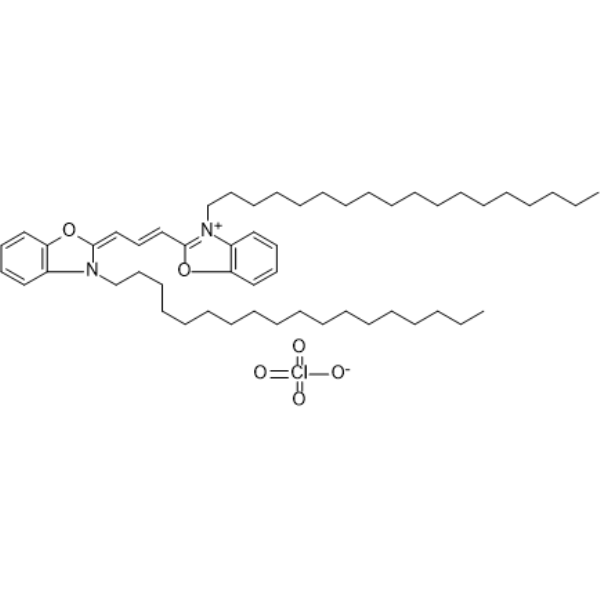
- Formula: C53H85ClN2O6
- Molecular Weight: 881.70
DiO is a long-chain carbocyanine dye. Carbocyanine dyes are widely used as Di to label cells, organelles, liposomes, viruses and lipoproteins.
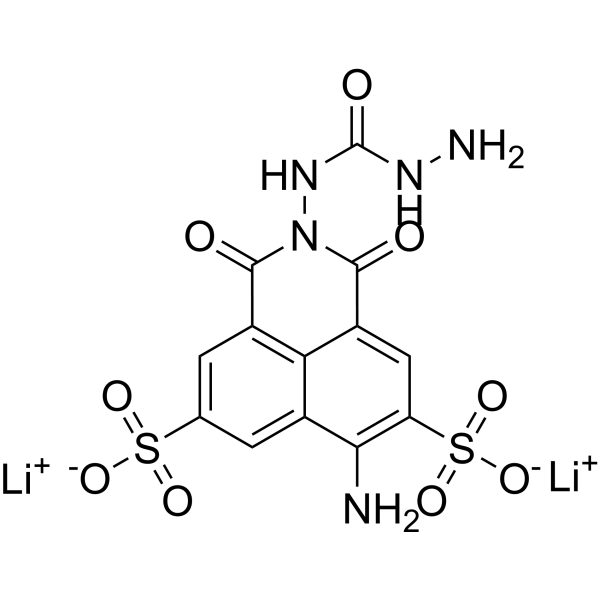
- Formula: C13H9Li2N5O9S2
- Molecular Weight: 457.25
Luc Yellow CH dilithium is a high-intensity fluorescent probe containing free hydrazyl groups. Luc Yellow CH can react with fatty aldehydes at room temperature. Luc Yellow CH serves as a biological tracer to monitor neuronal branching, regeneration, gap junction detection and characterization, and selective ablation of cells after aldehyde fixation. Luc Yellow CH displays the maximum excitation/emission of 430 nm/540 nm, respectively.
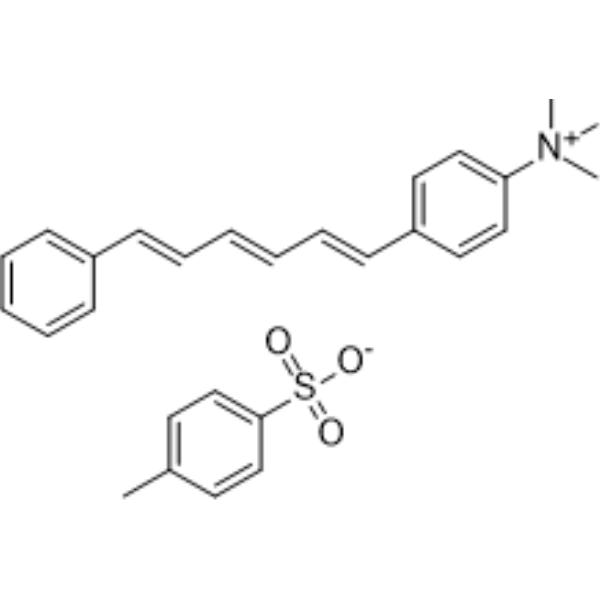
- Formula: C28H31NO3S
- Molecular Weight: 461.62
TMA-DPH is a hydrophobic fluorescent membrane probe (Ex=355 nm; Em=430 nm). TMA-DPH is able to anchor on the cell surface and localize to different regions of the phospholipid bilayer. By analyzing the fluorescence polarization values of TMA-DPH in the plasma membrane and membrane substructures, the fluidity of the cell membrane can be determined.

- Formula: C41H51BN6O2
- Molecular Weight: 670.69
Endo-pH is a cell-permeable, pH-responsive fluorescent probe based on BODIPY, with a pKa of 5.08. When pH decreases from 7.32 to 4.97, Endo-pH undergoes protonation under acidic conditions, resulting in a 79-fold increase in fluorescence intensity at 786 nm. The detection wavelengths of its protonated form are Ex/Em=688/786 nm, while the absorption wavelength of its non-protonated form is 745 nm. Endo-pH can be used for staining late endosomes in live cells and determining the fusion time of late endosomes and lysosomes.

- Formula: C13H11ClF3NO5
- Molecular Weight: 353.68
Mini202 is a pH-responsive fluorescent false neurotransmitter with a pKa=6.4, and also serves as a substrate for vesicular monoamine transporters (VMAT1, VMAT2). Mini202 is widely applicable to studies related to cancer cells, transfected cells, adipose tissue, and other subjects.

- Formula: C45H45FN2O9S2
- Molecular Weight: 840.98
Dexamethasone fluorescein is a fluorescently labeled steroid conjugate that binds to glucocorticoid receptors. Dexamethasone fluorescein binds to glucocorticoid receptors. Dexamethasone fluorescein serves as a marker for evaluating the delivery of drugs via subconjunctival injection and intratympanic administration. Sustained transscleral diffusion is achieved when Dexamethasone fluorescein is delivered via fibrin sealant. Dexamethasone fluorescein can be used to investigate the binding and localization of glucocorticoid receptors.
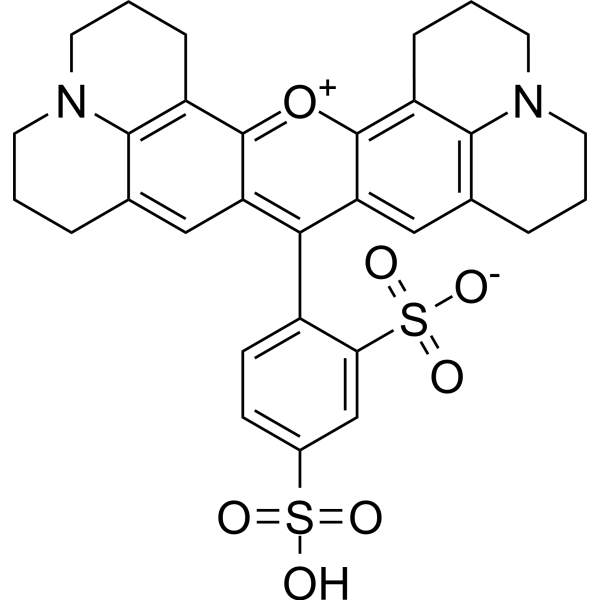
- Formula: C31H30N2O7S2
- Molecular Weight: 606.71
Texas Red (Sulforhodamine 101) is an amphoteric rhodamine red fluorescent dye (excitation/emission: 586/605 nm). Texas Red is used extensively for investigating neuronal morphology and acts as acell type-selective fluorescent marker of astrocytes bothin vivoand in slice preparations.
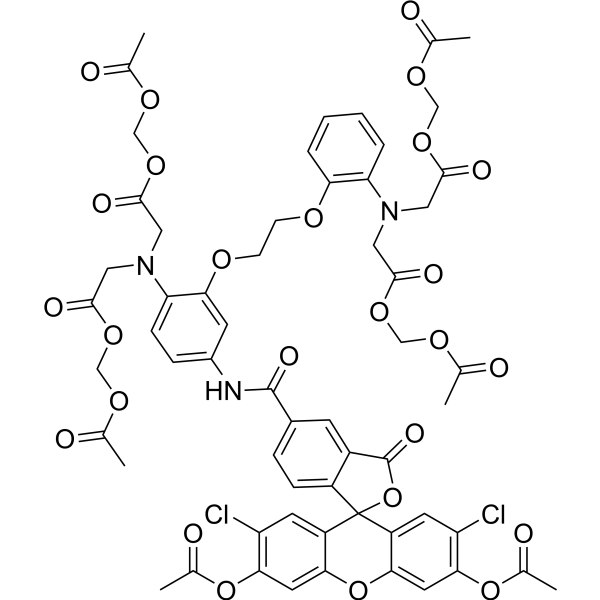
- Formula: C59H53Cl2N3O26
- Molecular Weight: 1290.96
Calcium Green 1AM is a cell-permeant fluorescent calcium indicator (Excitation 506 nm; Emission 531 nm). Calcium Green 1AM is converted to the fluorescent calcium indicator by intracellular esterases.

- Formula: C70H117N4O14PS2
- Molecular Weight: 1333.80
Rhodamine-DHPE is a fluorescently labeled phosphatidylethanolamine lipid that labels phospholipid bilayers. Rhodamine-DHPE serves as a fluorescence quenching substrate and membrane stain. The fluorescence lifetime of Rhodamine-DHPE decreases significantly in the presence of Cu2+-PS complexes. Rhodamine-DHPE effectively stains the membranes of human red blood cells and mouse fibroblasts, and supports lifetime-resolved imaging via pump-probe fluorescence microscopy.

- 1



