



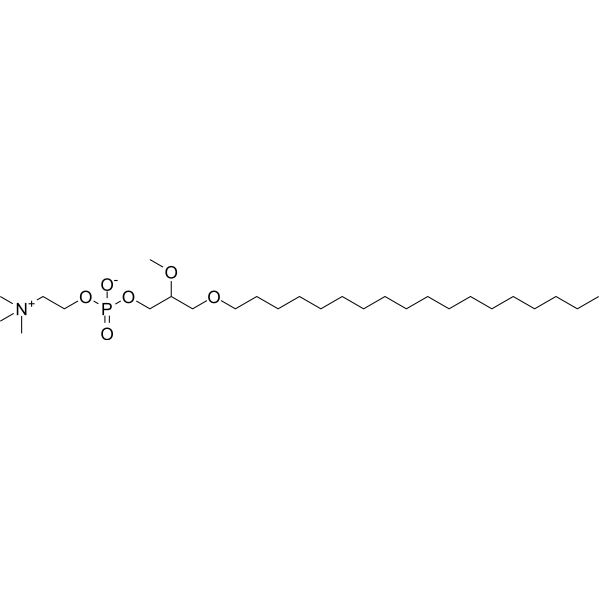
Edelfosine
Based on 1 publication(s) in Google Scholar
Edelfosine (ET-18-OCH3) is an orally active lipid raft modulator and apoptosis inducer that alters membrane fluidity and preferentially inserts into tumor cell membranes. Edelfosine recruits death receptor ligands (FasL/CD95L, TRAIL) and Bid to lipid rafts to form death-inducing signaling complexes, thereby initiating mitochondria-dependent apoptosis and inducing cytochrome c release. Edelfosine also exerts anti-inflammatory effects, promotes L-Selectin shedding, and causes no gastrointestinal or organ toxicity. In addition, Edelfosine inhibits nucleic acid and protein synthesis in Leishmania donovani and exhibits antiproliferative activity. Edelfosine can be used in research on multiple myeloma, inflammatory bowel diseases (such as ulcerative colitis and Crohn's disease), and visceral leishmaniasis.
Nur für Forschungszwecke. Wir verkaufen nicht an Patienten.
- Reinheit : 99.0%
- CAS. Nr.: 70641-51-9
- Formel: C27H58NO6P
- Molecular Weight:523.73
-
Speicherung:Powder -20°C, 3 years ; In solvent -80°C, 6 months , -20°C, 1 month

To place orders, for customer services and technical support, please contact: MedChemExpress USA
Tel: 609-228-6898 E-mail: [email protected] [email protected]


-
 Biologische Aktivität
-
Chemical Information
-
Lösungsmittel & Löslichkeit
- Protokoll
- Reinheit & Dokumentation
- Verweise
-
 Help & FAQs


Publications Citing Use of MedChemExpress (MCE) Edelfosine
MoreAlle Parasite Isoform-spezifische Produkte anzeigen
More

Biologische Aktivität
Beschreibung
Cellular Effect
|
Cell Line

|
Type | Value | Description | References |
|---|---|---|---|---|
| A-431 | IC50 |
13.5 μM
Compound: Edelfosine
|
Antiproliferative activity of compound was measured on human tumor cell line A431.
Antiproliferative activity of compound was measured on human tumor cell line A431.
|
[PMID: 7707324] |
| A549 | IC50 |
3.5 μM
Compound: 3, ET-18-OMe
|
Inhibition of Akt phosphorylation in human insulin-stimulated A549 cells incubated for 2 hrs prior to insulin-induction measured after 30 mins by ELISA
Inhibition of Akt phosphorylation in human insulin-stimulated A549 cells incubated for 2 hrs prior to insulin-induction measured after 30 mins by ELISA
|
[PMID: 23415083] |
| A549 | IC50 |
7.4 μM
Compound: 3, ET-18-OMe
|
Cytotoxicity against human A549 cells by flow cytometric analysis
Cytotoxicity against human A549 cells by flow cytometric analysis
|
[PMID: 23415083] |
| BXPC-3 | IC50 |
18.8 μM
Compound: EDLF
|
Growth inhibition of human BxPC3 cells after 72 hrs by XTT assay
Growth inhibition of human BxPC3 cells after 72 hrs by XTT assay
|
[PMID: 29547833] |
| CEM-SS | IC50 |
4 μM
Compound: ET-18-OMe
|
In vitro inhibition of CEM-SS cell growth by 50 %
In vitro inhibition of CEM-SS cell growth by 50 %
|
[PMID: 2016713] |
| CEM-SS | IC50 |
4 mM
Compound: 10
|
Concentration of compound required to 50% growth inhibition of HIV-1 in CEM-SS cells
Concentration of compound required to 50% growth inhibition of HIV-1 in CEM-SS cells
|
[PMID: 1901911] |
| FHC | IC50 |
45 μM
Compound: Edelfosine
|
In vitro inhibition of FHC normal human colon cell proliferation
In vitro inhibition of FHC normal human colon cell proliferation
|
10.1016/S0960-894X(97)00433-2 |
| HL-60 | IC50 |
1 μM
Compound: Edelfosine
|
Antiproliferative activity of compound was measured on human tumor cell line HL-60.
Antiproliferative activity of compound was measured on human tumor cell line HL-60.
|
[PMID: 7707324] |
| HL-60 | IC50 |
12 μM
Compound: ET-18-oMe
|
Inhibition of Protein Kinase C (PKC) isolated from HL-60 human promyelocytic leukemia cells
Inhibition of Protein Kinase C (PKC) isolated from HL-60 human promyelocytic leukemia cells
|
[PMID: 2342075] |
| HL-60 | IC50 |
2 μM
Compound: Edelfosine
|
In vitro inhibition of HL-60 human promyelocytic leukemia cell proliferation
In vitro inhibition of HL-60 human promyelocytic leukemia cell proliferation
|
10.1016/S0960-894X(97)00433-2 |
| HL-60 | IC50 |
6.1 μM
Compound: Edelfosine
|
Cytotoxicity measured in HL-60 leukemic cells after a 24 hr incubation period.
Cytotoxicity measured in HL-60 leukemic cells after a 24 hr incubation period.
|
[PMID: 7707324] |
| HT-29 | IC50 |
2 μM
Compound: Edelfosine
|
In vitro inhibition of the HT-29 transformed human colon cell proliferation
In vitro inhibition of the HT-29 transformed human colon cell proliferation
|
10.1016/S0960-894X(97)00433-2 |
| Jurkat | IC50 |
12.2 μM
Compound: Edelfosine
|
Cytotoxicity against human Jurkat cells assessed as live cells in neubauer chamber after 24 hrs by trypan blue assay
Cytotoxicity against human Jurkat cells assessed as live cells in neubauer chamber after 24 hrs by trypan blue assay
|
[PMID: 21571403] |
| K562 | IC50 |
6.1 μM
Compound: Edelfosine
|
Antiproliferative activity of compound was measured on human tumor cell line K-562.
Antiproliferative activity of compound was measured on human tumor cell line K-562.
|
[PMID: 7707324] |
| MCF7 | IC50 |
9.3 μM
Compound: 3, ET-18-OMe
|
Cytotoxicity against human MCF7 cells by flow cytometric analysis
Cytotoxicity against human MCF7 cells by flow cytometric analysis
|
[PMID: 23415083] |
| MDA-MB-231 | IC50 |
5 μM
Compound: Edelfosine
|
In vitro inhibition of estrogen receptor negative MDA-MB-231 human breast cancer cell proliferation
In vitro inhibition of estrogen receptor negative MDA-MB-231 human breast cancer cell proliferation
|
10.1016/S0960-894X(97)00433-2 |
| MDA-MB-435 | IC50 |
12 μM
Compound: ET-18-OCH3
|
Cytotoxicity against human MDA-MB-435 cells after 3 days in serum free conditions by MTT assay
Cytotoxicity against human MDA-MB-435 cells after 3 days in serum free conditions by MTT assay
|
[PMID: 16279790] |
| MDA-MB-435 | IC50 |
3 μM
Compound: ET-18-OCH3
|
Inhibition of Akt phosphorylation in MDA-MB-435 cells after 2 hrs
Inhibition of Akt phosphorylation in MDA-MB-435 cells after 2 hrs
|
[PMID: 16279790] |
| PANC-1 | IC50 |
25.7 μM
Compound: EDLF
|
Growth inhibition of human PANC1 cells after 72 hrs by XTT assay
Growth inhibition of human PANC1 cells after 72 hrs by XTT assay
|
[PMID: 29547833] |
| THP-1 | CC50 |
12.9 μM
Compound: Edelfosine
|
Cytotoxicity against human THP-1 cells
Cytotoxicity against human THP-1 cells
|
[PMID: 36944273] |
| THP-1 | EC50 |
1 μM
Compound: Edelfosine
|
Cytotoxicity against human THP1 cells assessed as reduction in cell viability after 24 hrs by propidium iodide staining based fluorescence microscopic analysis
Cytotoxicity against human THP1 cells assessed as reduction in cell viability after 24 hrs by propidium iodide staining based fluorescence microscopic analysis
|
[PMID: 29501944] |
| THP-1 | IC50 |
3.1 μM
Compound: Edelfosine
|
Leishmanicidal activity against amastigote stage of Leishmania infantum expressing GFP infected in human THP1 cells after 48 hrs by flow cytometric analysis
Leishmanicidal activity against amastigote stage of Leishmania infantum expressing GFP infected in human THP1 cells after 48 hrs by flow cytometric analysis
|
[PMID: 24448421] |
| THP-1 | IC50 |
4.9 μM
Compound: Edelfosine
|
Cytotoxicity against human THP1 cells after 24 hrs by propidium iodide staining-based flow cytometric analysis
Cytotoxicity against human THP1 cells after 24 hrs by propidium iodide staining-based flow cytometric analysis
|
[PMID: 24448421] |
| THP-1 | IC50 |
4.96 μM
Compound: Edelfosine
|
Cytotoxicity against human THP1 cells assessed as live cells in neubauer chamber after 24 hrs by trypan blue assay
Cytotoxicity against human THP1 cells assessed as live cells in neubauer chamber after 24 hrs by trypan blue assay
|
[PMID: 21571403] |
| THP-1 | IC50 |
4.96 μM
Compound: Edelfosine
|
Cytotoxicity against human THP1 cells assessed as reduction in cell viability measured after 24 hrs by propidium iodide staining based flow cytometry
Cytotoxicity against human THP1 cells assessed as reduction in cell viability measured after 24 hrs by propidium iodide staining based flow cytometry
|
[PMID: 32223141] |
| THP-1 | IC50 |
4.96 μM
Compound: Edelfosine
|
Cytotoxicity against human THP-1 cells assessed as reduction in cell viability incubated for 24 hrs
Cytotoxicity against human THP-1 cells assessed as reduction in cell viability incubated for 24 hrs
|
[PMID: 32738977] |
In Vitro
Edelfosine (10 μM; 24-48 h) induces apoptosis in human multiple myeloma (MM) cell lines (MM144, MM1S, MM1R, RPMI-8226, OPM-2), leukemic Jurkat T lymphoid cells and JY B lymphoid cells, with MM144 cells showing the highest sensitivity; however, it does not induce apoptosis in Fas/CD95-deficient human OPM-2 MM cells[1].
Edelfosine (10 μM; 15 h) induces the translocation of Fas/CD95, DR4, DR5, FADD, procaspase-8, activated caspase-8 and Bid to lipid rafts in human MM144 cells, thereby promoting the formation of the death-inducing signaling complex (DISC), which consists of Fas/CD95, FADD and caspase-8[1].
Edelfosine (10 μM; 3-24 h) induces apoptosis in human MM144 cells, with this effect emerging after 15 h of incubation. Activation of caspase-3 and PARP is detectable at this time point, and over 50% of cell apoptosis is observed after 24 h of incubation[1].
Edelfosine (5 μg/mL; 12 h, 18 h) delays spontaneous apoptosis of neutrophils compared with the medium-only control group[2].
Edelfosine (0.01-5 μg/mL; 15 min) downregulates cell surface L-selectin, CD43 and CD44 (but not CD11a, CD11b or HLA) in a concentration-dependent manner, with an IC50 of 0.29 μM for L-selectin downregulation[2].
Edelfosine (1.9-95 μM; 4 h) inhibits Leishmania donovani amastigotes in J774A.1 macrophages. After 4 hours of treatment, its ED50 value is 19.47 μM as detected by light microscopy and 23.16 μM as detected by flow cytometry[3].
MedChemExpress (MCE) has not independently confirmed the accuracy of these methods. They are for reference only.
-
Cell Line:Human multiple myeloma (MM) cell lines (MM144, MM1S, MM1R, RPMI-8226, OPM-2)
-
Concentration:10 μM
-
Incubation Time:24 h, 48 h
-
Result:Induced potent apoptotic responses in all tested MM cell lines. Showed higher sensitivity in MM144 cells (higher cell-surface Fas/CD95 content).
Produced similar apoptotic cell death rates in dexamethasone-sensitive MM1S cells and dexamethasone-resistant MM1R cells.
-
Cell Line:Human MM144 cells and primary MM cells from patients
-
Concentration:10 μM
-
Incubation Time:12 h
-
Result:Potentiated coclustering of lipid rafts and Fas/CD95 in MM144 cells, as shown by yellow colocalization areas in merged confocal images.
Induced similar coclustering in primary MM cells from patients.
-
Cell Line:Human MM144 cells
-
Concentration:10 μM
-
Incubation Time:15 h
-
Result:Induced translocation of Fas/CD95, DR4, DR5, FADD, procaspase-8, cleaved active caspase-8 forms, and Bid into lipid raft fractions.
Achieved almost complete translocation of Fas/CD95, DR5, FADD, and Bid into lipid rafts.\n
Induced formation of DISC containing Fas/CD95, FADD, and caspase-8 in whole cell lysates and in isolated lipid raft fractions.
Had its induced DISC formation prevented by disruption of lipid rafts with methyl-β-cyclodextrin.
-
Cell Line:Fas/CD95-deficient human OPM-2 MM cells, and OPM-2 cells transduced with full-length Fas/CD95 or truncated FasΔ57C retrovirus
-
Concentration:10 μM
-
Incubation Time:24 h
-
Result:Did not induce apoptosis in Fas/CD95-deficient OPM-2 cells. Restored sensitivity to edelfosine in OPM-2 cells transduced with full-length Fas/CD95.
Failed to restore sensitivity in OPM-2 cells transduced with truncated FasΔ57C.
Did not restore Fas/CD95 expression in Fas/CD95-deficient OPM-2 cells, nor increase Fas/CD95 expression in Fas/CD95-positive MM144 cells.
-
Cell Line:Human MM144 cells stably transfected with Bcl-Xₗ (MM144-Bcl-Xₗ) or empty vector (MM144-Neo)
-
Concentration:10 μM
-
Incubation Time:15 h (cytochrome c release); 24 h (apoptosis)
-
Result:Induced apoptosis and cytochrome c release from mitochondria to the cytosol in MM144-Neo cells.
Had both induced cytochrome c release and apoptosis prevented by overexpression of Bcl-Xₗ.
In Vivo
Edelfosine (5 mg/kg; p.o.; daily) reduces TNBS-induced ulcerative colitis severity in Wistar rats by 45.5% at 24 hours and 76.5% at 7 days post-TNBS administration, while abating neutrophil infiltration and supporting colon tissue repair[2].
Edelfosine (40 mg/kg; p.o.; daily; up to 4 weeks) shows no cardiotoxicity, hepatotoxicity, renal toxicity, or gastrointestinal histologic damage in healthy Wistar rats, and does not inhibit colonic mucosal prostaglandin E2 synthesis[2].
MedChemExpress (MCE) has not independently confirmed the accuracy of these methods. They are for reference only.
-
Animal Model:Swiss mice inflammation model[2]
-
Dosage:2.5 mg/kg; 5 mg/kg
-
Administration:p.o.; daily; 21 days
-
Result:Inhibited inflammation by 34%.\nInhibited inflammation by 49%.\nCaused no body weight loss during treatment.
-
Animal Model:Wistar rats with Inflammatory bowel disease[2]
-
Dosage:5 mg/kg
-
Administration:p.o.; daily
-
Result:Protected against TNBS-induced body weight loss.\nReduced colon wet weight.\nInhibited colonic mucosal damage score by 45.5% at 24 hours post-TNBS administration.\nInhibited colonic mucosal damage score by 76.5% at 7 days post-TNBS administration.\nReduced ulcer formation, edema, and inflammatory cell infiltration in colon sections, with focal reparative processes observed.\nDramatically reduced colonic myeloperoxidase and neutrophil elastase activities.\nResulted in only submucosal focal mild inflammatory cell infiltration, compared to widespread intense infiltration in untreated controls.
-
Animal Model:Healthy Wistar rats[2]
-
Dosage:40 mg/kg
-
Administration:p.o.; daily; 1 week; 4 weeks
-
Result:Caused no body weight loss or overt toxicity during 4 weeks of treatment.\nShowed no cardiotoxicity, hepatotoxicity, or renal toxicity via biochemical and functional analyses.\nCaused no histologic damage to kidney, liver, heart, or stomach tissue.\nDid not inhibit basal prostaglandin E2 synthesis in rat colonic mucosal samples (78 ± 10 pg PGE2/mg tissue in control vs. 83 ± 9 pg PGE2/mg tissue in treated rats).


Chemical Information
-
CAS. Nr. 70641-51-9
-
Appearance Solid
-
Molecular Weight 523.73
-
Formel C27H58NO6P
-
Color White to off-white
-
SMILES
CCCCCCCCCCCCCCCCCCOCC(OC)COP([O-])(OCC[N+](C)(C)C)=O
-
Synonyms
ET-18-OCH3
-
Versand
Room temperature in continental US; may vary elsewhere.
-
Speicherung
Powder -20°C 3 years In solvent -80°C 6 months -20°C 1 month


Publications (1)
-
Journal Impact Factor
-
Most Recent


Lösungsmittel & Löslichkeit
In Vitro:
DMSO : 25 mg/mL (47.73 mM; Need ultrasonic; Hygroscopic DMSO has a significant impact on the solubility of product, please use newly opened DMSO)
Please refer to the solubility information to select the appropriate solvent. Once prepared, please aliquot and store the solution to prevent product inactivation from repeated freeze-thaw cycles.
Storage method and period of stock solution: -80°C, 6 months; -20°C, 1 month. When stored at -80°C, please use it within 6 months. When stored at -20°C, please use it within 1 month.
Please refer to the solubility information to select the appropriate solvent. Once prepared, please aliquot and store the solution to prevent product inactivation from repeated freeze-thaw cycles.
Storage method and period of stock solution: -80°C, 6 months; -20°C, 1 month. When stored at -80°C, please use it within 6 months. When stored at -20°C, please use it within 1 month.
Konzentration (Stammlösung) × Volumen (Stammlösung) = Konzentration (Ziellösung) × Volumen (Ziellösung)
In Vivo:
Select the appropriate dissolution method based on your experimental animal and administration route.
- For the following dissolution methods, please ensure to first prepare a clear stock solution using an In Vitro approach and then sequentially add co-solvents:
- To ensure reliable experimental results, the clarified stock solution can be appropriately stored based on storage conditions. As for the working solution for In Vivo experiments, it is recommended to prepare freshly and use it on the same day.
- The percentages shown for the solvents indicate their volumetric ratio in the final prepared solution. If precipitation or phase separation occurs during preparation, heat and/or sonication can be used to aid dissolution.
Add each solvent one by one: 10% DMSO 40% PEG300 5% Tween-80 45% Saline
Solubility: ≥ 1.25 mg/mL (2.39 mM); Clear solution
This protocol yields a clear solution of ≥ 1.25 mg/mL (saturation unknown).
Taking 1 mL working solution as an example, add 100 μL DMSO stock solution (12.5 mg/mL) to 400 μL PEG300, and mix evenly; then add 50 μL Tween-80 and mix evenly; then add 450 μL Saline to adjust the volume to 1 mL.
Preparation of Saline: Dissolve 0.9 g sodium chloride in ddH₂O and dilute to 100 mL to obtain a clear Saline solution.
Add each solvent one by one: 10% DMSO 90% (20% SBE-β-CD in Saline)
Solubility: ≥ 1.25 mg/mL (2.39 mM); Clear solution
This protocol yields a clear solution of ≥ 1.25 mg/mL (saturation unknown).
Taking 1 mL working solution as an example, add 100 μL DMSO stock solution (12.5 mg/mL) to 900 μL 20% SBE-β-CD in Saline, and mix evenly.
Preparation of 20% SBE-β-CD in Saline (4°C, storage for one week): 2 g SBE-β-CD powder is dissolved in 10 mL Saline, completely dissolve until clear.
For the following dissolution methods, please prepare the working solution directly:
It is recommended to prepare fresh solutions and use them promptly within a short period of time.
The percentages shown for the solvents indicate their volumetric ratio in the final prepared solution. If precipitation or phase separation occurs during preparation, heat and/or sonication can be used to aid dissolution.
Add each solvent one by one: PBS
Solubility: 25 mg/mL (47.73 mM); Clear solution; Need ultrasonic
In Vivo Dissolution Calculator
Please enter the basic information of animal experiments:
-
-
-
-
Recommended: Prepare an additional quantity of animals to account for potential losses during experiments.
Please enter your animal formula composition:
-
%DMSO +
Recommended: Keep the proportion of DMSO in working solution below 2% if your animal is weak.
-
%+
-
+%Tween-80 + +
-
%Saline +
The co-solvents required include: DMSO, . All of co-solvents are available by MedChemExpress (MCE). , Tween 80. All of co-solvents are available by MedChemExpress (MCE).
Working solution concentration: 0.22 mg/mL
Method for preparing stock solution: mg drug dissolved in μL DMSO. Stock solution concentration: mg/mL.
1. Take μL DMSO stock solution;
2. Add μL .
μL , mix evenly;
3. Then add μL Tween 80, mix evenly;
4. Then add μL
Please ensure that the stock solution in the first step is dissolved to a clear state, and add co-solvents in sequence. You can use ultrasonic heating (ultrasonic cleaner, recommended frequency 20-40 kHz), vortexing, etc. to assist dissolution.


Reinheit & Dokumentation
-
Data Sheet (283 KB)
-
SDS (254 KB)
- English - EN (254 KB)
- Français - FR (254 KB)
- Deutsch - DE (254 KB)
- Norwegian - NO (254 KB)
- Español - ES (254 KB)
- Swedish - SV (254 KB)
- Italian - IT (254 KB)
- Korean - KR (254 KB)
- Portuguese - PT (254 KB)
-
Handling Instructions (2659 KB)
Verweise
[1]. Gajate C, et al. Edelfosine and perifosine induce selective apoptosis in multiple myeloma by recruitment of death receptors and downstream signaling molecules into lipid rafts. Blood. 2007;109(2):711-719. [Content Brief]
[2]. Mollinedo F, et al. Novel anti-inflammatory action of edelfosine lacking toxicity with protective effect in experimental colitis. J Pharmacol Exp Ther. 2009;329(2):439-449. [Content Brief]
[3]. Azzouz S, et al. Leishmanicidal activity of edelfosine, miltefosine and ilmofosine. Basic Clin Pharmacol Toxicol. 2005;96(1):60-65. [Content Brief]
[4]. Hac-Wydro K, et al. Effect of edelfosine on tumor and normal cells model membranes--a comparative study. Colloids Surf B Biointerfaces. 2010;76(1):366-369. [Content Brief]


Complete Stock Solution Preparation Table
Please refer to the solubility information to select the appropriate solvent. Once prepared, please aliquot and store the solution to prevent product inactivation from repeated freeze-thaw cycles.
Storage method and period of stock solution: -80°C, 6 months; -20°C, 1 month. When stored at -80°C, please use it within 6 months. When stored at -20°C, please use it within 1 month.
| Optional Solvent | Concentration Solvent Mass | 1 mg | 5 mg | 10 mg | 25 mg |
|---|---|---|---|---|---|
| DMSO | 1 mM | 1.9094 mL | 9.5469 mL | 19.0938 mL | 47.7345 mL |
| 5 mM | 0.3819 mL | 1.9094 mL | 3.8188 mL | 9.5469 mL | |
| 10 mM | 0.1909 mL | 0.9547 mL | 1.9094 mL | 4.7735 mL | |
| 15 mM | 0.1273 mL | 0.6365 mL | 1.2729 mL | 3.1823 mL | |
| 20 mM | 0.0955 mL | 0.4773 mL | 0.9547 mL | 2.3867 mL | |
| 25 mM | 0.0764 mL | 0.3819 mL | 0.7638 mL | 1.9094 mL | |
| 30 mM | 0.0636 mL | 0.3182 mL | 0.6365 mL | 1.5912 mL | |
| 40 mM | 0.0477 mL | 0.2387 mL | 0.4773 mL | 1.1934 mL |


Edelfosine Related Classifications
HY-108610A Related Classifications
 Powered by Bioz