



Asperglaucin B
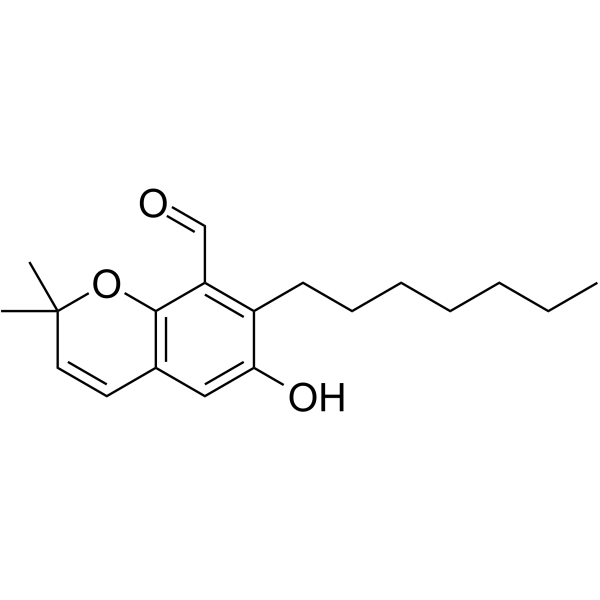
Asperglaucin B is an alkylated salicylaldehyde derivative from the fungus Aspergillus chevalieri SQ-8, with antibacterial activities. Asperglaucin B displays potent antibacterial activities against two plant pathogens Pseudomonas syringae pv actinidae (Psa) and Bacillus cereus, with an MIC value of 6.25 μM.
Para uso exclusivo en investigación. No vendemos a pacientes.
- No. CAS: 2701570-80-9
- Fòrmula: C19H26O3
- Peso molecular:302.41
-
Almacenamiento:
Please store the product under the recommended conditions in the Certificate of Analysis.

To place orders, for customer services and technical support, please contact: MedChemExpress USA
Tel: 609-228-6898 E-mail: [email protected] [email protected]


-
 Actividad biológica
-
Chemical Information
- Protocolo
- Pureza y Documentación
- Referencias
-
 Help & FAQs




Actividad biológica
Descripciòn
IC50 & Target
MIC: 6.25 μM (Pseudomonas syringae pv actinidae (Psa) and Bacillus cereus)[1]
In Vitro
The possible bacteriostatic mechanism for Asperglaucin B is to alter the external structure of B. cereus and Psa, and to cause the rupture or deformation of the cell membranes, respectively[1].
MedChemExpress (MCE) has not independently confirmed the accuracy of these methods. They are for reference only.


Chemical Information
-
No. CAS 2701570-80-9
-
Peso molecular 302.41
-
Fòrmula C19H26O3
-
SMILES
O=CC1=C(CCCCCCC)C(O)=CC2=C1OC(C)(C)C=C2
-
Structure Classification
-
Initial Source
Aspergillus chevalieri SQ-8
-
Envío
Room temperature in continental US; may vary elsewhere.
-
Almacenamiento
Please store the product under the recommended conditions in the Certificate of Analysis.


Pureza y Documentación
Referencias

Calculators
Concentration (start) × Volume (start) = Concentration (final) × Volume (final)


Asperglaucin B Related Classifications
HY-N10281 Related Classifications
 Powered by Bioz