



Seliforant

Based on 1 Customer Validation
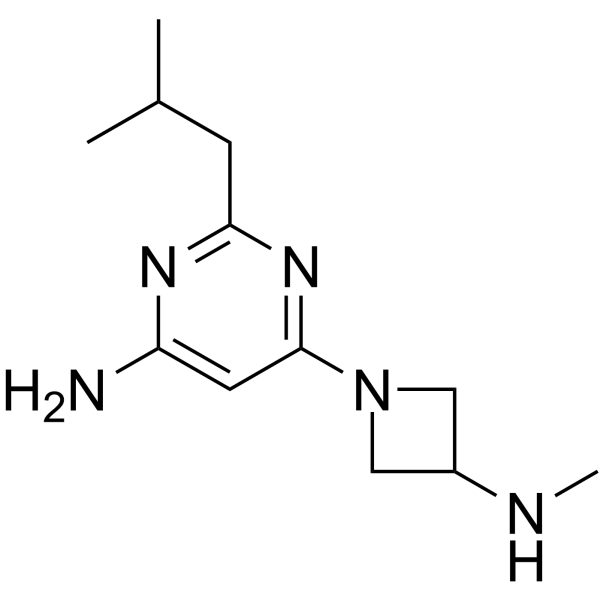
Seliforant (SENS-111) is a selective, orally active histamine H4 receptor antagonist. Seliforant inhibits the sustained activity of vestibular neurons and modulates vestibular-related responses. Seliforant reduces spontaneous nystagmus in rats with excitotoxic acute unilateral vestibular loss. Seliforant shows no sedative effect. Seliforant can be used in research related to acute unilateral vestibular loss, vestibular dysfunction, and acute unilateral vestibular lesions.
Nos produits utilisent uniquement pour la recherche. Nous ne vendons pas aux patients.
- CAS No.: 1164115-89-2
- Formule: C12H21N5
- Masse moléculaire:235.33
-
Stockage:Powder -20°C, 3 years , 4°C, 2 years ; In solvent -80°C, 6 months , -20°C, 1 month

To place orders, for customer services and technical support, please contact: MedChemExpress USA
Tel: 609-228-6898 E-mail: [email protected] [email protected]


-
 Activité biologique
-
Chemical Information
-
Solvant et solubilité
- Pureté et documentation
- Références
-
 Help & FAQs


Voir tous les produits spécifiques à Isoform Histamine Receptor
More

Activité biologique
Description
IC50 & Target
[1]|
H4 receptor |
In Vitro
Seliforant (at levels corresponding to plasma concentrations of 60-150 ng mL-1) antagonizes histamine H4 receptor activity in inner ear tissues[2].
MedChemExpress (MCE) has not independently confirmed the accuracy of these methods. They are for reference only.
In Vivo
Seliforant (SENS-111) (10 mg·kg−1; i.v.; single dose) produces a statistically significant 21% reduction in normalized spontaneous nystagmus frequency in rats with acute unilateral vestibular loss, maintains a significant 15% reduction when co-administered with methylprednisolone, but loses efficacy when co-administered with meclizine[1].
MedChemExpress (MCE) has not independently confirmed the accuracy of these methods. They are for reference only.
-
Animal Model:Long-Evans (12-week-old female, ~175-200 g, acute unilateral vestibular loss induced via two transtympanic injections of kainic acid)[1]
-
Dosage:10 mg·kg-1; 20 mg·kg-1
-
Administration:i.v.; single dose
-
Result:Reduced normalized spontaneous nystagmus frequency by a statistically significant 22% at the peak of vertigo symptoms (1 hour after baseline recording and treatment) at 10 mg·kg-1 dose, almost abolishing symptom worsening seen in vehicle controls.
Showed a non-significant 12% reduction in normalized spontaneous nystagmus frequency compared to vehicle controls at 20 mg·kg-1 dose.
Reached plasma concentrations of 112 ng·mL-1 3 hours post-administration at 10 mg·kg-1 dose.
Reached plasma concentrations of 319 ng·mL-1 3 hours post-administration at 20 mg·kg-1 dose.
-
Animal Model:Long-Evans (12-week-old female, ~175-200 g, acute unilateral vestibular loss induced via a single transtympanic injection of kainic acid)[1]
-
Dosage:10 mg·kg-1; 10 mg·kg-1 + 5.2 mg·kg-1 meclizine; 10 mg·kg-1 + 6.2 mg·kg-1 methylprednisolone
-
Administration:i.v.; single dose; i.p. (meclizine, methylprednisolone)
-
Result:Reduced normalized spontaneous nystagmus frequency by a statistically significant 21% at the peak of vertigo symptoms (1 hour after treatment) when administered alone at 10 mg·kg-1.
Lost beneficial effect when co-administered with 5.2 mg·kg-1 meclizine.
Maintained a statistically significant 15% reduction in normalized spontaneous nystagmus frequency compared to vehicle controls when co-administered with 6.2 mg·kg-1 methylprednisolone.
Caused no reported side effects in treated animals.
Essai clinique
| NCT Number | Sponsor | Condition | Start Date |
Phase

|
|---|---|---|---|---|
| NCT01329991 | Plexxikon| | 2011-05 | PHASE1 |


Chemical Information
-
CAS No. 1164115-89-2
-
Appearance Solid
-
Masse moléculaire 235.33
-
Formule C12H21N5
-
Color Off-white to light brown
-
SMILES
CNC1CN(C2=NC(CC(C)C)=NC(N)=C2)C1
-
Synonyms
SENS-111
-
Livraison
Room temperature in continental US; may vary elsewhere.
-
Stockage
Powder -20°C 3 years 4°C 2 years In solvent -80°C 6 months -20°C 1 month


Solvant et solubilité
In Vitro:
DMSO : 100 mg/mL (424.94 mM; Need ultrasonic; Hygroscopic DMSO has a significant impact on the solubility of product, please use newly opened DMSO)
Please refer to the solubility information to select the appropriate solvent. Once prepared, please aliquot and store the solution to prevent product inactivation from repeated freeze-thaw cycles.
Storage method and period of stock solution: -80°C, 6 months; -20°C, 1 month. When stored at -80°C, please use it within 6 months. When stored at -20°C, please use it within 1 month.
Please refer to the solubility information to select the appropriate solvent. Once prepared, please aliquot and store the solution to prevent product inactivation from repeated freeze-thaw cycles.
Storage method and period of stock solution: -80°C, 6 months; -20°C, 1 month. When stored at -80°C, please use it within 6 months. When stored at -20°C, please use it within 1 month.
Concentration (start) × Volume (start) = Concentration (final) × Volume (final)
In Vivo:
Select the appropriate dissolution method based on your experimental animal and administration route.
- For the following dissolution methods, please ensure to first prepare a clear stock solution using an In Vitro approach and then sequentially add co-solvents:
- To ensure reliable experimental results, the clarified stock solution can be appropriately stored based on storage conditions. As for the working solution for In Vivo experiments, it is recommended to prepare freshly and use it on the same day.
- The percentages shown for the solvents indicate their volumetric ratio in the final prepared solution. If precipitation or phase separation occurs during preparation, heat and/or sonication can be used to aid dissolution.
Add each solvent one by one: 10% DMSO 40% PEG300 5% Tween-80 45% Saline
Solubility: ≥ 2.5 mg/mL (10.62 mM); Clear solution
This protocol yields a clear solution of ≥ 2.5 mg/mL (saturation unknown).
Taking 1 mL working solution as an example, add 100 μL DMSO stock solution (25.0 mg/mL) to 400 μL PEG300, and mix evenly; then add 50 μL Tween-80 and mix evenly; then add 450 μL Saline to adjust the volume to 1 mL.
Preparation of Saline: Dissolve 0.9 g sodium chloride in ddH₂O and dilute to 100 mL to obtain a clear Saline solution.
Add each solvent one by one: 10% DMSO 90% (20% SBE-β-CD in Saline)
Solubility: ≥ 2.5 mg/mL (10.62 mM); Clear solution
This protocol yields a clear solution of ≥ 2.5 mg/mL (saturation unknown).
Taking 1 mL working solution as an example, add 100 μL DMSO stock solution (25.0 mg/mL) to 900 μL 20% SBE-β-CD in Saline, and mix evenly.
Preparation of 20% SBE-β-CD in Saline (4°C, storage for one week): 2 g SBE-β-CD powder is dissolved in 10 mL Saline, completely dissolve until clear.
In Vivo Dissolution Calculator
Please enter the basic information of animal experiments:
-
-
-
-
Recommended: Prepare an additional quantity of animals to account for potential losses during experiments.
Please enter your animal formula composition:
-
%DMSO +
Recommended: Keep the proportion of DMSO in working solution below 2% if your animal is weak.
-
%+
-
+%Tween-80 + +
-
%Saline +
The co-solvents required include: DMSO, . All of co-solvents are available by MedChemExpress (MCE). , Tween 80. All of co-solvents are available by MedChemExpress (MCE).
Working solution concentration: 0.22 mg/mL
Method for preparing stock solution: mg drug dissolved in μL DMSO. Stock solution concentration: mg/mL.
1. Take μL DMSO stock solution;
2. Add μL .
μL , mix evenly;
3. Then add μL Tween 80, mix evenly;
4. Then add μL
Please ensure that the stock solution in the first step is dissolved to a clear state, and add co-solvents in sequence. You can use ultrasonic heating (ultrasonic cleaner, recommended frequency 20-40 kHz), vortexing, etc. to assist dissolution.


Pureté et documentation
-
Fiche technique (276 KB)
-
SDS (254 KB)
- English - EN (254 KB)
- Français - FR (254 KB)
- Deutsch - DE (254 KB)
- Norwegian - NO (254 KB)
- Español - ES (254 KB)
- Swedish - SV (254 KB)
- Italian - IT (254 KB)
- Korean - KR (254 KB)
- Portuguese - PT (254 KB)
-
Instruction de manipulation (2659 KB)
Références
[1]. Petremann M, et al. Effect of the novel histamine H4 receptor antagonist SENS-111 on spontaneous nystagmus in a rat model of acute unilateral vestibular loss. Br J Pharmacol. 2020;177(3):623-633. [Content Brief]
[2]. Venail F, et al. Safety, tolerability, pharmacokinetics and pharmacokinetic-pharmacodynamic modelling of the novel H4 receptor inhibitor SENS-111 using a modified caloric test in healthy subjects. Br J Clin Pharmacol. 2018;84(12):2836-2848. [Content Brief]


Complete Stock Solution Preparation Table
Please refer to the solubility information to select the appropriate solvent. Once prepared, please aliquot and store the solution to prevent product inactivation from repeated freeze-thaw cycles.
Storage method and period of stock solution: -80°C, 6 months; -20°C, 1 month. When stored at -80°C, please use it within 6 months. When stored at -20°C, please use it within 1 month.
| Optional Solvent | Concentration Solvent Mass | 1 mg | 5 mg | 10 mg | 25 mg |
|---|---|---|---|---|---|
| DMSO | 1 mM | 4.2494 mL | 21.2468 mL | 42.4935 mL | 106.2338 mL |
| 5 mM | 0.8499 mL | 4.2494 mL | 8.4987 mL | 21.2468 mL | |
| 10 mM | 0.4249 mL | 2.1247 mL | 4.2494 mL | 10.6234 mL | |
| 15 mM | 0.2833 mL | 1.4165 mL | 2.8329 mL | 7.0823 mL | |
| 20 mM | 0.2125 mL | 1.0623 mL | 2.1247 mL | 5.3117 mL | |
| 25 mM | 0.1700 mL | 0.8499 mL | 1.6997 mL | 4.2494 mL | |
| 30 mM | 0.1416 mL | 0.7082 mL | 1.4165 mL | 3.5411 mL | |
| 40 mM | 0.1062 mL | 0.5312 mL | 1.0623 mL | 2.6558 mL | |
| 50 mM | 0.0850 mL | 0.4249 mL | 0.8499 mL | 2.1247 mL | |
| 60 mM | 0.0708 mL | 0.3541 mL | 0.7082 mL | 1.7706 mL | |
| 80 mM | 0.0531 mL | 0.2656 mL | 0.5312 mL | 1.3279 mL | |
| 100 mM | 0.0425 mL | 0.2125 mL | 0.4249 mL | 1.0623 mL |


Seliforant Related Classifications
HY-109074 Related Classifications
 Powered by Bioz