



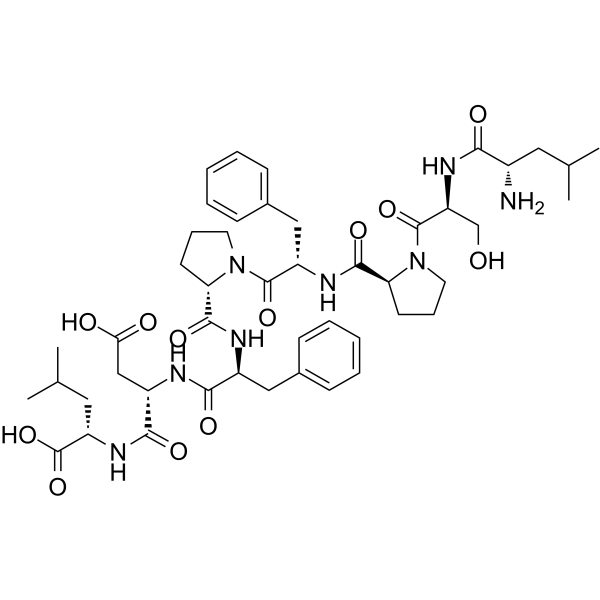
p2Ca
p2Ca, an 8-mer peptide, is a ligand that is naturally processed and presented to the Ld-alloreactive T cell clone, 2C.
Para uso exclusivo en investigación. No vendemos a pacientes.
- No. CAS: 142606-55-1
- Fòrmula: C47H66N8O12
- Peso molecular:935.07
-
Almacenamiento:
Please store the product under the recommended conditions in the Certificate of Analysis.

To place orders, for customer services and technical support, please contact: MedChemExpress USA
Tel: 609-228-6898 E-mail: [email protected] [email protected]


-
 Actividad biológica
-
Chemical Information
-
Solvente y solubilidad
- Protocolo
- Pureza y Documentación
- Referencias
-
 Help & FAQs




Actividad biológica
Descripciòn
In Vitro
p2Ca and QL9 peptides assume distinct conformations when bind to Ld and, furthermore, demonstrate that there is flexibility in peptide binding within the MHC class I cleft. Ld antigenic peptide p2Ca (LSPFPFDL) is 8-mer that lack the proline at position 2 and thus use alternative amino-terminal anchors. The p2Ca octamer is identified as the ligand that is naturally processed and presented to the Ld-alloreactive T cell clone, 2C[1]. p2Ca, is immunodominant in allorecognition of the murine MHC class I molecule H-2Ld. The majority of Ld-alloreactive T-cell clones are specific for Ld-p2Ca and this immunodominance is not due to peptide cross-reactivity[2]. p2Ca is a ubiquitously expressed self-peptide. p2Ca is derived from the mouse mitochondrial enzyme α-ketoglutarate dehydrogenase. p2Ca is present in every tissue of BALB/c mice that has been examined, including the spleen and thymus. It is also expressed by mouse tumor cell lines such as the mastocytoma P815. CTL derived in vitro recognize specifically the p2Ca/L d complex and use Vβ8 regions predominantly. The cultured cells lyse target cells with lower levels of p2Ca than the levels used for induction. This result suggests that it may be possible to use peptides at high concentrations to elicit CTL that react with endogenous levels of a peptide/class I complex[3].
MedChemExpress (MCE) has not independently confirmed the accuracy of these methods. They are for reference only.
In Vivo
MedChemExpress (MCE) has not independently confirmed the accuracy of these methods. They are for reference only.


Chemical Information
-
No. CAS 142606-55-1
-
Peso molecular 935.07
-
Fòrmula C47H66N8O12
-
Sequence
Leu-Ser-Pro-Phe-Pro-Phe-Asp-Leu
-
Sequence Shortening
LSPFPFDL
-
Structure Classification
-
Initial Source
tissues of H-2d mice
-
Envío
Room temperature in continental US; may vary elsewhere.
-
Almacenamiento
Please store the product under the recommended conditions in the Certificate of Analysis.


Solvente y solubilidad
In Vitro
H2O
Peptide Solubility and Storage Guidelines:
1. Calculate the length of the peptide.
2. Calculate the overall charge of the entire peptide according to the following table:
| Contents | Assign value | |
|---|---|---|
| Acidic amino acid | Asp (D), Glu (E), and the C-terminal -COOH. | -1 |
| Basic amino acid | Arg (R), Lys (K), His (H), and the N-terminal -NH2 | +1 |
| Neutral amino acid | Gly (G), Ala (A), Leu (L), Ile (I), Val (V), Cys (C), Met (M), Thr (T), Ser (S), Phe (F), Tyr (Y), Trp (W), Pro (P), Asn (N), Gln (Q) | 0 |
3. Recommended solution:
| Overall charge of peptide | Details |
|---|---|
| Negative (<0) |
1. Try to dissolve the peptide in water first. 2. If water fails, add NH4OH (<50 μL). 3. If the peptide still does not dissolve, add DMSO (50-100 μL) to solubilize the peptide. |
| Positive (>0) |
1. Try to dissolve the peptide in water first. 2. If water fails, try dissolving the peptide in a 10%-30% acetic acid solution. 3. If the peptide still does not dissolve, try dissolving the peptide in a small amount of DMSO. |
| Zero (=0) |
1. Try to dissolve the peptide in organic solvent (acetonitrile, methanol, etc.) first. 2. For very hydrophobic peptides, try dissolving the peptide in a small amount of DMSO, and then dilute the solution with water to the desired concentration. |


Pureza y Documentación
Referencias
[1]. Hornell TM, et al. Peptide length variants p2Ca and QL9 present distinct conformations to L(d)-specific T cells. J Immunol. 2001 Oct 15;167(8):4207-14. [Content Brief]
[2]. Connolly JM, et al. The peptide p2Ca is immunodominant in allorecognition of Ld by beta chain variable region V beta 8+ but not V beta 8- strains. Proc Natl Acad Sci U S A. 1994 Nov 22;91(24):11482-6. [Content Brief]
[3]. Tjoa BA, et al. Generation of cytotoxic T-lymphocytes to a self-peptide/class I complex: a model for peptide-mediated tumor rejection. Cancer Res. 1994 Jan 1;54(1):204-8. [Content Brief]

Calculators
Concentration (start) × Volume (start) = Concentration (final) × Volume (final)


p2Ca Related Classifications
HY-P0260 Related Classifications
 Powered by Bioz