
8 Results for "

paradoxical

" in MedChemExpress (MCE) Product Catalog:
Products (8)

8 Results for "paradoxical" in MCE Product Catalog:

44
44 Cited Publications
Referencia número: HY-16966
No. CAS: 1884220-36-3
Target:  

ULK AMPK Autophagy Apoptosis

Áreas de investigación:  

Cancer

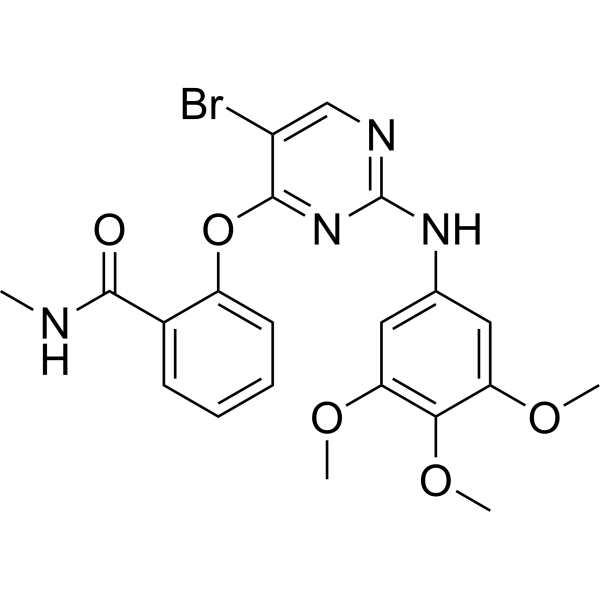
SBI-0206965 is a potent, selective and cell permeable autophagy kinase ULK1 inhibitor with IC50s of 108 nM for ULK1 kinase and 711 nM for the highly related kinase ULK2. SBI-0206965 is also an AMPK inhibitor that can paradoxically increase Thr172 phosphorylation .
loading...
    loading...
4
4 Cited Publications
Referencia número: HY-N2609
No. CAS: 2196-14-7
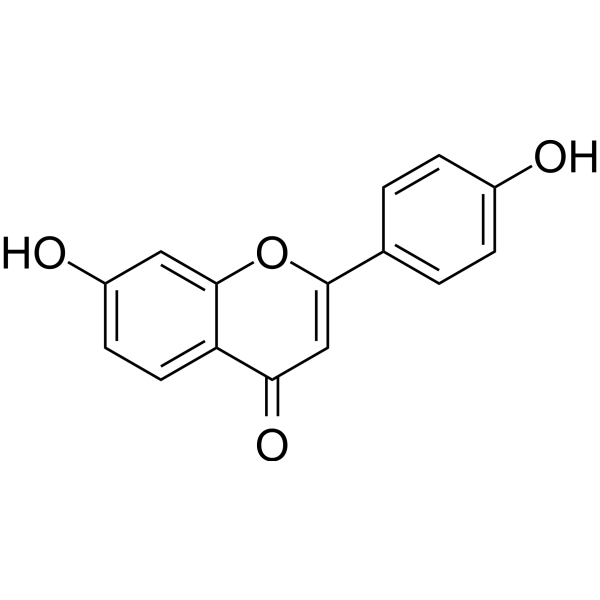
7,4'-Dihydroxyflavone (7,4'-DHF) is a flavonoid, which can be isolated from Glycyrrhiza uralensis. 7,4'-Dihydroxyflavone is eotaxin/CCL11 inhibitor and CBR1 inhibitor (IC50=0.28 μM). 7,4'-Dihydroxyflavone has the ability to consistently suppress eotaxin production and prevent dexamethasone (Dex)‐paradoxical adverse effects on eotaxin production . 7,4'-Dihydroxyflavone (7,4'-DHF) inhibits MUC5AC gene expression, mucus production and secretion via regulation of NF-κB, STAT6 and HDAC2.7,4'-Dihydroxyflavone (7,4'-DHF) decreases phorbol 12-myristate 13-acetate (PMA) stimulated NCI-H292 human airway epithelial cell MUC5AC gene expression and mucus production with IC50 value of 1.4 µM .
loading...
    loading...
Referencia número: HY-158790
No. CAS: 2771208-83-2
Pureza:  99.29%
Target:  

Ferroptosis

Áreas de investigación:  

Cancer

(R)-HTS-3 is an lysophosphatidylcholine acyltransferase 3 (LPCAT3) inhibitor, with an IC50 of 0.09 μM. (R)-HTS-3 suppresses the C20:4 content of PE, PC, and PS, while promoting a correspondingelevation in C22:4 phospholipids and a paradoxical increase in C20:4 phosphatidylinositol (PI) lipids .
loading...
    loading...
Referencia número: HY-P4816
No. CAS: 388602-02-6
Target:  

Bacterial Fungal

Áreas de investigación:  

Infection Inflammation/Immunology

Pseudin-2, an AMP thast could be isolated from the skin of the South American paradoxical frog Pseudis paradoxa, exert a potent growth inhibitory effect against Gram-negative bacteria .
loading...
    loading...
Referencia número: HY-N2609R
No. CAS: 2196-14-7
7,4'-Dihydroxyflavone (7,4'-DHF) is a flavonoid, which can be isolated from Glycyrrhiza uralensis. 7,4'-Dihydroxyflavone is eotaxin/CCL11 inhibitor and CBR1 inhibitor (IC50=0.28 μM). 7,4'-Dihydroxyflavone has the ability to consistently suppress eotaxin production and prevent dexamethasone (Dex)‐paradoxical adverse effects on eotaxin production . 7,4'-Dihydroxyflavone (7,4'-DHF) inhibits MUC5AC gene expression, mucus production and secretion via regulation of NF-κB, STAT6 and HDAC2.7,4'-Dihydroxyflavone (7,4'-DHF) decreases phorbol 12-myristate 13-acetate (PMA) stimulated NCI-H292 human airway epithelial cell MUC5AC gene expression and mucus production with IC50 value of 1.4 µM .
loading...
    loading...
Referencia número: HY-18596
No. CAS: 162100-15-4
Target:  

5-HT Receptor

Áreas de investigación:  

Neurological Disease

SB-215505 is an orally active and subtype-selective 5-HT2B receptor antagonist with pKi values of 8.3, 6.77, 7.66 for 5-HT2B, 5-HT2A, 5-HT2C, respectively . SB-215505 increases wakefulness and motor activity in rats .
loading...
    loading...
Referencia número: HY-182940
Áreas de investigación:  

Neurological Disease

SARM1-IN-10 is an orally active SARM1 inhibitor with a pIC50 of 7.1 and a pKd of 8.3. As a base-exchange inhibitor, SARM1-IN-10 forms a NAD + adduct at the active site of the TIR domain of SARM1, blocks enzymatic function, and induces a unique rotameric state of W662 at the catalytic site of SARM1. SARM1-IN-10 acts as a paradoxical neurodegeneration inducer at low doses and an inhibitor at high doses, and it can exacerbate or protect against SARM1-mediated neurodegeneration depending on concentration. SARM1-IN-10 can be used in studies of peripheral neurodegeneration .
loading...
    loading...
Referencia número: HY-W747508
No. CAS: 58814-86-1
Target:  

Fungal Antibiotic

Áreas de investigación:  

Infection

Aculeacin A is a β-1,3-glucan synthase inhibitor. Aculeacin A is an antifungal antibiotic. Aculeacin A inhibits cell wall glucan synthesis in growing yeast cells, induces cell lysis, osmotic fragility, cell aggregation and abnormal cell morphology, without affecting the synthesis of proteins, nucleic acids or mannan. Aculeacin A acts only on growing yeast cells and has a narrow antifungal spectrum, mainly targeting Candida and Torulopsis species. Aculeacin A shows reduced activity in human serum and exhibits a paradoxical dose-response pattern. Aculeacin A has an inoculum effect against some Candida albicans strains, and its activity is pH-stable. Aculeacin A can be used in studies of fungal infections, such as those caused by Candida, Torulopsis and other species .
loading...
    loading...

