



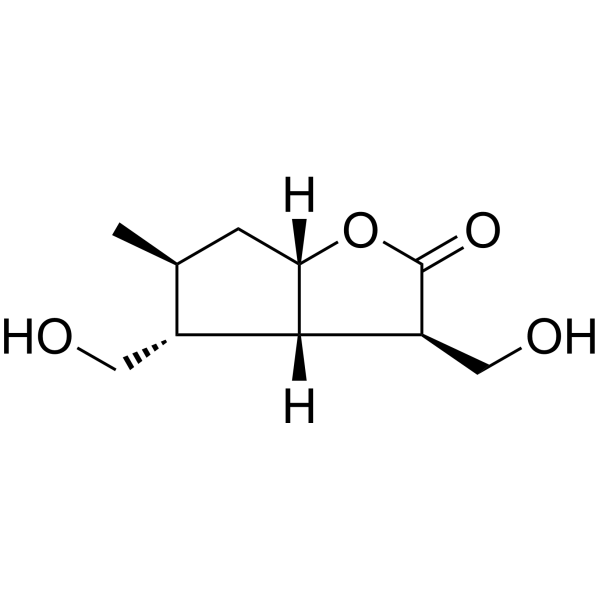
Gelsemiol
Gelsemiol is the main active ingredient in Verbena littoralis H. B. K.. Gelsemiol enhanced nerve growth factor (NGF) -induced axonal elongation in PC12D cells.
Nur für Forschungszwecke. Wir verkaufen nicht an Patienten.
- CAS. Nr.: 110414-77-2
- Formel: C10H16O4
- Molecular Weight:200.23
-
Speicherung:
Please store the product under the recommended conditions in the Certificate of Analysis.

To place orders, for customer services and technical support, please contact: MedChemExpress USA
Tel: 609-228-6898 E-mail: [email protected] [email protected]


-
 Biologische Aktivität
-
Chemical Information
- Protokoll
- Reinheit & Dokumentation
- Verweise
-
 Help & FAQs




Biologische Aktivität
Beschreibung
In Vitro
Gelsemiol (30-300μM; 48 h) has no neuritis-inducing activity in PC12D cells[1].
Gelsemiol (30-300μM; 48 h), together with NGF (2 ng/mL), significantly enhances the proportion of axon-carrying cells increased and axon length lengthened in PC12D cells[1].
MedChemExpress (MCE) has not independently confirmed the accuracy of these methods. They are for reference only.


Chemical Information
-
CAS. Nr. 110414-77-2
-
Molecular Weight 200.23
-
Formel C10H16O4
-
SMILES
OC[C@H]1[C@@]2([H])[C@@](C[C@H](C)[C@H]2CO)([H])OC1=O
-
Structure Classification
-
Versand
Room temperature in continental US; may vary elsewhere.
-
Speicherung
Please store the product under the recommended conditions in the Certificate of Analysis.


Reinheit & Dokumentation
Verweise

Calculators
Konzentration (Stammlösung) × Volumen (Stammlösung) = Konzentration (Ziellösung) × Volumen (Ziellösung)


Gelsemiol Related Classifications
HY-N3938 Related Classifications
 Powered by Bioz