



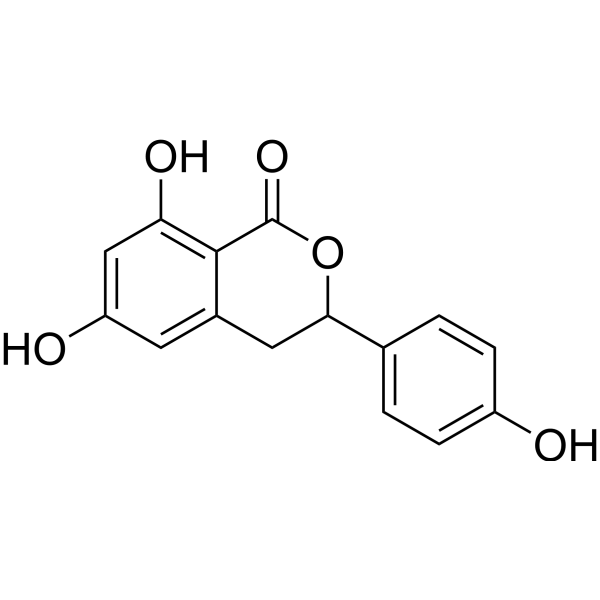
Thunberginol C
Thunberginol C is an orally active, selective, and non-competitive inhibitor of AChE and BChE, with IC50 values of 41.96 and 42.36 μM, respectively. Thunberginol C exerts cytoprotective, pro-collagen type I restorative, MMP-1 inhibitory, hyaluronic acid restorative, anti-photoaging effects in skin cells. Thunberginol C exerts neuroprotective, anxiolytic, TNF-α inhibitory, neuroinflammation inhibitory, and oxidative stress inhibitory effects. Thunberginol C can be used for the research of Alzheimer’s disease, UVB-induced skin photoaging, allergic reactions, oral bacterial infections, and stress-induced anxiety.
For research use only. We do not sell to patients.
- CAS No.: 147517-06-4
- Formula: C15H12O5
- Molecular Weight:272.25
-
Storage:
Please store the product under the recommended conditions in the Certificate of Analysis.

To place orders, for customer services and technical support, please contact: MedChemExpress USA
Tel: 609-228-6898 E-mail: [email protected] [email protected]


-
 Biological Activity
-
Chemical Information
- Purity & Documentation
- References
-
 Help & FAQs




Biological Activity
|
AChE 41.96 μM (IC50) |
BChE 42.36 μM (IC50) |
MMP-1 |
Thunberginol C non-competitively inhibits acetylcholinesterase (AChE) with an IC50 of 41.96 μM and a Ki of 45.6 μM via van der Waals interactions at the enzyme's peripheral anionic site[1].
Thunberginol C non-competitively inhibits butyrylcholinesterase (BChE) with an IC50 of 42.36 μM and a Ki of 49.2 μM via a hydrogen bond and hydrophobic interactions at the enzyme's peripheral anionic site[1].
Thunberginol C (1 μM; 24 h) significantly increases cell viability, type I procollagen and hyaluronic acid production and inhibits MMP-1 production in UVB-irradiated Hs68 human foreskin fibroblast[2].
Thunberginol C (10 ppm) inhibits the growth of Bacteroides melaninogenicus and Fusobacterium nucleatum oral bacteria, with an MIC of 10 ppm for both species[3].
Thunberginol C inhibits antigen-induced contraction of tracheal chain isolated from sensitized guinea pig, while showing little inhibition for histamine-induced contraction[3].
Thunberginol C (1-30 μM; 24 h) protects primary cortical neurons against Corticosterone (HY-B1618)-induced cell death[4].
MedChemExpress (MCE) has not independently confirmed the accuracy of these methods. They are for reference only.
-
Cell Line:UVB-irradiated Hs68 human foreskin fibroblasts
-
Concentration:1 μM
-
Incubation Time:24 h
-
Result:Restored type I procollagen production to 76.80% of non-irradiated control levels from UVB-induced 63.38%.\nReduced UVB-induced MMP-1 production to 108.97% of non-irradiated control levels from 396.10%.\n
Increased hyaluronic acid production to 80.54% of non-irradiated control levels from UVB-induced 58.29%, with no statistical significance.
-
Cell Line:Neuronal cells
-
Concentration:1; 3; 10; 30 μM
-
Incubation Time:24 h
-
Result:Protected primary cortical neurons against Corticosterone-induced cell death.
MedChemExpress (MCE) has not independently confirmed the accuracy of these methods. They are for reference only.
-
Animal Model:Male CD-1 mice (chronic restraint stress model)[4]
-
Dosage:2; 20 mg/kg
-
Administration:p.o.; daily; 14 days
-
Result:Significantly improved the restraint stress-induced decrease in percentage of time spent in open arms and percentage of open arm entries, without affecting total arm entries at both 2 mg/kg and 20 mg/kg.
Significantly inhibited the restraint stress-induced increase in plasma TNF-α concentration at 20 mg/kg, but did not affect plasma corticosterone concentration.
Dose-dependently reduced the restraint stress-induced increase in Iba-1-labeled area in the hippocampus at both 2 mg/kg and 20 mg/kg.
Significantly reduced the restraint stress-induced increase in hippocampal TBARS levels, and significantly increased the activities of hippocampal superoxide dismutase, glutathione peroxidase, and glutathione reductase that were decreased by restraint stress at 20 mg/kg.


Chemical Information
-
CAS No. 147517-06-4
-
Molecular Weight 272.25
-
Formula C15H12O5
-
SMILES
O=C1C2=C(O)C=C(O)C=C2CC(C3=CC=C(O)C=C3)O1
-
Structure Classification
-
Initial Source
-
Shipping
Room temperature in continental US; may vary elsewhere.
-
Storage
Please store the product under the recommended conditions in the Certificate of Analysis.


Purity & Documentation
References
[1]. Hwang J, et al. Discovery of Natural Inhibitors of Cholinesterases from Hydrangea: In Vitro and In Silico Approaches. Nutrients. 2021 Jan 17;13(1):254. [Content Brief]
[2]. Shin JS, et al. Chemical Constituents from Leaves of Hydrangea serrata and Their Anti-photoaging Effects on UVB-Irradiated Human Fibroblasts. Biol Pharm Bull. 2019;42(3):424-431. [Content Brief]
[4]. Lee J, et al. Hydrangea macrophylla and Thunberginol C Attenuate Stress-Induced Anxiety in Mice. Antioxidants (Basel). 2022 Jan 26;11(2):234. [Content Brief]
[5]. Şahin H, et al. Two new phenolic compounds and some biological activities of Scorzonera pygmaea Sibth. & Sm. subaerial parts. Nat Prod Res. 2020 Mar;34(5):621-628. [Content Brief]

Calculators
Concentration (start) × Volume (start) = Concentration (final) × Volume (final)


Thunberginol C Related Classifications
HY-N1151 Related Classifications
 Powered by Bioz
- Thunberginol C
- 147517-06-4
- Bacterial
- Cholinesterase (ChE)
- MMP
- TNF Receptor
- Bacteroides melaninogenicus
- peripheral anionic site
- UVB-induced skin photoaging
- Alzheimer’s disease
- CD-1 mice
- Hs68 human foreskin fibroblasts
- Fusobacterium nucleatum
- butyrylcholinesterase
- primary cortical neurons
- acetylcholinesterase
- Inhibitor
- inhibitor
- inhibit