



INF7TAT-P55 acetate

Based on 1 Customer Validation
INF7TAT-P55 acetate (P55 acetate) is a polypeptide derived from INF7TAT (HY-P11000) with G1K, G20L and Y22N mutations. INF7TAT-P55 acetate serves as a delivery carrier to deliver preassembled CRISPR ribonucleases into cells for genome editing.
For research use only. We do not sell to patients.
- Purity : 98.14%
- Formula: C182H282N56O48S·xC2H4O2
- Molecular Weight:4054.60 (free base)
-
Storage:
Sealed storage, away from moisture.
Powder -80°C, 2 years , -20°C, 1 year* In solvent : -80°C, 6 months; -20°C, 1 month (sealed storage, away from moisture)


To place orders, for customer services and technical support, please contact: MedChemExpress USA
Tel: 609-228-6898 E-mail: [email protected] [email protected]


-
 Biological Activity
-
Chemical Information
-
Solvent & Solubility
- Protocols
- Purity & Documentation
- References
-
 Help & FAQs




Biological Activity
Description
In Vitro
INF7TAT-P55 (peptide/RNP molar ratio 10:1; 1 h) acetate enables efficient, gentle peptide-mediated CRISPR RNP delivery with improved editing rates in primary human CD34+ HSPCs and high edited cell yields in primary human T cells, supporting multiple genome editing applications while preserving cell health[1].
MedChemExpress (MCE) has not independently confirmed the accuracy of these methods. They are for reference only. Further protocols information, click here.


Chemical Information
-
Appearance Solid
-
Molecular Weight 4054.60 (free base)
-
Formula C182H282N56O48S·xC2H4O2
-
Color White to off-white
-
Synonyms
P55 acetate
-
Sequence
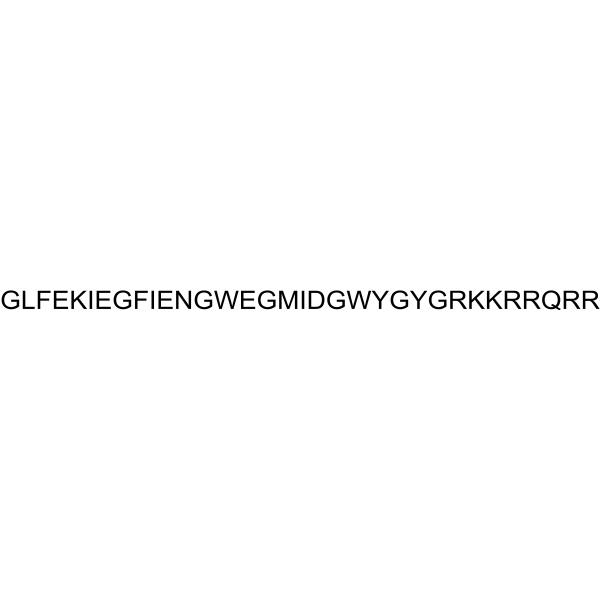
Lys-Leu-Phe-Glu-Ala-Ile-Glu-Gly-Phe-Ile-Glu-Asn-Gly-Trp-Glu-Gly-Met-Ile-Asp-Leu-Trp-Asn-Gly-Tyr-Gly-Arg-Lys-Lys-Arg-Arg-Gln-Arg-Arg
-
Sequence Shortening
KLFEAIEGFIENGWEGMIDLWNGYGRKKRRQRR
-
Shipping
Room temperature in continental US; may vary elsewhere.
-
Storage
Sealed storage, away from moisture
Powder -80°C 2 years -20°C 1 year * In solvent : -80°C, 6 months; -20°C, 1 month (sealed storage, away from moisture)


Solvent & Solubility
In Vitro:
H2O : 2 mg/mL (Need ultrasonic)

Protocols
-
Gene Editing
Gene editing modify specific sites within the genome through gene deletions, insertions or conversions to study functionally unknown genes or conduct gene therapy. It is also used to change the biological traits of organisms to establish new varieties. Gene editing techniques include zinc finger nuclease (ZFN), transcription activator-like effector nuclease (TALEN), and clustered regularly interspaced short palindromic repeats (CRISPR)/CRISPR-associated protein 9 (Cas 9) (CRISPR/Cas9).
-
CRISPR-Cas9 knockout in cultured mammalian cells
CRISPR-Cas9 knockout in cultured mammalian cells uses an sgRNA to direct Cas9 to a complementary genomic sequence adjacent to a compatible PAM; Cas9 creates a targeted DNA double-strand break, and repair by non-homologous end joining can introduce insertions or deletions that disrupt the coding sequence or functional genomic element. The readout of knockout is detection of edited alleles and loss of gene product or phenotype, commonly by PCR/Sanger-sequence trace decomposition, targeted sequencing, immunoblotting, immunostaining, or flow cytometry when the target protein is detectable at the cell surface.
-
CRISPR/Cas9 Knockout Animal Model
CRISPR/Cas9 knockout animal modeling uses guide RNA to direct Cas9 to a genomic target, where Cas9 creates a DNA double-strand break; repair by error-prone non-homologous end joining generates insertions or deletions that can disrupt coding sequence and produce knockout alleles. Classic animal-model workflows deliver Cas9 mRNA or Cas9 protein with sgRNA into fertilized zygotes by microinjection or electroporation, then transfer edited embryos into pseudopregnant recipients and genotype founders for target-site mutations.


Purity & Documentation
-
Data Sheet (279 KB)
-
SDS (254 KB)
- English - EN (254 KB)
- Français - FR (254 KB)
- Deutsch - DE (254 KB)
- Norwegian - NO (254 KB)
- Español - ES (254 KB)
- Swedish - SV (254 KB)
- Italian - IT (254 KB)
- Korean - KR (254 KB)
- Portuguese - PT (254 KB)
-
Handling Instructions (2659 KB)
References

Calculators
Concentration (start) × Volume (start) = Concentration (final) × Volume (final)


INF7TAT-P55 acetate Related Classifications
HY-P10999A Related Classifications
 Powered by Bioz