



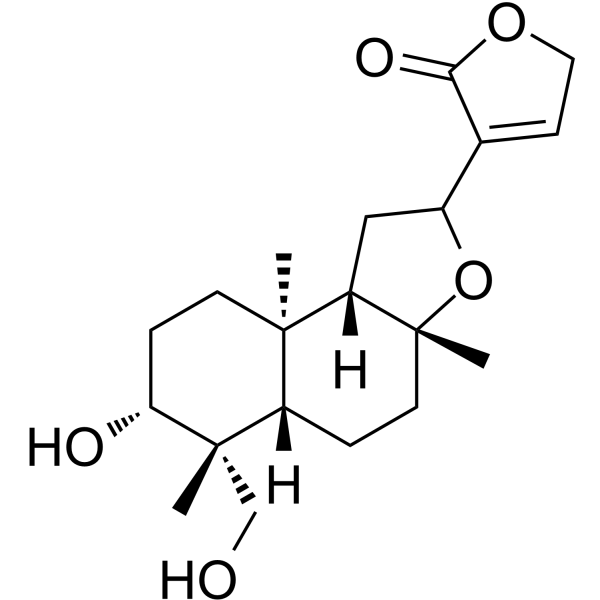
Isoandrographolide

Based on 1 Customer Validation
Isoandrographolide is an orally active NLRP3 inflammasome inhibitor and AKT/GSK-3β/β-catenin pathway inhibitor. Isoandrographolide inhibits the expression of NLRP3, ASC, and caspase-1, and reduces the levels of phosphorylated AKT, phosphorylated GSK-3β, and β-catenin. Isoandrographolide alleviates inflammatory responses, reduces collagen deposition, suppresses epithelial-mesenchymal transition (EMT), induces differentiation of leukemia cells, inhibits the growth of leukemia cells, protects lung and kidney tissues, regulates cytokine levels, and also exhibits hepatoprotective effects. Isoandrographolide can be used in studies related to silicosis, murine myeloid leukemia, renal tubulointerstitial fibrosis, and non-alcoholic fatty liver disease.
For research use only. We do not sell to patients.
- Purity : 98.34%
- CAS No.: 4176-96-9
- Formula: C20H30O5
- Molecular Weight:350.45
-
Storage:Powder -20°C, 3 years ; In solvent -80°C, 6 months , -20°C, 1 month

To place orders, for customer services and technical support, please contact: MedChemExpress USA
Tel: 609-228-6898 E-mail: [email protected] [email protected]


-
 Biological Activity
-
Chemical Information
-
Solvent & Solubility
- Protocols
- Purity & Documentation
- References
-
 Help & FAQs


All Caspase Isoforms
More

Biological Activity
Description
|
NLRP3 |
Caspase-1 |
Akt |
GSK-3β |
In Vitro
Isoandrographolide (0.1-100 μM; 48 h) exhibits no significant cytotoxicity to A549 cells[1].
Isoandrographolide (0.15-0.6 μM; 24 h) dose-dependently suppresses silica + LPS-induced migratory capacity of A549 cells[1].
Isoandrographolide (0.15-0.6 μM; 24 h) dose-dependently downregulates silica + LPS-induced elevations in α-SMA, Col-III, FN, NLRP3, ASC and caspase-1 protein expression as well as IL-6, IL-1β and TGF-β1 mRNA expression in A549 cells[1].
Isoandrographolide (5-50 μM; 48 h) potently induces phagocytosis and inhibits growth of mouse myeloid leukemia (M1) cells[2].
Isoandrographolide binds to PPARα with a binding energy of -8.52 kcal/mol and an inhibition constant of 0.566 μM, demonstrating strong interaction with the target protein[4].
Isoandrographolide (100-500 μM; 24 h) reduces HepG2 cell viability in a concentration-dependent manner, with a GI25 of 878.18 μM[4].
Isoandrographolide (12.5-50 μM; 24 h) reduces lipid accumulation, triglyceride levels, LDH leakage, and transaminase levels in PO-BSA induced steatotic HepG2 cells in a concentration-dependent manner[4].
MedChemExpress (MCE) has not independently confirmed the accuracy of these methods. They are for reference only.
-
Cell Line:human alveolar epithelial A549 cells
-
Concentration:0.1 0.3, 1, 3, 10, 30, 100 μM
-
Incubation Time:48 h
-
Result:Showed no significant cytotoxicity at any tested concentration, including the highest dose of 100 μM, with cell viability remaining near 100% across all concentrations.
-
Cell Line:silica + LPS-induced human alveolar epithelial A549 cells
-
Concentration:0.15, 0.3, 0.6 μM
-
Incubation Time:24 h
-
Result:Dose-dependently inhibited silica + LPS-induced increases in A549 cell migratory capacity.
Significantly reduced relative mobility compared to the silica + LPS group.
Showed a more potent inhibitory effect than the same dose of Andrographolide (HY-N0191) at 0.6 μM.
-
Cell Line:silica + LPS-induced human alveolar epithelial A549 cells
-
Concentration:0.15, 0.3, 0.6 μM
-
Incubation Time:24 h
-
Result:Reduced silica + LPS-induced upregulation of α-SMA, Col-III and FN in a dose-dependent manner, and exerted stronger inhibitory effects than 0.6 μM andrographolide.
Inhibited silica + LPS-induced increases in NLRP3, ASC and caspase-1 expression dose-dependently, and exhibited more potent activity than 0.6 μM andrographolide.
-
Cell Line:silica + LPS-induced human alveolar epithelial A549 cells
-
Concentration:0.15, 0.3, 0.6 μM
-
Incubation Time:24 h
-
Result:Dose-dependently reduced silica + LPS-induced elevated mRNA levels of IL-6, IL-1β, and TGF-β1.
Significantly decreased the relative mRNA expression of these cytokines compared to the silica + LPS group.
Showed a more potent inhibitory effect than 0.6 μM andrographolide.
-
Cell Line:HepG2 cells
-
Concentration:100, 200, 300, 400, 500 μM
-
Incubation Time:24 h
-
Result:Reduced cell viability to 95.32% (100 μM), 91.91% (200 μM), 85.85% (300 μM), 80.59% (400 μM) and 68.76% (500 μM), with 300-500 μM showing significant decreases versus control; the GI25 value was 878.18 μM.
In Vivo
Isoandrographolide (25-100 mg/kg; i.g.; daily; 7 days) dose-dependently ameliorates tubulointerstitial fibrosis in UUO-induced mice[3].
Isoandrographolide (25 mg/kg; p.o.; daily; 28 days) reduces plasma hepatotoxicity marker enzyme levels (ALT, AST) in HFD-fed rats with NAFLD[4].
MedChemExpress (MCE) has not independently confirmed the accuracy of these methods. They are for reference only.
-
Animal Model:Kunming (KM) (male, 6-8 weeks old, 25 g)[1]
-
Dosage:25 mg/kg; 50 mg/kg
-
Administration:i.g.; daily; 28 days
-
Result:Significantly reduced silica-induced lung index and partially reversed body weight loss, and ameliorated lung morphological injury at 50 mg/kg.
Decreased collagen volume fraction, hydroxyproline levels and Col-III expression, and regulated E-cadherin/α-SMA to inhibit EMT.
Attenuated pulmonary inflammation and downregulated NLRP3/caspase-1 pathway.
The 50 mg/kg dose showed stronger effects than 50 mg/kg andrographolide.
-
Animal Model:Kunming (KM) (male, 6-8 weeks old, 20 g)[3]
-
Dosage:25 mg/kg; 50 mg/kg; 100 mg/kg
-
Administration:i.g.; daily; 7 days
-
Result:Significantly ameliorated renal pelvic dilation, cortical atrophy and tubular injury scores at 50 mg/kg and 100 mg/kg.
Significantly lowered renal IL-1β levels at 50 mg/kg and 100 mg/kg, with 100 mg/kg showing stronger efficacy than 100 mg/kg andrographolide.
Significantly decreased collagen volume fraction at 25-100 mg/kg; 50 mg/kg and 100 mg/kg exhibited stronger anti-fibrotic effects than 100 mg/kg andrographolide.
Significantly restored E-cadherin expression and suppressed α-SMA and fibronectin expression at 50 mg/kg and 100 mg/kg, with stronger efficacy than equivalent doses of andrographolide.
Significantly reduced renal tubular p-AKT1, p-GSK-3β and nuclear β-cadherin levels at 50 mg/kg and 100 mg/kg.


Chemical Information
-
CAS No. 4176-96-9
-
Appearance Solid
-
Molecular Weight 350.45
-
Formula C20H30O5
-
Color White to off-white
-
SMILES
C[C@]12[C@@]3([H])[C@](OC(C4=CCOC4=O)C3)(CC[C@]1([H])[C@@](C)([C@@H](CC2)O)CO)C
-
Structure Classification
-
Shipping
Room temperature in continental US; may vary elsewhere.
-
Storage
Powder -20°C 3 years In solvent -80°C 6 months -20°C 1 month


Solvent & Solubility
In Vitro:
DMSO : 100 mg/mL (285.35 mM; Need ultrasonic; Hygroscopic DMSO has a significant impact on the solubility of product, please use newly opened DMSO)
Please refer to the solubility information to select the appropriate solvent. Once prepared, please aliquot and store the solution to prevent product inactivation from repeated freeze-thaw cycles.
Storage method and period of stock solution: -80°C, 6 months; -20°C, 1 month. When stored at -80°C, please use it within 6 months. When stored at -20°C, please use it within 1 month.
Please refer to the solubility information to select the appropriate solvent. Once prepared, please aliquot and store the solution to prevent product inactivation from repeated freeze-thaw cycles.
Storage method and period of stock solution: -80°C, 6 months; -20°C, 1 month. When stored at -80°C, please use it within 6 months. When stored at -20°C, please use it within 1 month.
Concentration (start) × Volume (start) = Concentration (final) × Volume (final)
In Vivo:
Select the appropriate dissolution method based on your experimental animal and administration route.
- For the following dissolution methods, please ensure to first prepare a clear stock solution using an In Vitro approach and then sequentially add co-solvents:
- To ensure reliable experimental results, the clarified stock solution can be appropriately stored based on storage conditions. As for the working solution for In Vivo experiments, it is recommended to prepare freshly and use it on the same day.
- The percentages shown for the solvents indicate their volumetric ratio in the final prepared solution. If precipitation or phase separation occurs during preparation, heat and/or sonication can be used to aid dissolution.
Add each solvent one by one: 10% DMSO 40% PEG300 5% Tween-80 45% Saline
Solubility: ≥ 2.5 mg/mL (7.13 mM); Clear solution
This protocol yields a clear solution of ≥ 2.5 mg/mL (saturation unknown).
Taking 1 mL working solution as an example, add 100 μL DMSO stock solution (25.0 mg/mL) to 400 μL PEG300, and mix evenly; then add 50 μL Tween-80 and mix evenly; then add 450 μL Saline to adjust the volume to 1 mL.
Preparation of Saline: Dissolve 0.9 g sodium chloride in ddH₂O and dilute to 100 mL to obtain a clear Saline solution.
Add each solvent one by one: 10% DMSO 90% (20% SBE-β-CD in Saline)
Solubility: ≥ 2.5 mg/mL (7.13 mM); Clear solution
This protocol yields a clear solution of ≥ 2.5 mg/mL (saturation unknown).
Taking 1 mL working solution as an example, add 100 μL DMSO stock solution (25.0 mg/mL) to 900 μL 20% SBE-β-CD in Saline, and mix evenly.
Preparation of 20% SBE-β-CD in Saline (4°C, storage for one week): 2 g SBE-β-CD powder is dissolved in 10 mL Saline, completely dissolve until clear.
In Vivo Dissolution Calculator
Please enter the basic information of animal experiments:
-
-
-
-
Recommended: Prepare an additional quantity of animals to account for potential losses during experiments.
Please enter your animal formula composition:
-
%DMSO +
Recommended: Keep the proportion of DMSO in working solution below 2% if your animal is weak.
-
%+
-
+%Tween-80 + +
-
%Saline +
The co-solvents required include: DMSO, . All of co-solvents are available by MedChemExpress (MCE). , Tween 80. All of co-solvents are available by MedChemExpress (MCE).
Working solution concentration: 0.22 mg/mL
Method for preparing stock solution: mg drug dissolved in μL DMSO. Stock solution concentration: mg/mL.
1. Take μL DMSO stock solution;
2. Add μL .
μL , mix evenly;
3. Then add μL Tween 80, mix evenly;
4. Then add μL
Please ensure that the stock solution in the first step is dissolved to a clear state, and add co-solvents in sequence. You can use ultrasonic heating (ultrasonic cleaner, recommended frequency 20-40 kHz), vortexing, etc. to assist dissolution.


Purity & Documentation
-
Data Sheet (290 KB)
-
SDS (252 KB)
- English - EN (252 KB)
- Français - FR (252 KB)
- Deutsch - DE (252 KB)
- Norwegian - NO (252 KB)
- Español - ES (252 KB)
- Swedish - SV (252 KB)
- Italian - IT (252 KB)
- Korean - KR (252 KB)
- Portuguese - PT (252 KB)
-
Handling Instructions (2659 KB)
References
[1]. Song Z, et al. Isoandrographolide inhibits NLRP3 inflammasome activation and attenuates silicosis in mice. Int Immunopharmacol. 2022;105:108539. [Content Brief]
[2]. Matsuda T, et al. Cell differentiation-inducing diterpenes from Andrographis paniculata Nees. Chem Pharm Bull (Tokyo). 1994;42(6):1216-1225. [Content Brief]
[4]. Toppo E, et al. Hepatoprotective effect of selected isoandrographolide derivatives on steatotic HepG2 cells and High Fat Diet fed rats. Eur J Pharmacol. 2021;899:174056. [Content Brief]


Complete Stock Solution Preparation Table
Please refer to the solubility information to select the appropriate solvent. Once prepared, please aliquot and store the solution to prevent product inactivation from repeated freeze-thaw cycles.
Storage method and period of stock solution: -80°C, 6 months; -20°C, 1 month. When stored at -80°C, please use it within 6 months. When stored at -20°C, please use it within 1 month.
| Optional Solvent | Concentration Solvent Mass | 1 mg | 5 mg | 10 mg | 25 mg |
|---|---|---|---|---|---|
| DMSO | 1 mM | 2.8535 mL | 14.2674 mL | 28.5347 mL | 71.3369 mL |
| 5 mM | 0.5707 mL | 2.8535 mL | 5.7069 mL | 14.2674 mL | |
| 10 mM | 0.2853 mL | 1.4267 mL | 2.8535 mL | 7.1337 mL | |
| 15 mM | 0.1902 mL | 0.9512 mL | 1.9023 mL | 4.7558 mL | |
| 20 mM | 0.1427 mL | 0.7134 mL | 1.4267 mL | 3.5668 mL | |
| 25 mM | 0.1141 mL | 0.5707 mL | 1.1414 mL | 2.8535 mL | |
| 30 mM | 0.0951 mL | 0.4756 mL | 0.9512 mL | 2.3779 mL | |
| 40 mM | 0.0713 mL | 0.3567 mL | 0.7134 mL | 1.7834 mL | |
| 50 mM | 0.0571 mL | 0.2853 mL | 0.5707 mL | 1.4267 mL | |
| 60 mM | 0.0476 mL | 0.2378 mL | 0.4756 mL | 1.1889 mL | |
| 80 mM | 0.0357 mL | 0.1783 mL | 0.3567 mL | 0.8917 mL | |
| 100 mM | 0.0285 mL | 0.1427 mL | 0.2853 mL | 0.7134 mL |


Isoandrographolide Related Classifications
HY-N10359 Related Classifications
 Powered by Bioz