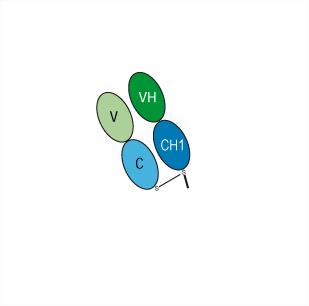
Sulesomab
Sulesomab (IMMU-MN3) is a murine monoclonal antibody fragment of the IgG1 class that binds to Normal Cross-Reactive Antigen-90 present on leukocytes. Sulesomab is cleared into infection nonspecifically through increased capillary membrane permeability.
商品は「研究用試薬」です。人や動物の医療用・臨床診断用・食品用の製品ではありません。
研究用途以外に使用した場合、当社は一切の責任を負いかねます。
- CAS 番号: 167747-19-5
-
保管条件:
Please store the product under the recommended conditions in the Certificate of Analysis.

生物活性
製品説明
Isotype
Fab'-G1-nd
Species Reactivity
Human
IC50 & Target
CEACAM6
遺伝子ID
アクセッション番号
Conjugated
Unconjugated
Reconsititution
The product can be reconstituted/diluted with sterile PBS or saline.
Format
-
Fab'-G1-nd
アプリケーション
ELISA, FACS, Functional assay
化学情報
-
CAS 番号 167747-19-5
-
SMILES
[Sulesomab]
-
Formulation
Please refer to the lot-specific COA for specific buffer information.
-
保管条件
Please store the product under the recommended conditions in the Certificate of Analysis.
プロトコル
-
Research Protocol for Infectious Diseases
Infectious-disease experiments test how pathogens interact with host barriers, innate immune receptors, inflammatory signaling, pathogen replication, and tissue injury; pattern-recognition receptors such as TLRs, RIG-I-like receptors, NOD-like receptors, and inflammasomes detect microbial molecules and activate NF-κB, interferon, and cytokine responses. The central hypothesis is that infection severity reflects the balance between pathogen burden and host response: protective inflammation restricts pathogen growth, whereas excessive or mislocalized inflammation contributes to tissue damage and disease phenotype. Unresolved questions include which host pathways are protective versus pathogenic, why some infection models fail to translate to human disease, and which combined readouts best predict clinically relevant infection outcomes.
-
Transepithelial/transendothelial electrical resistance assay
TEER measures electrical resistance across epithelial or endothelial monolayers cultured on permeable supports, and the readout reflects ionic conductance through the cell barrier, especially the paracellular pathway regulated by junctional integrity. TEER can be measured without destroying the monolayer and is commonly used before or during transport, permeability, barrier-disruption, and barrier-maturation experiments. TEER values are influenced by biological maturation and technical conditions; reported factors include temperature, medium formulation, passage number, electrode geometry, membrane properties, and junctional length during early monolayer maturation. Therefore, TEER should be interpreted with blank-insert subtraction, area normalization, repeated readings, and, when possible, orthogonal barrier readouts such as FITC-dextran flux or tight-junction staining.
純度とドキュメンテーション
参考文献
Calculators
濃度 (開始) × 体積 (開始) = 濃度 (終了) × 体積 (終了)