



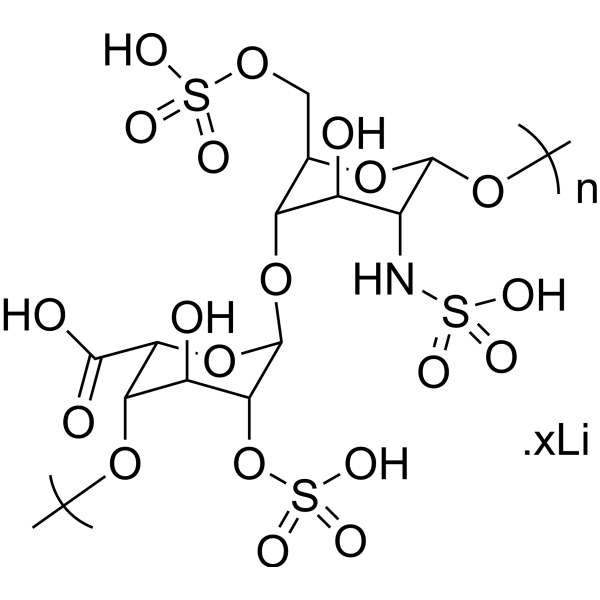
Heparin Lithium salt
Based on 3 publication(s) in Google Scholar
Heparin Lithium salt is an anticoagulant which binds reversibly to antithrombin III (ATIII). Heparin Lithium salt significantly inhibits exosome-cell interactions.
연구목적의 판매만을 진행합니다. 환자를 대상으로 한 판매는 하지 않습니다.
- CAS No.: 9045-22-1
- 화학식: (C14H25NO20S3)n.xLi
-
보관:
4°C, sealed storage, away from moisture and light
* In solvent : -80°C, 6 months; -20°C, 1 month (sealed storage, away from moisture and light)

To place orders, for customer services and technical support, please contact: MedChemExpress USA
Tel: 609-228-6898 E-mail: [email protected] [email protected]


-
 Biological Activity
-
Chemical Information
-
용액&용해도
- 순도&문서
- References
-
 Help & FAQs


-
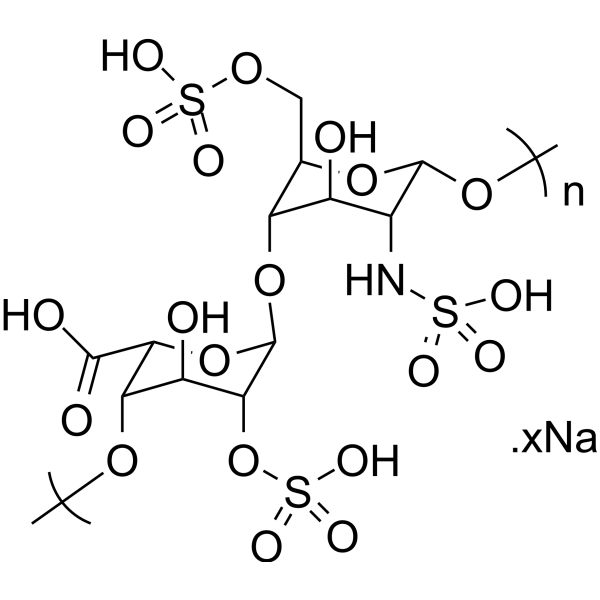
HY-17567A
Heparin sodium saltAnticoagulant -
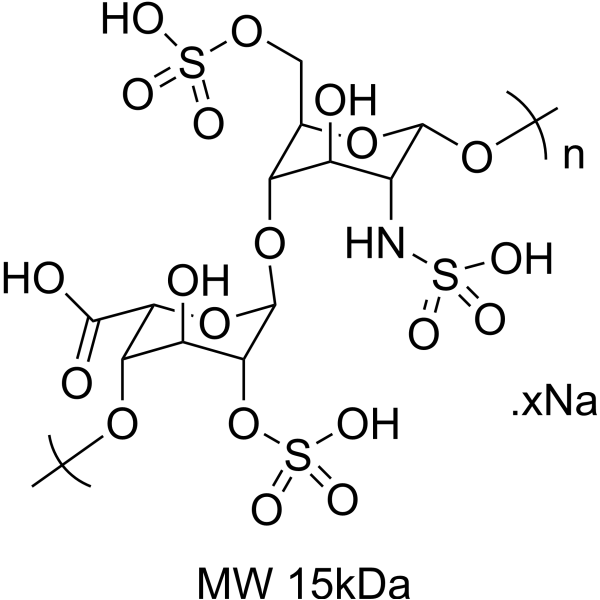
HY-17567C
Heparin sodium salt (MW 15kDa)Anticoagulant Agent -
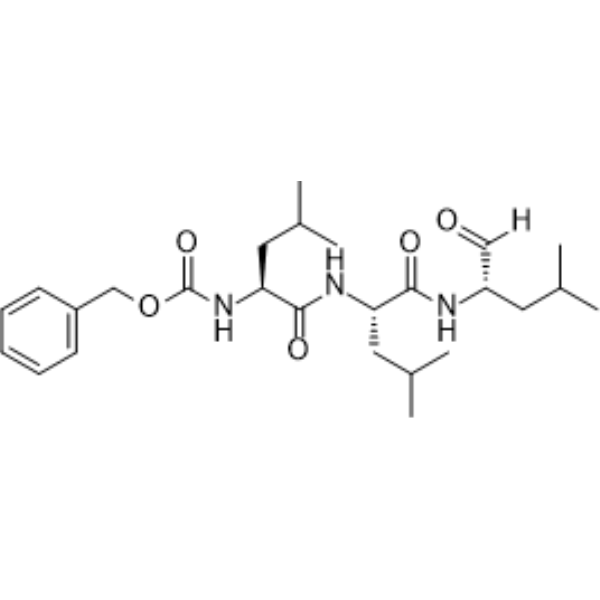
HY-13259
MG-132Proteasome Inhibitor -
HY-P1929
BivalirudinThrombin Inhibitor -

HY-10219
RapamycinmTOR Inhibitor -
HY-D0843
N-EthylmaleimideCysteine Residues Modifier -
HY-15306
EltrombopagTPO Receptor Agonist -
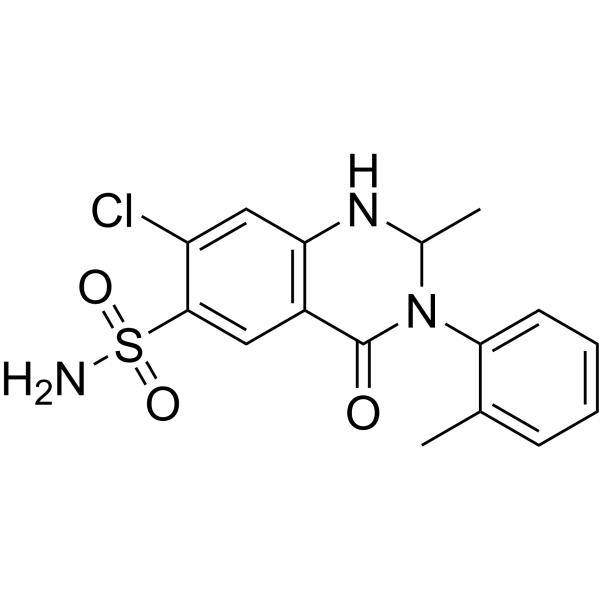
HY-B0209
MetolazoneDiuretics -
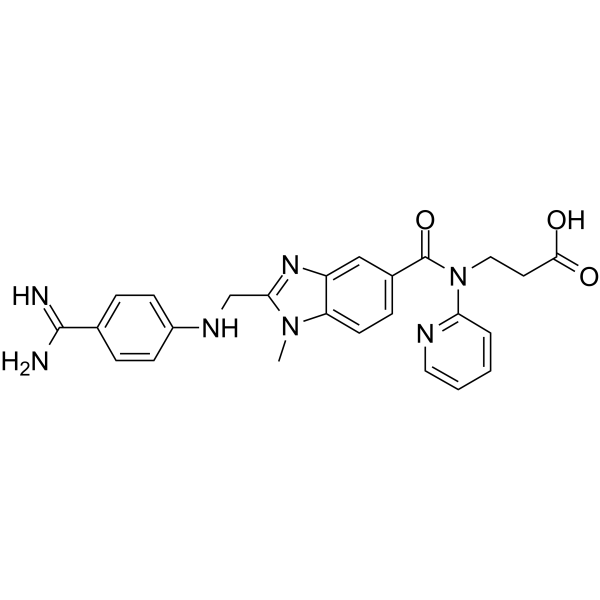
HY-10163
DabigatranThrombin Inhibitor -
HY-B0209R
Metolazone (Standard) -
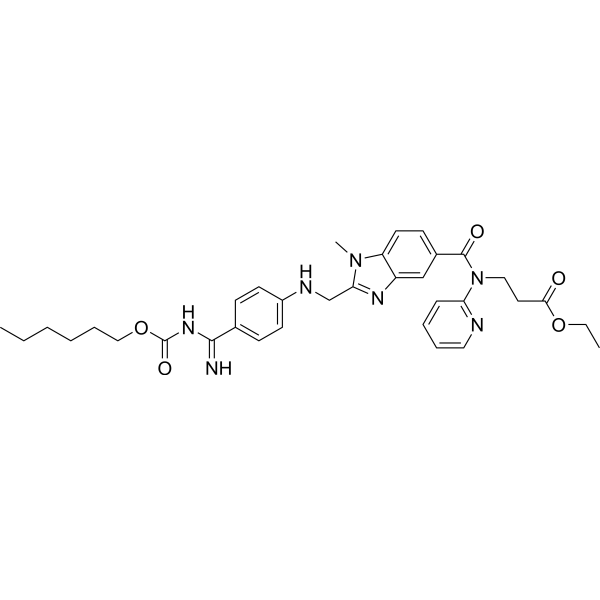
HY-10274
Dabigatran etexilateAntithrombotic Agent -

HY-10163R
Dabigatran (Standard)Thrombin Inhibitor
Publications Citing Use of MedChemExpress (MCE) Heparin Lithium salt
More

Biological Activity
제품 설명
IC50 & Target
Antithrombin III[1]
In Vitro
Heparin is a potent anticoagulant drug based on its ability to accelerate the rate at which antithrombin inhibits serine proteases in the blood coagulation cascade. Heparin interactes most tightly with peptides containing a complementary binding site of high positive charge density. Heparin resembles DNA as both are highly charged linear polymers that behave as polyelectrolytes. Heparin is believed to function as an anticoagulant primarily through its interaction with AT III by enhancing AT-III-mediated inhibition of blood coagulation factors, including thrombin and factor Xa. Heparin binds to AT III and thrombin in a ternary complex, increasing the bimolecular rate constant for the inhibition of thrombin by a factor of 2000. Heparin is principally located in the granules of tissue mast cells that are closely associated with the immune response. Heparin makes numerous contacts with both FGF-2 and FGFR-1 stabilizing FGF–FGFR binding. Heparin also makes contacts with the FGFR-1 of the adjacent FGF–FGFR complex, thus seeming to promote FGFR dimerization[1].
MedChemExpress (MCE) has not independently confirmed the accuracy of these methods. They are for reference only. .
Clinical Trial
| NCT Number | Sponsor | Condition | Start Date |
Phase

|
|---|---|---|---|---|
| NCT01329991 | Plexxikon| | 2011-05 | PHASE1 |


Chemical Information
-
CAS No. 9045-22-1
-
Appearance Solid
-
화학식 (C14H25NO20S3)n.xLi
-
Color White to off-white
-
SMILES
O[C@H]1[C@H](O[C@H]2[C@H](OS(O)(=O)=O)[C@@H](O)[C@H](OC)[C@H](C(O)=O)O2)[C@@H](COS(O)(=O)=O)O[C@H](OC)[C@@H]1NS(O)(=O)=O.[n].[.xLi]
-
선적
Room temperature in continental US; may vary elsewhere.
-
보관
4°C, sealed storage, away from moisture and light
* In solvent : -80°C, 6 months; -20°C, 1 month (sealed storage, away from moisture and light)


Publications (3)
-
Journal Impact Factor
-
Most Recent
-
Autophagy
Chaperone-mediated autophagy degrades SERPINA1E342K/α1-antitrypsin Z variant and alleviates cell stress. [Abstract]2025 Mar 20. PMID: 40114294 -
Nat Commun
The role of extracellular vesicle fusion with target cells in triggering systemic inflammation. [Abstract]2024 Feb 7;15(1):1150. PMID: 38326335 -


용액&용해도
In Vitro:
H2O : 100 mg/mL (Need ultrasonic)
DMSO : < 1 mg/mL (insoluble or slightly soluble)
In Vivo:
For the following dissolution methods, please prepare the working solution directly:
It is recommended to prepare fresh solutions and use them promptly within a short period of time.
The percentages shown for the solvents indicate their volumetric ratio in the final prepared solution. If precipitation or phase separation occurs during preparation, heat and/or sonication can be used to aid dissolution.
Add each solvent one by one: PBS
Solubility: 100 mg/mL; Clear solution; Need ultrasonic


순도&문서
-
Data Sheet (285 KB)
-
SDS (419 KB)
- English - EN (419 KB)
- Français - FR (419 KB)
- Deutsch - DE (419 KB)
- Norwegian - NO (419 KB)
- Español - ES (419 KB)
- Swedish - SV (419 KB)
- Italian - IT (419 KB)
- Korean - KR (419 KB)
- Portuguese - PT (419 KB)
-
Handling Instructions (2659 KB)
References
[1]. Capila I, et al. Heparin-protein interactions. Angew Chem Int Ed Engl. 2002 Feb 1;41(3):391-412. [Content Brief]
[2]. Anurag Purushothaman, et al. Fibronectin on the Surface of Myeloma Cell-derived Exosomes Mediates Exosome-Cell Interactions. J Biol Chem. 2016 Jan 22;291(4):1652-63. [Content Brief]

Calculators
Concentration (start) × Volume (start) = Concentration (final) × Volume (final)


Heparin Lithium salt Related Classifications
HY-17567B Related Classifications
 Powered by Bioz