



CPPD-Q
Based on 1 publication(s) in Google Scholar
CPPD-Q is a PPD-quinone. CPPD-Q induces increased intestinal permeability and oxidative stress in C. elegans. CPPD-Q targets HMP-2 and ACS-22 to regulate the intestinal barrier, and targets SOD-3 and GST-4 to mediate oxidative stress responses. CPPD-Q induces reactive oxygen species (ROS) production through quinone-mediated redox cycling, and exhibits oxidative potential through dithiothreitol depletion. CPPD-Q is used in research related to intestinal diseases.
연구목적의 판매만을 진행합니다. 환자를 대상으로 한 판매는 하지 않습니다.
- Purity : 99.12%
- CAS No.: 68054-78-4
- 화학식: C18H20N2O2
- 분자량:296.36
-
보관:
4°C, protect from light
* In solvent : -80°C, 6 months; -20°C, 1 month (protect from light)


To place orders, for customer services and technical support, please contact: MedChemExpress USA
Tel: 609-228-6898 E-mail: [email protected] [email protected]


-
 Biological Activity
-
Chemical Information
-
용액&용해도
- Protocol
- 순도&문서
- References
-
 Help & FAQs


-

HY-163650
DTPD-QAntioxidant -
HY-Y0525
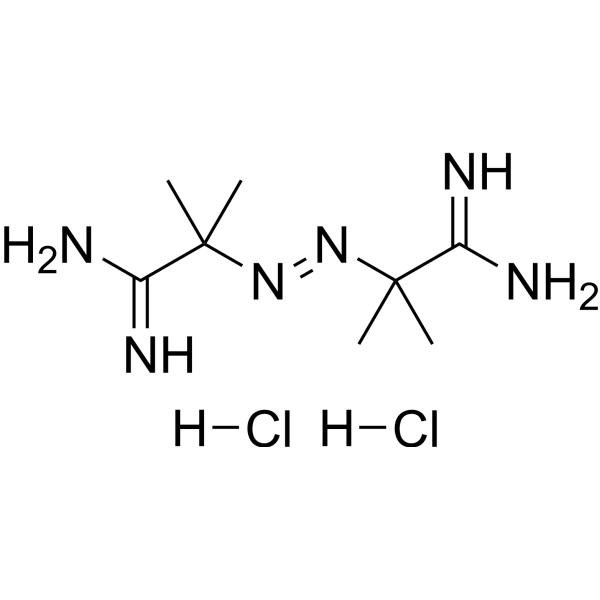
AAPHRadical Generator -
HY-W011235
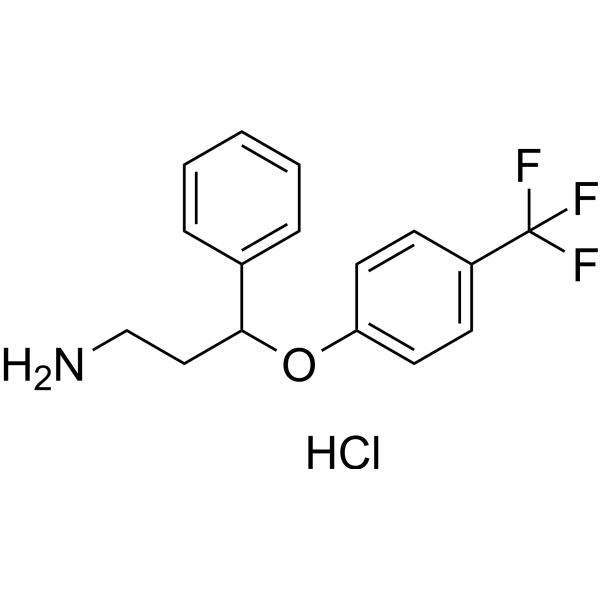
Norfluoxetine hydrochlorideMetabolite of Fluoxetine -

HY-W041343
4-Benzoylbenzoic acidPhotooxidant -
HY-139324
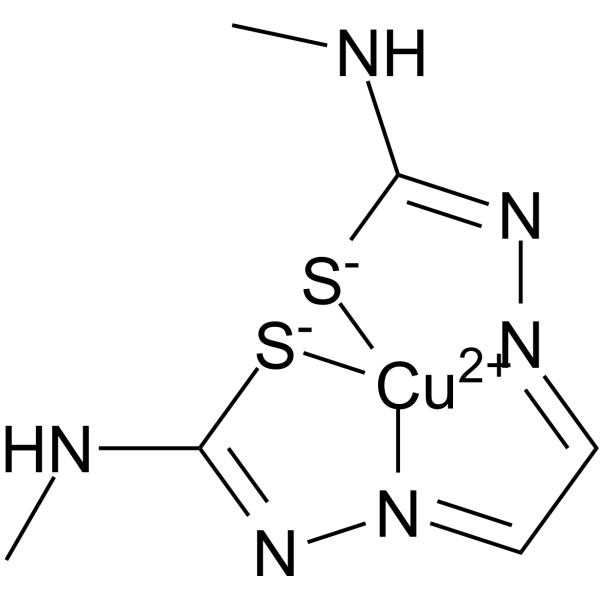
Cu(II)GTSMGSK3β/AβOs Inhibitor -
HY-B0843AS
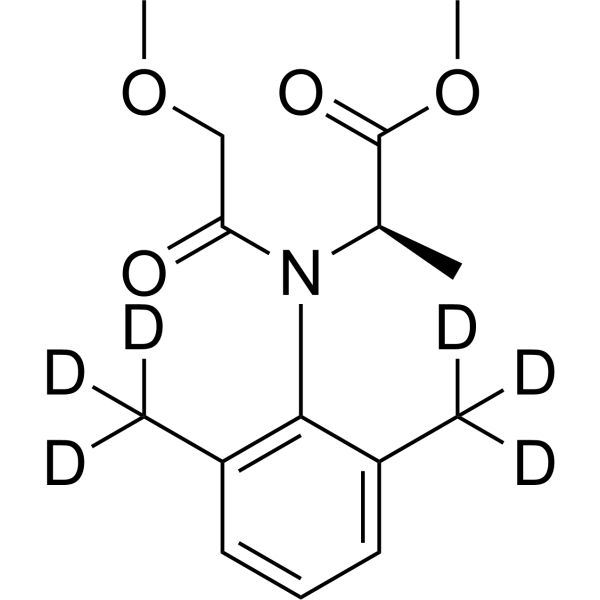
Metalaxyl-M-d6Fungicide -

HY-W775354
1,2,3,4,7,8-HexachlorodibenzofuranCYP1A1/1B1 Activator -

HY-W011235R
Norfluoxetine hydrochloride (Standard)Reference Standard -

HY-168804
SOTS-1 (technical grade)Azo-compound
Publications Citing Use of MedChemExpress (MCE) CPPD-Q
More

Biological Activity
제품 설명
|
HMP-2 |
ACS-22 |
SOD-3 |
GST-4 |
In Vitro
CPPD-Q (10-100 μM; 30 min) as part of a six-chemical mixture increases HK-2 ROS release to 118-241 % of control[3].
CPPD-Q (20 μM; 24 h) as part of a six-chemical mixture dysregulates oxidative stress genes in HK-2 cells, upregulating CCL5, SLC7A11, FTH1, SPINK1, FHL2, PRNP, CYBB, NCF2, TXNRD1, and GCLM and downregulating MB[3].
CPPD-Q (10-100 μM; 24 h) as part of a six-chemical mixture reduces HK-2 cell viability from 92.4 % to 61.2 %, indicating cytotoxicity[3].
CPPD-Q (0.01-20 mg/L; 30 min) inhibits Vibrio fischeri bioluminescence with a 30-min EC50 of 6.98 mg/L (extrapolated), indicating toxic acute aquatic toxicity[5].
CPPD-Q (0.01-0.19 μM; 0-36 min) exhibits a DTT consumption rate of 1.17 μM min−1 μM−1 in the cell-free DTT assay, indicating intrinsic oxidative potential[7].
MedChemExpress (MCE) has not independently confirmed the accuracy of these methods. They are for reference only.
-
Cell Line:Human Kidney-2 (HK-2) cells
-
Concentration:0, 10, 20, 40, 80, 100 μM (per individual chemical)
-
Incubation Time:24 h
-
Result:Cell viability of HK-2 cells decreased from 92.4 % to 61.2 % after 24-h exposure to the six-chemical mixture containing CPPD-Q.
-
Cell Line:Human Kidney-2 (HK-2) cells
-
Concentration:0 and 20 μM (per individual chemical)
-
Incubation Time:24 h
-
Result:After 24-h exposure to the six-chemical mixture containing CPPD-Q at 20 μM, ten of 90 genes were significantly upregulated: CCL5, SLC7A11, FTH1, SPINK1, FHL2, PRNP, CYBB, NCF2, TXNRD1, and GCLM.
One gene, MB, was significantly downregulated.
In Vivo
CPPD-Q (0.01‑10 μg/L; solution exposure; from L1 larvae exposure to day 1 of adulthood) activates the GST‑4 detoxification and SOD‑3‑mediated antioxidant defense pathways in nematodes[1].
Under CPPD-Q exposure conditions (0.01‑10 μg/L; solution exposure; from L1 larvae to day 1 of adulthood), loss of hmp‑2 and pkc‑3 function amplifies CPPDQ-induced intestinal oxidative damage; knockdown of acs‑22 and erm‑1 does not exacerbate CPPDQ-induced ROS[1].
CPPD-Q (0.01-10 μg/L; solution exposure; from L1 larvae exposure to day 1 of adulthood) disrupts nematode intestinal barrier function in a concentration-dependent manner; at high concentration (10 μg/L), the damage is more severe, with complete barrier leakage[1].
CPPD-Q (0.01‑10 μg/L; solution exposure; from L1 larvae exposure to day 1 of adulthood) primarily mediates impairment of the intestinal barrier function in C. elegans by inhibiting the expression of hmp‑2 and acs‑22 genes[1].
MedChemExpress (MCE) has not independently confirmed the accuracy of these methods. They are for reference only.
-
Animal Model:Wild-type N2 Caenorhabditis elegans
[1] -
Dosage:0.01 μg/L; 0.1 μg/L; 1 μg/L; 10 μg/L
-
Administration:solution exposure; from L1 larvae to day 1 of adulthood
-
Result:Disrupted the intestinal barrier function of the nematode.
Inhibited the expression of the hmp-2 and acs-22 genes.
Induced oxidative stress in the nematode intestine.
Activated the C. elegans GST-4 detoxification and SOD-3-mediated antioxidant defense pathways.


Chemical Information
-
CAS No. 68054-78-4
-
Appearance Solid
-
분자량 296.36
-
화학식 C18H20N2O2
-
Color Brown to red
-
SMILES
O=C1C(NC2CCCCC2)=CC(C(NC3=CC=CC=C3)=C1)=O
-
선적
Room temperature in continental US; may vary elsewhere.
-
보관
4°C, protect from light
* In solvent : -80°C, 6 months; -20°C, 1 month (protect from light)


Publications (1)
-
Journal Impact Factor
-
Most Recent
-
Environ Pollut
2026 Jul 1:400:128295. PMID: 42105897


용액&용해도
In Vitro:
DMSO : 1 mg/mL (3.37 mM; ultrasonic and warming and heat to 60°C; Hygroscopic DMSO has a significant impact on the solubility of product, please use newly opened DMSO)
Please refer to the solubility information to select the appropriate solvent. Once prepared, please aliquot and store the solution to prevent product inactivation from repeated freeze-thaw cycles.
Storage method and period of stock solution: -80°C, 6 months; -20°C, 1 month (protect from light). When stored at -80°C, please use it within 6 months. When stored at -20°C, please use it within 1 month.
Please refer to the solubility information to select the appropriate solvent. Once prepared, please aliquot and store the solution to prevent product inactivation from repeated freeze-thaw cycles.
Storage method and period of stock solution: -80°C, 6 months; -20°C, 1 month (protect from light). When stored at -80°C, please use it within 6 months. When stored at -20°C, please use it within 1 month.
Concentration (start) × Volume (start) = Concentration (final) × Volume (final)


순도&문서
-
Data Sheet (290 KB)
-
SDS (252 KB)
- English - EN (252 KB)
- Français - FR (252 KB)
- Deutsch - DE (252 KB)
- Norwegian - NO (252 KB)
- Español - ES (252 KB)
- Swedish - SV (252 KB)
- Italian - IT (252 KB)
- Korean - KR (252 KB)
- Portuguese - PT (252 KB)
-
Handling Instructions (2659 KB)
References
[1]. Wang Y, et al. Comparison of intestinal toxicity in enhancing intestinal permeability and in causing ROS production of six PPD quinones in Caenorhabditis elegans. The Science of the total environment. 2024 Jun 01;927:172306. [Content Brief]
[5]. Wang W, et al. Toxicity of substituted p-phenylenediamine antioxidants and their derived novel quinones on aquatic bacterium: Acute effects and mechanistic insights. Journal of hazardous materials. 2024 May 05;469:133900. [Content Brief]


Complete Stock Solution Preparation Table
Please refer to the solubility information to select the appropriate solvent. Once prepared, please aliquot and store the solution to prevent product inactivation from repeated freeze-thaw cycles.
Storage method and period of stock solution: -80°C, 6 months; -20°C, 1 month (protect from light). When stored at -80°C, please use it within 6 months. When stored at -20°C, please use it within 1 month.
| Optional Solvent | Concentration Solvent Mass | 1 mg | 5 mg | 10 mg | 25 mg |
|---|---|---|---|---|---|
| DMSO | 1 mM | 3.3743 mL | 16.8714 mL | 33.7427 mL | 84.3569 mL |


CPPD-Q Related Classifications
HY-W728085 Related Classifications
 Powered by Bioz