



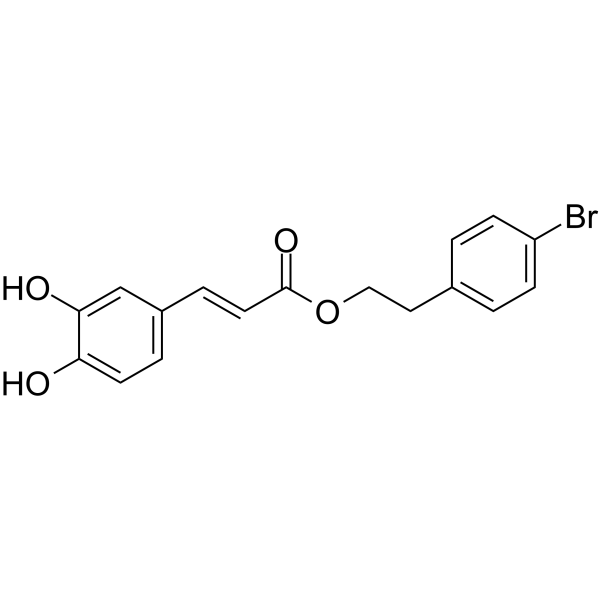
F-17
F-17 is a potential inhibitor of virulence factor. F-17 shows very significant inhibitory effect on biofilm, elastase, pyocyanin, and swarming motility. F-17 also shows a good binding effect on LasR and PqsR. F-17 has no obvious cytotoxicity.
연구목적의 판매만을 진행합니다. 환자를 대상으로 한 판매는 하지 않습니다.
- CAS No.: 1572464-22-2
- 화학식: C17H15BrO4
- 분자량:363.20
-
보관:
Please store the product under the recommended conditions in the Certificate of Analysis.

To place orders, for customer services and technical support, please contact: MedChemExpress USA
Tel: 609-228-6898 E-mail: [email protected] [email protected]


-
 Biological Activity
-
Chemical Information
- Protocol
- 순도&문서
- References
-
 Help & FAQs




Biological Activity
제품 설명
Cellular Effect
|
Cell Line

|
Type | Value | Description | References |
|---|---|---|---|---|
| DU-145 | IC50 |
35.4 μM
Compound: Table 1, 4'=Br
|
Antiproliferative activity against human DU145 cells after 48 hrs by MTT assay
Antiproliferative activity against human DU145 cells after 48 hrs by MTT assay
|
[PMID: 27979593] |
| ECa-109 cell line | IC50 |
40.3 μM
Compound: Table 1, 4'=Br
|
Antiproliferative activity against human ECA109 cells after 48 hrs by MTT assay
Antiproliferative activity against human ECA109 cells after 48 hrs by MTT assay
|
[PMID: 27979593] |
| HeLa | IC50 |
56.8 μM
Compound: Table 1, 4'=Br
|
Antiproliferative activity against human HeLa cells after 48 hrs by MTT assay
Antiproliferative activity against human HeLa cells after 48 hrs by MTT assay
|
[PMID: 27979593] |
| MCF7 | IC50 |
28.2 μM
Compound: Table 1, 4'=Br
|
Antiproliferative activity against human MCF7 cells after 48 hrs by MTT assay
Antiproliferative activity against human MCF7 cells after 48 hrs by MTT assay
|
[PMID: 27979593] |
Clinical Trial
| NCT Number | Sponsor | Condition | Start Date |
Phase
|
|---|---|---|---|---|
| NCT01329991 | Plexxikon| | 2011-05 | PHASE1 |


Chemical Information
-
CAS No. 1572464-22-2
-
분자량 363.20
-
화학식 C17H15BrO4
-
SMILES
O=C(OCCC1=CC=C(Br)C=C1)/C=C/C2=CC=C(O)C(O)=C2
-
선적
Room temperature in continental US; may vary elsewhere.
-
보관
Please store the product under the recommended conditions in the Certificate of Analysis.


순도&문서
References

Calculators
Concentration (start) × Volume (start) = Concentration (final) × Volume (final)


F-17 Related Classifications
HY-115969 Related Classifications
 Powered by Bioz