



NN1213 acetate

Based on 1 Customer Validation
NN1213 acetate, a long-acting human amylin peptide analog, is a selective Amylin receptor agonist with EC50 values of 0.177 and 0.262 nM for hAMY3R and rAMY3R, respectively. NN1213 acetate significantly reduces food intake and fat mass. NN1213 acetate can reduce body weightin diet-induced obese rats. NN1213 acetate can be used for the research of obesity.
연구목적의 판매만을 진행합니다. 환자를 대상으로 한 판매는 하지 않습니다.
- Purity : 99.65%
- 화학식: C198H316N56O63S2.xC2H4O2
- 분자량:4553.10 (free base)
-
보관:
Sealed storage, away from moisture.
Powder -80°C, 2 years , -20°C, 1 year* In solvent : -80°C, 6 months; -20°C, 1 month (sealed storage, away from moisture)


To place orders, for customer services and technical support, please contact: MedChemExpress USA
Tel: 609-228-6898 E-mail: [email protected] [email protected]


-
 Biological Activity
-
Chemical Information
-
용액&용해도
- Protocol
- 순도&문서
- References
-
 Help & FAQs


-

HY-P10798
EloralintideAmylin Receptor Agonist -
HY-P3462
CagrilintideAMYR/CTR agonist -
HY-P1070
Amylin, amide, humanGlucoregulatory Hormone -
HY-P3462A
Cagrilintide acetateAMYR/CTR Agonist -

HY-P10745
PetrelintideDual Amylin/Calcitonin Receptor Agonist -

HY-P11274A
Zenagamtide sodiumGLP-1/Amylin/Calcitonin Receptor Agonist


Biological Activity
제품 설명
In Vitro
In Vivo
NN1213 (3-100 nmol/kg; s.c.; single dose) acetate produces a dose-dependent, long-duration reduction in food intake in rats[1].
NN1213 (3-300 nmol/kg; s.c.; single dose) acetate produces a dose-dependent, long-duration reduction in food intake in beagle dogs[1].
NN1213 (10 nmol/kg; s.c.; daily; 17 days) acetate decreases body weight and food intake in diet-induced obese rats[2].
MedChemExpress (MCE) has not independently confirmed the accuracy of these methods. They are for reference only.
-
Animal Model:Rat (diet-induced obese, fed high-energy diet)[1]
-
Dosage:0.7 nmol/kg (3 µg/kg); 2.2 nmol/kg (10 µg/kg); 6.6 nmol/kg (30 µg/kg); 22 nmol/kg (100 µg/kg)
-
Administration:s.c.; daily; 21 days
-
Result:Transiently reduced food intake, with maximal suppression during days 1-2; by day 15, food intake was close to vehicle control levels but still slightly reduced.
Produced dose-dependent body weight loss: the 0.7 nmol/kg group lost 4.7% of baseline body weight, while the 2.2, 6.6, and 22 nmol/kg groups lost 8.7-9.3% of baseline body weight.
Over 21 days, the 0.7 nmol/kg group lost 32.0 ± 3.6 g, and the 22 nmol/kg group lost 69.6 ± 7.5 g (equivalent to 90.7% of initial body weight).
Confirmed via magnetic resonance imaging that body weight loss was primarily driven by a dose-dependent reduction in fat mass, with minimal effects on lean mass.


Chemical Information
-
Appearance Solid
-
분자량 4553.10 (free base)
-
화학식 C198H316N56O63S2.xC2H4O2
-
Color White to off-white
-
Sequence
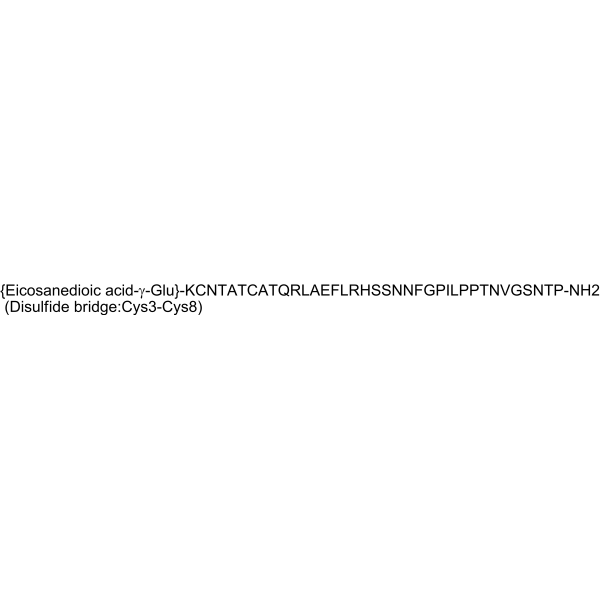
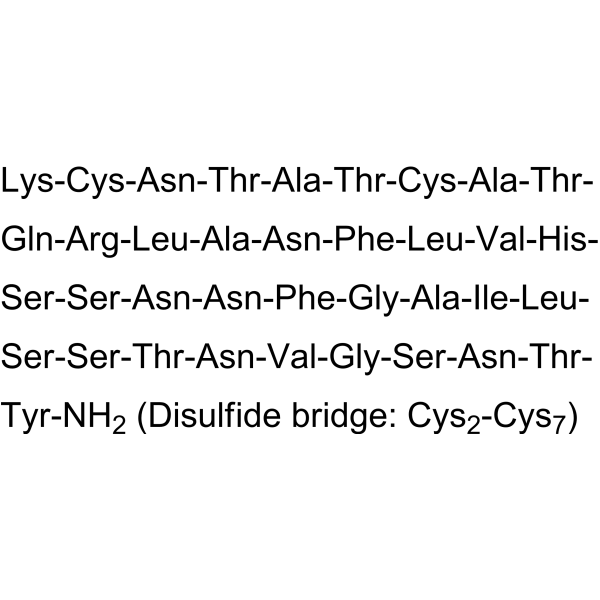
{Lys(γGlu-γGlu-C20 diacid)}-Cys-Asn-Thr-Ala-Thr-Cys-Ala-Thr-Gln-Arg-Leu-Ala-Asp-Phe-Leu-Arg-His-Ser-Ser-Pro-Asn-Phe-Gly-Ala-Ile-Pro-Ser-Ser-Thr-Asn-Val-Gly-Ser-Arg-Thr-Tyr-NH2 (disulfide bridge:Cys2-Cys7)
-
Sequence Shortening
{Lys(γGlu-γGlu-C20 diacid)}-CNTATCATQRLADFLRHSSPNFGAIPSSTNVGSRTY-NH2 (disulfide bridge:Cys2-Cys7)
-
선적
Room temperature in continental US; may vary elsewhere.
-
보관
Sealed storage, away from moisture
Powder -80°C 2 years -20°C 1 year * In solvent : -80°C, 6 months; -20°C, 1 month (sealed storage, away from moisture)


용액&용해도
In Vitro:
DMSO : 100 mg/mL (Need ultrasonic; Hygroscopic DMSO has a significant impact on the solubility of product, please use newly opened DMSO)


순도&문서
-
Data Sheet (298 KB)
-
SDS (252 KB)
- English - EN (252 KB)
- Français - FR (252 KB)
- Deutsch - DE (252 KB)
- Norwegian - NO (252 KB)
- Español - ES (252 KB)
- Swedish - SV (252 KB)
- Italian - IT (252 KB)
- Korean - KR (252 KB)
- Portuguese - PT (252 KB)
-
Handling Instructions (2659 KB)
References

Calculators
Concentration (start) × Volume (start) = Concentration (final) × Volume (final)


NN1213 acetate Related Classifications
HY-P11245A Related Classifications
 Powered by Bioz