



YXG-158
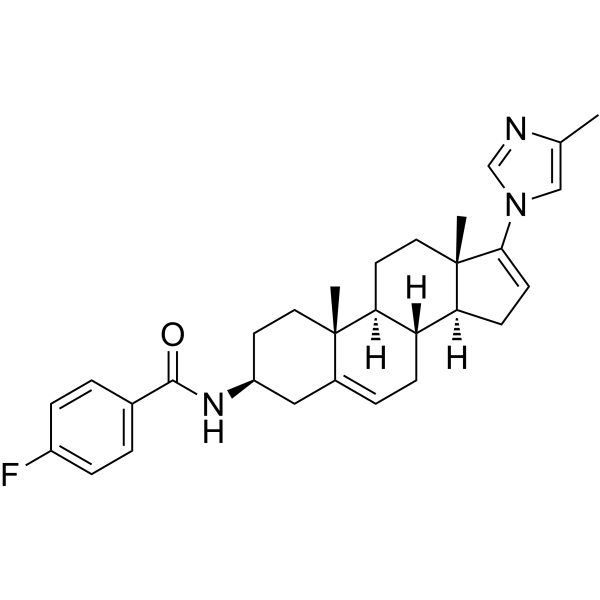
YXG‑158 is an orally active, anticancer bifunctional steroid analog with both androgen receptor (AR) degradation activity (DC50 = 1.28 μM) and CYP17A1 inhibitory activity (IC50 = 100 nM). YXG-158 reduces AR protein and mRNA expression via proteasome-dependent degradation, degrades AR-V7, and inhibits CYP17A1 enzymatic activity to block androgen biosynthesis. YXG-158 inhibits the activities of ERα and ERβ, as well as cancer cell proliferation. YXG-158 decreases the weight of androgen-sensitive organs in castrated rats treated with testosterone propionate, downregulates AR protein, reduces PSA levels, and suppresses tumor growth in Enzalutamide (HY-70002)-sensitive and -resistant xenograft models. YXG-158 can be used in prostate cancer-related research.
연구목적의 판매만을 진행합니다. 환자를 대상으로 한 판매는 하지 않습니다.
- CAS No.: 2952994-34-0
- 화학식: C30H36FN3O
- 분자량:473.62
-
보관:
Please store the product under the recommended conditions in the Certificate of Analysis.

To place orders, for customer services and technical support, please contact: MedChemExpress USA
Tel: 609-228-6898 E-mail: [email protected] [email protected]


-
 Biological Activity
-
Chemical Information
- 순도&문서
- References
-
 Help & FAQs




Biological Activity
제품 설명
IC50 & Target
[1]|
CYP17A1 100 nM (IC50) |
ERα 103 nM (IC50) |
ERβ 498 nM (IC50) |
AR-V7 |
Cellular Effect
|
Cell Line

|
Type | Value | Description | References |
|---|---|---|---|---|
| HEK293 | IC50 |
120.5 nM
|
Inhibition of dihydrotestosterone-induced transcriptional activation of wild-type AR in HEK293 cells assessed via luciferase reporter gene assay after 24 hours of treatment.
Inhibition of dihydrotestosterone-induced transcriptional activation of wild-type AR in HEK293 cells assessed via luciferase reporter gene assay after 24 hours of treatment.
|
37458396 |
| HEK293 | IC50 |
389.8 nM
|
Inhibition of dihydrotestosterone-induced transcriptional activation of F876L mutant AR in HEK293 cells assessed via luciferase reporter gene assay after 24 hours of treatment.
Inhibition of dihydrotestosterone-induced transcriptional activation of F876L mutant AR in HEK293 cells assessed via luciferase reporter gene assay after 24 hours of treatment.
|
37458396 |
| HEK293 | IC50 |
371.3 nM
|
Inhibition of dihydrotestosterone-induced transcriptional activation of W741L mutant AR in HEK293 cells assessed via luciferase reporter gene assay after 24 hours of treatment.
Inhibition of dihydrotestosterone-induced transcriptional activation of W741L mutant AR in HEK293 cells assessed via luciferase reporter gene assay after 24 hours of treatment.
|
37458396 |
| HEK293 | IC50 |
79.75 nM
|
Inhibition of dihydrotestosterone-induced transcriptional activation of T877A mutant AR in HEK293 cells assessed via luciferase reporter gene assay after 24 hours of treatment.
Inhibition of dihydrotestosterone-induced transcriptional activation of T877A mutant AR in HEK293 cells assessed via luciferase reporter gene assay after 24 hours of treatment.
|
37458396 |
| LNCaP | IC50 |
472.8 nM
|
Antiproliferative activity against LNCaP prostate cancer cells assessed as reduction in cell viability incubated for 6 days by CellTiter-Glo assay.
Antiproliferative activity against LNCaP prostate cancer cells assessed as reduction in cell viability incubated for 6 days by CellTiter-Glo assay.
|
37458396 |
| LNCaP | DC50 |
1.28 μM
|
Degradation of AR protein in LNCaP prostate cancer cells assessed via ELISA kit after 24 hours of treatment.
Degradation of AR protein in LNCaP prostate cancer cells assessed via ELISA kit after 24 hours of treatment.
|
37458396 |
In Vitro
YXG-158 (compound 23-h) potently inhibits recombinant human CYP17A1 enzyme with an IC50 of 0.100 μM; it suppresses the growth of LNCaP prostate cancer cells with an IC50 of 472.8 nM; it partially inhibits the transcriptional activation of wild-type and mutant ARF876L, ARW741L, and ART877A in dihydrotestosterone-induced HEK293 cells, with IC50 values ranging from 79.75 nM to 389.8 nM[1].
YXG-158 degrades AR protein in LNCaP prostate cancer cells, with a DC50 of 1.28 μM[1].
YXG-158 (1-20 μM; 24 h) induces dose-dependent degradation of full-length AR in LNCaP, VCaP and 22RV1 prostate cancer cells, and reduces AR-V7 levels in 22RV1 cells; it also degrades AR protein in LNCaP prostate cancer cells in a proteasome-dependent manner[1].
YXG-158 (1-20 μM; 48 h) reduces the level of AR mRNA in cultured LNCaP prostate cancer cells in a dose-dependent manner[1].
YXG-158 exerts no significant inhibitory effect on hERG K+ channel and GABAA receptor currents at concentrations up to 40 μM, with an IC50 > 40 μM[1].
YXG-158 exhibits low to moderate inhibitory effects on CYP1A2, CYP2C9, CYP2C19, and CYP2D6 enzymes, and shows submicromolar inhibitory activity against CYP3A4 enzyme[1].
MedChemExpress (MCE) has not independently confirmed the accuracy of these methods. They are for reference only.
-
Cell Line:LNCaP, VCaP, 22RV1 prostate cancer cells
-
Concentration:1, 5, 10, 20 μM
-
Incubation Time:24 hours
-
Result:Induced dose-dependent degradation of full-length AR in LNCaP, VCaP, and 22RV1 prostate cancer cells.
Reduced AR-V7 protein abundance in 22RV1 cells in a dose-dependent manner.
-
Cell Line:LNCaP prostate cancer cells
-
Concentration:20 μM
5 μM MG-132 (HY-13259) -
Incubation Time:24 hours
-
Result:Degraded AR protein after 24 hours of incubation.
Restored AR protein levels when co-incubated with proteasome inhibitor MG-132.
-
Cell Line:LNCaP prostate cancer cells
-
Concentration:1, 10, 20 μM
-
Incubation Time:48 hours
-
Result:Reduced AR mRNA levels in a dose-dependent manner.
Parmacokinetics
| Species | Dose | Route | AUC0-t | T1/2 | Tmax | Cmax |
|---|---|---|---|---|---|---|
| Rat[1] | 10 mg/kg | p.o. | 68872 ng·h/mL | 3.28 h | 4.00 h | 6431 ng/mL |
In Vivo
YXG-158 (10-30 mg/kg; p.o.; once daily; for 28 consecutive days) exhibits anti-tumor activity in Enzalutamide (HY-70002)-sensitive castration-resistant prostate cancer and castration-resistant prostate cancer xenograft models[1].
MedChemExpress (MCE) has not independently confirmed the accuracy of these methods. They are for reference only.
-
Animal Model:Sprague-Dawley (male, castrated, testosterone propionate-stimulated)[1]
-
Dosage:20 mg/kg
-
Administration:p.o.; daily; 10 days
-
Result:Induced a 64% reduction in seminal vesicle weight gain compared to the testosterone propionate-only group.
Induced a 67% reduction in ventral prostate weight gain compared to the testosterone propionate-only group.
-
Animal Model:SCID (male, 6 weeks old, castrated, subcutaneous xenograft of 5 × 10⁶ LNCaP/AR cells)[1]
-
Dosage:10 mg/kg; 30 mg/kg
-
Administration:p.o.; daily; 28 days
-
Result:Achieved a tumor growth inhibition (TGI) of 56%, reduced PSA levels, and induced a 40% reduction in relative AR protein expression in tumor tissue at 10 mg/kg.
Induced nearly static tumor growth, reduced PSA levels to the lowest level among treatment groups, and reduced relative AR protein expression by 52% at 30 mg/kg.
Caused no animal weight loss during treatment.
-
Animal Model:BALB/c nude (male, 6 weeks old, SPF-grade, castrated, subcutaneous xenograft of 5 × 10⁷ C4-2b-ENZ cells)[1]
-
Dosage:10 mg/kg; 30 mg/kg
-
Administration:p.o.; daily; 28 days
-
Result:Effectively inhibited tumor growth compared to vehicle control at 10 mg/kg.
Induced remarkable tumor regression with ΔT/ΔC% = -10% at 30 mg/kg.
Caused no significant animal weight loss during treatment.


Chemical Information
-
CAS No. 2952994-34-0
-
분자량 473.62
-
화학식 C30H36FN3O
-
SMILES
C[C@@]12[C@](CC=C2N3C=C(N=C3)C)([H])[C@@]4([H])[C@@](CC1)([H])[C@@]5(C(C[C@H](CC5)NC(C6=CC=C(C=C6)F)=O)=CC4)C
-
선적
Room temperature in continental US; may vary elsewhere.
-
보관
Please store the product under the recommended conditions in the Certificate of Analysis.


순도&문서
References

Calculators
Concentration (start) × Volume (start) = Concentration (final) × Volume (final)


YXG-158 Related Classifications
HY-155666 Related Classifications
 Powered by Bioz