



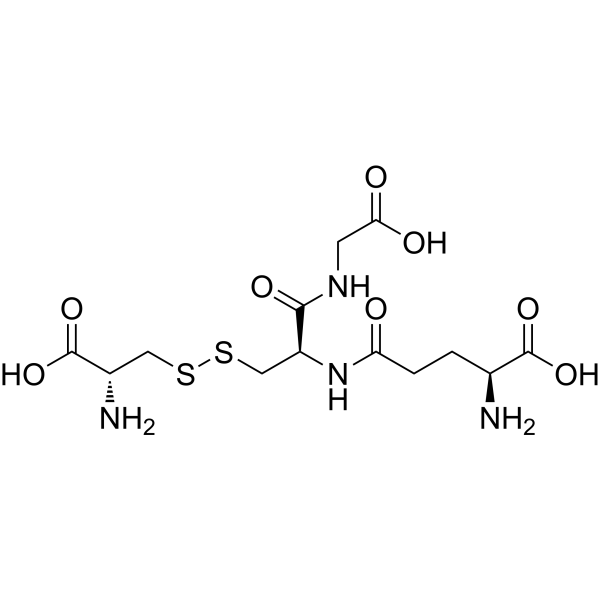
L-Cysteine-glutathione disulfide

Based on 1 Customer Validation
L-Cysteine-glutathione disulfide (L-CySSG; CYSH-GSH) is a thiol-modified glutathione prodrug with antioxidant, anti-inflammatory, and oral activities. L-Cysteine-glutathione disulfide reduces the production of mitochondrial ROS, and alleviates oxidative stress, inflammatory responses, and elevated levels of hepatic enzymes. L-Cysteine-glutathione disulfide prevents liver injury in mice induced by high-fat diet or LPS. The expression level of L-Cysteine-glutathione disulfide changes during tuberculosis infection, so it can serve as a biomarker for pulmonary tuberculosis. L-Cysteine-glutathione disulfide is applicable to research on pulmonary tuberculosis, metabolic dysfunction-associated steatotic liver disease, and liver injury.
For research use only. We do not sell to patients.
- Purity : 97.61%
- CAS No.: 13081-14-6
- Formula: C13H22N4O8S2
- Molecular Weight:426.47
-
Storage:Powder -20°C, 3 years ; In solvent -80°C, 6 months , -20°C, 1 month

To place orders, for customer services and technical support, please contact: MedChemExpress USA
Tel: 609-228-6898 E-mail: [email protected] [email protected]


-
 Biological Activity
-
Chemical Information
-
Solvent & Solubility
- Purity & Documentation
- References
-
 Help & FAQs


All Endogenous Metabolite Isoforms
More

Biological Activity
Description
In Vivo
L-Cysteine-glutathione disulfide (1.25-2.5 mM/kg; i.p.; first administration at 9:00 a.m.; second administration 1.5 h after the first) significantly protects mice against liver injury induced by high-fat diet plus LPS (HY-D1056) by alleviating oxidative stress, inflammatory responses and elevation of hepatic enzymes, while restoring the expression of mitochondrial transporters (but failing to restore mitochondrial GSH levels)[2].
MedChemExpress (MCE) has not independently confirmed the accuracy of these methods. They are for reference only.
-
Animal Model:C57BL/6J (male, 8-10 weeks old, fed 2% cholesterol + 0.5% sodium cholate hypercholesterolemic diet for 2 days)[2]
-
Dosage:2.5 mM/kg
-
Administration:i.p.; single dose
-
Result:Reduced serum alanine aminotransferase (ALT) levels from elevated HC diet-induced levels.
Improved liver structural damage observed via H&E staining.
Reduced liver protein oxidation to ~0.7% relative to control.
Restored total liver GSH levels to ~27 μmol/mg prot (similar to control levels of ~25 μmol/mg prot).
Did not restore mitochondrial GSH (mGSH) levels.
Increased expression of the mitochondrial GSH transporter OGC.
Reduced macrophage infiltration marker F4/80 and inflammasome marker NLRP3 expression.
-
Animal Model:C57BL/6J (male, 8-10 weeks old, fed 2% cholesterol + 0.5% sodium cholate hypercholesterolemic diet for 2 days, injected with 5 mg/kg LPS i.p.)[2]
-
Dosage:1.25 mM/kg (first dose); 2.5 mM/kg (second dose)
-
Administration:i.p.; first dose at 09:00 AM; second dose 1.5 hours after first dose
-
Result:Reduced serum ALT levels from elevated HC+LPS-induced levels.
Improved liver structural damage observed via H&E staining.
Reduced liver protein oxidation and 8-hydroxyguanosine (oxidative DNA damage) levels to near control levels.
Did not restore mitochondrial GSH (mGSH) levels.
Restored expression of the mitochondrial GSH transporter OGC.
Reduced macrophage infiltration marker F4/80 and inflammasome marker NLRP3 expression.


Chemical Information
-
CAS No. 13081-14-6
-
Appearance Solid
-
Molecular Weight 426.47
-
Formula C13H22N4O8S2
-
Color White to off-white
-
SMILES
OC(CNC([C@H](CSSC[C@H](N)C(O)=O)NC(CC[C@H](N)C(O)=O)=O)=O)=O
-
Synonyms
L-CySSG; CYSH-GSH
-
Shipping
Room temperature in continental US; may vary elsewhere.
-
Storage
Powder -20°C 3 years In solvent -80°C 6 months -20°C 1 month


Solvent & Solubility
In Vitro:
H2O : 20 mg/mL (46.90 mM; Need ultrasonic and warming)
Please refer to the solubility information to select the appropriate solvent. Once prepared, please aliquot and store the solution to prevent product inactivation from repeated freeze-thaw cycles.
Storage method and period of stock solution: -80°C, 6 months; -20°C, 1 month. When stored at -80°C, please use it within 6 months. When stored at -20°C, please use it within 1 month.
Please refer to the solubility information to select the appropriate solvent. Once prepared, please aliquot and store the solution to prevent product inactivation from repeated freeze-thaw cycles.
Storage method and period of stock solution: -80°C, 6 months; -20°C, 1 month. When stored at -80°C, please use it within 6 months. When stored at -20°C, please use it within 1 month.
Concentration (start) × Volume (start) = Concentration (final) × Volume (final)


Purity & Documentation
-
Data Sheet (275 KB)
-
SDS (394 KB)
- English - EN (394 KB)
- Français - FR (394 KB)
- Deutsch - DE (394 KB)
- Norwegian - NO (394 KB)
- Español - ES (394 KB)
- Swedish - SV (394 KB)
- Italian - IT (394 KB)
- Korean - KR (394 KB)
- Portuguese - PT (394 KB)
-
Handling Instructions (2659 KB)
References


Complete Stock Solution Preparation Table
Please refer to the solubility information to select the appropriate solvent. Once prepared, please aliquot and store the solution to prevent product inactivation from repeated freeze-thaw cycles.
Storage method and period of stock solution: -80°C, 6 months; -20°C, 1 month. When stored at -80°C, please use it within 6 months. When stored at -20°C, please use it within 1 month.
| Optional Solvent | Concentration Solvent Mass | 1 mg | 5 mg | 10 mg | 25 mg |
|---|---|---|---|---|---|
| H2O | 1 mM | 2.3448 mL | 11.7242 mL | 23.4483 mL | 58.6208 mL |
| 5 mM | 0.4690 mL | 2.3448 mL | 4.6897 mL | 11.7242 mL | |
| 10 mM | 0.2345 mL | 1.1724 mL | 2.3448 mL | 5.8621 mL | |
| 15 mM | 0.1563 mL | 0.7816 mL | 1.5632 mL | 3.9081 mL | |
| 20 mM | 0.1172 mL | 0.5862 mL | 1.1724 mL | 2.9310 mL | |
| 25 mM | 0.0938 mL | 0.4690 mL | 0.9379 mL | 2.3448 mL | |
| 30 mM | 0.0782 mL | 0.3908 mL | 0.7816 mL | 1.9540 mL | |
| 40 mM | 0.0586 mL | 0.2931 mL | 0.5862 mL | 1.4655 mL |


L-Cysteine-glutathione disulfide Related Classifications
HY-135174 Related Classifications
 Powered by Bioz
Keywords
- L-Cysteine-glutathione disulfide
- 13081-14-6
- L-CySSG
- CYSH-GSH
- Endogenous Metabolite
- Reactive Oxygen Species (ROS)
- Bacterial
- hypercholesterolemia-induced liver injury
- pulmonary tuberculosis
- liver injury
- tuberculosis infection
- mice
- mitochondrial glutathione transporter OGC
- metabolic dysfunction-associated steatotic liver disease
- mitochondrial reactive oxygen species
- LPS-induced liver injury
- Inhibitor
- inhibitor
- inhibit