
LIN28-IN-1
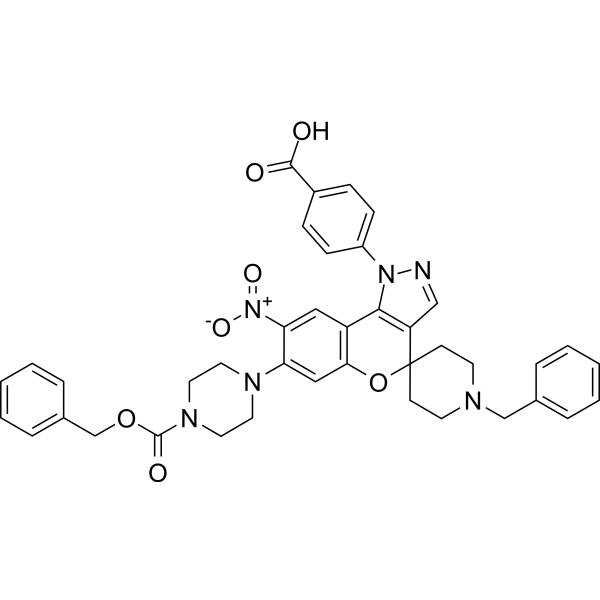
LIN28-IN-1 (compound 5) is an inhibitor of the RNA-binding and regulatory protein LIN28 and binds to the LIN28 cold shock domain (CSD). LIN28-IN-1 effectively inhibits the interaction between LIN28 and let-7 miRNA (IC50: 5.4 μM), blocking the negative impact of LIN28 on epigenetic gene regulation. LIN28-IN-1 significantly inhibits the proliferation of JAR cancer cells expressing LIN28 (IC50: 6.4 μM).
For research use only. We do not sell to patients.
- Formula: C40H38N6O7
- Molecular Weight:714.77
-
Storage:
Please store the product under the recommended conditions in the Certificate of Analysis.
Biological Activity
Description
IC50 & Target
IC50: 5.4 μM (LIN28-let-7)[1]
Chemical Information
-
Molecular Weight 714.77
-
Formula C40H38N6O7
-
SMILES
OC(C1=CC=C(N2C(C(C=C([N+]([O-])=O)C(N3CCN(C(OCC4=CC=CC=C4)=O)CC3)=C5)=C5OC67CCN(CC8=CC=CC=C8)CC7)=C6C=N2)C=C1)=O
-
Shipping
Room temperature in continental US; may vary elsewhere.
-
Storage
Please store the product under the recommended conditions in the Certificate of Analysis.
Protocols
-
Cell Cytotoxicity Assay
Cytotoxicity assays are usually based on the assessment of cell membrane damage, which can also be indirectly detected by measuring cell viability. Detection methods include MTT assay, CKK-8 assay, LDH assay and ATP assay, etc.
-
CRISPRi/CRISPRa gene-regulation editing
CRISPRi and CRISPRa use catalytically inactive Cas9, typically SpCas9 D10A/H840A, as an RNA-guided DNA-binding platform that targets genomic loci through sgRNA complementarity and an adjacent PAM without generating Cas9 nuclease-mediated DNA cleavage. CRISPRi represses transcription by recruiting dCas9 alone or dCas9 fused to repressor domains such as KRAB to promoters or transcription start site regions, while CRISPRa activates transcription by recruiting activation domains such as VP64, VPR, or SAM components to promoter-proximal regions. The primary readout is target-gene expression change, commonly measured by RT-qPCR, RNA-seq, reporter fluorescence, or protein-level assays, and the readout reflects transcriptional repression or activation at the targeted endogenous locus.
-
Cell Viability Determination by MTT Colorimetric Assay
The following protocol uses the MTT colorimetric assay as a classic literature-established method for assessing cell viability/metabolic activity in cultured mammalian cells. MTT[3-(4,5-dimethylthiazol-2-yl)-2,5-diphenyltetrazolium bromide] is reduced by metabolically active cells to a colored formazan product; the amount of formazan is quantified spectrophotometrically and provides an indirect measure of metabolically active viable cells. Importantly, MTT reduction reflects cellular oxidoreductase/metabolic activity rather than an absolute direct count of living cells, so changes in cellular metabolism can alter the signal independently of cell number.
Purity & Documentation
References
Calculators
Concentration (start) × Volume (start) = Concentration (final) × Volume (final)

