



Api137 TFA

Based on 1 Customer Validation
Api137 TFA is an antimicrobial peptide that interferes with bacterial growth by inhibiting translation. Api137 TFA inhibits protein synthesis by trapping of release factors on the 70S ribosome following hydrolysis of the nascent polypeptide chain.
For research use only. We do not sell to patients.
- Purity : 99.40%
- Formula: C104H171N37O22.xC2HF3O2
- Molecular Weight:2291.71 (free acid)
-
Storage:
Sealed storage, away from moisture.
Powder -80°C, 2 years , -20°C, 1 year* In solvent : -80°C, 6 months; -20°C, 1 month (sealed storage, away from moisture)

To place orders, for customer services and technical support, please contact: MedChemExpress USA
Tel: 609-228-6898 E-mail: [email protected] [email protected]


-
 Biological Activity
-
Chemical Information
-
Solvent & Solubility
- Protocols
- Purity & Documentation
- References
-
 Help & FAQs




Biological Activity
Description


Chemical Information
-
Appearance Solid
-
Molecular Weight 2291.71 (free acid)
-
Formula C104H171N37O22.xC2HF3O2
-
Color White to off-white
-
Sequence
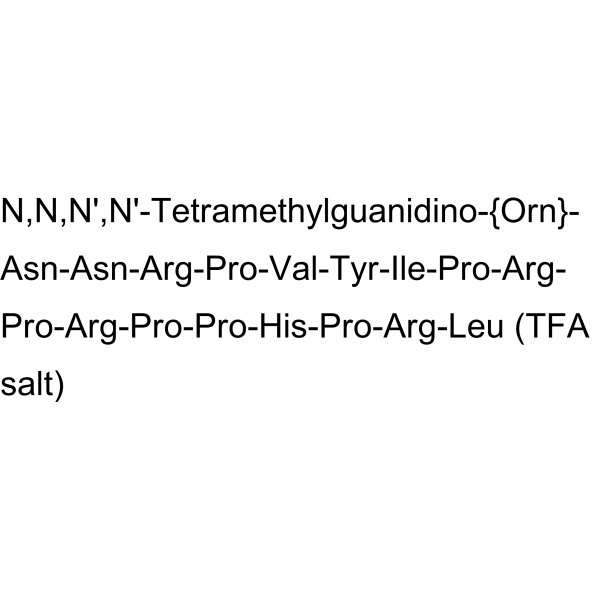
N,N,N',N'-Tetramethylguanidino-{Orn}-Asn-Asn-Arg-Pro-Val-Tyr-Ile-Pro-Arg-Pro-Arg-Pro-Pro-His-Pro-Arg-Leu
-
Sequence Shortening
N,N,N',N'-Tetramethylguanidino-{Orn}-NNRPVYIPRPRPPHPRL
-
Shipping
Room temperature in continental US; may vary elsewhere.
-
Storage
Sealed storage, away from moisture
Powder -80°C 2 years -20°C 1 year * In solvent : -80°C, 6 months; -20°C, 1 month (sealed storage, away from moisture)


Solvent & Solubility
In Vitro:
H2O : 100 mg/mL (Need ultrasonic)


Purity & Documentation
-
Data Sheet (276 KB)
-
SDS (252 KB)
- English - EN (252 KB)
- Français - FR (252 KB)
- Deutsch - DE (252 KB)
- Norwegian - NO (252 KB)
- Español - ES (252 KB)
- Swedish - SV (252 KB)
- Italian - IT (252 KB)
- Korean - KR (252 KB)
- Portuguese - PT (252 KB)
-
Handling Instructions (2659 KB)
References
[1]. Florin T, et, al. An antimicrobial peptide that inhibits translation by trapping release factors on the ribosome. Nat Struct Mol Biol. 2017 Sep;24(9):752-757. [Content Brief]
[2]. Graf M, et, al. Intracellular Antimicrobial Peptides Targeting the Protein Synthesis Machinery. Adv Exp Med Biol. 2019:1117:73-89. [Content Brief]

Calculators
Concentration (start) × Volume (start) = Concentration (final) × Volume (final)


Api137 TFA Related Classifications
HY-P5723A Related Classifications
 Powered by Bioz