



Orniplabin

Based on 1 Customer Validation
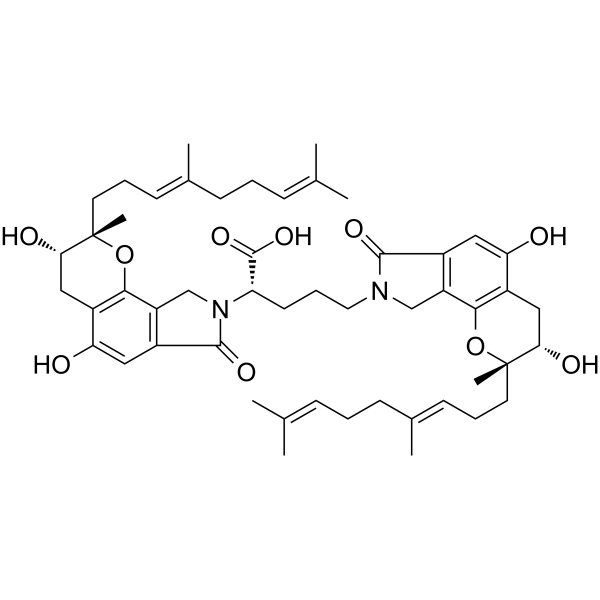
Orniplabin (SMTP-7) is a plasminogen modulator with a human EC50 of 65 μM. Orniplabin enhances the activation of plasminogen by plasminogen activators and increases the binding capacity of plasminogen to fibrin. Orniplabin elevates plasma levels of plasmin-α2-antiplasmin complex in vivo. Orniplabin is also a soluble epoxide hydrolase (sEH) inhibitor that prevents the hydrolysis and inactivation of anti-inflammatory epoxy fatty acids in vivo, exerting anti-inflammatory effects. Orniplabin inhibits the Cterm-EH and Nterm-phos of sEH with IC50 values of 23 μM and 6 μM, respectively. Orniplabin can be used in research related to pulmonary embolism and thrombotic stroke.
For research use only. We do not sell to patients.
- Purity : 95.0%
- CAS No.: 733805-92-0
- Formula: C51H68N2O10
- Molecular Weight:869.09
-
Storage:
-20°C, sealed storage, away from moisture
* In solvent : -80°C, 6 months; -20°C, 1 month (sealed storage, away from moisture)

To place orders, for customer services and technical support, please contact: MedChemExpress USA
Tel: 609-228-6898 E-mail: [email protected] [email protected]


-
 Biological Activity
-
Chemical Information
- Protocols
- Purity & Documentation
- References
-
 Help & FAQs




Biological Activity
Description
IC50 & Target
[2]|
sEH |
Cterm-EH 23 μM (IC50) |
Nterm-phos 6 μM (IC50) |
In Vitro
Orniplabin (100 μM; 30 min) enhances the u-PA-catalyzed conversion of purified human plasminogen to active two-chain plasmin[1].
Orniplabin (120 μM) induces a conformational change in purified human plasminogen, as manifested by a shortened elution time in size-exclusion chromatography[1].
Orniplabin (10 min) inhibits the hydrolysis of 14,15-EET to 14,15-DHET in HepG2 cells with an IC50 of 6.5 μM[2].
Orniplabin (10 min) inhibits both Cterm-EH and Nterm-phos catalytic activities in the purified mouse sEH enzyme system, with IC50 values of 23 μM and 6 μM, respectively[2].
MedChemExpress (MCE) has not independently confirmed the accuracy of these methods. They are for reference only.
In Vivo
Orniplabin (5 mg/kg; i.v.; bolus injection; administered ~ 20 minutes post-embolization) enhances thrombus clearance ~ 3-fold in a rat pulmonary embolism model, and further increases clearance when combined with scu-PA[1].
Orniplabin (5-30 mg/kg; i.v.; bolus injection) does not increase bleeding risk in healthy male ICR mice[1].
MedChemExpress (MCE) has not independently confirmed the accuracy of these methods. They are for reference only.
-
Animal Model:ICR (male, 7 weeks of age)[1]
-
Dosage:5 mg/kg; 10 mg/kg
-
Administration:i.v.; bolus injection
-
Result:Elevated plasma Pm-AP levels ~1.5-fold relative to saline-treated controls.
-
Animal Model:Wistar (male, ~120 g)[1]
-
Dosage:5 mg/kg (alone); 5 mg/kg (with scu-PA)
-
Administration:i.v.; bolus injection; administered ~20 minutes post-embolization
-
Result:Increased the clot clearance rate to 19.8% per 20 minutes, a ~3-fold increase relative to the spontaneous clearance rate of 6.4% per 20 minutes observed in saline-treated controls.
Increased the clot clearance rate to 42.3% per 20 minutes when combined with scu-PA.
-
Animal Model:ICR (male, 6 weeks of age)[1]
-
Dosage:5 mg/kg; 30 mg/kg
-
Administration:i.v.; bolus injection
-
Result:Did not cause a statistically significant prolongation of bleeding time relative to controls.
Did not cause a statistically significant increase in bleeding volume relative to controls.


Chemical Information
-
CAS No. 733805-92-0
-
Appearance Solid
-
Molecular Weight 869.09
-
Formula C51H68N2O10
-
Color White to off-white
-
SMILES
O=C1C2=C(C3=C(C[C@H](O)[C@@](CC/C=C(C)/CC/C=C(C)/C)(C)O3)C(O)=C2)CN1[C@H](C(O)=O)CCCN4CC5=C(C=C(O)C6=C5O[C@](CC/C=C(C)/CC/C=C(C)/C)(C)[C@@H](O)C6)C4=O
-
Synonyms
SMTP-7
-
Shipping
Room temperature in continental US; may vary elsewhere.
-
Storage
-20°C, sealed storage, away from moisture
* In solvent : -80°C, 6 months; -20°C, 1 month (sealed storage, away from moisture)


Purity & Documentation
-
Data Sheet (290 KB)
-
SDS (252 KB)
- English - EN (252 KB)
- Français - FR (252 KB)
- Deutsch - DE (252 KB)
- Norwegian - NO (252 KB)
- Español - ES (252 KB)
- Swedish - SV (252 KB)
- Italian - IT (252 KB)
- Korean - KR (252 KB)
- Portuguese - PT (252 KB)
-
Handling Instructions (2659 KB)
References
Hot Topics
-
All
-
Topics
-
Most Recent
-
Oldest
-
Topics Targeted Protein Degradation (TPD): From PROTACs to Molecular Glues
Targeted protein degradation is a drug discovery strategy that uses cellular protein degradation systems to selectively eliminate disease-associated proteins, and its core modalities include PROTACs and molecular glue degraders.
2026-06-18

Calculators
Concentration (start) × Volume (start) = Concentration (final) × Volume (final)


Orniplabin Related Classifications
HY-122311 Related Classifications
 Powered by Bioz