



Poloxamer 105 (L35)

Based on 1 Customer Validation
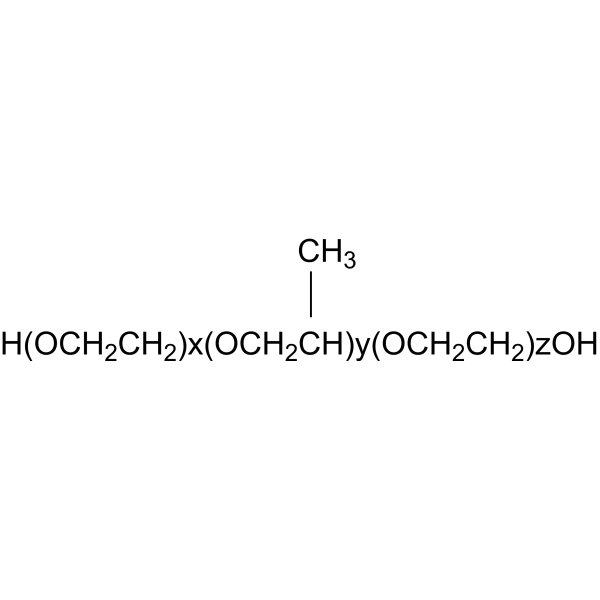
Poloxamer 105 L35 is block polymer of polyoxyethylene and polyoxypropylene with average molecular mass of 1900 Da. Poloxamer 105 L35 forms thermoreversible hydrogel, that is utilized in food additives, drug delivery carriers in cosmetics, pharmaceutical ingredients and tissue engineering.
For research use only. We do not sell to patients.
- CAS No.: 9003-11-6
- Molecular Weight:1900(Average)
-
Storage:
Please store the product under the recommended conditions in the Certificate of Analysis.

To place orders, for customer services and technical support, please contact: MedChemExpress USA
Tel: 609-228-6898 E-mail: [email protected] [email protected]


-
 Biological Activity
-
Chemical Information
-
Solvent & Solubility
- Protocols
- Purity & Documentation
- References
-
 Help & FAQs


-
HY-D1005A8
Poloxamer 181 (L61)Biochemical Assay Agent -
HY-D1005
Poloxamer 407 (F127)LPL Receptor Inhibitor -
HY-D1005A
Poloxamer 188Linear Copolymer -
HY-D1005A22
Poloxamer 338 (F108)Biochemical Assay Agent -
HY-D1005A10
Poloxamer 184 (L64)Biochemical Assay Agent -
HY-D1005B
Poloxamer 237 (F87)Alcohol Substance -
HY-D1005H
Poloxamer 188 (F68)Nonionic Linear Copolymer -
HY-D1005A6
Poloxamer 124 (L44)Biochemical Assay Agent -
HY-D1005A25
Poloxamer 403 (P123)Biochemical Assay Agent -
HY-D1005A23
Poloxamer 401 (L121)Biochemical Assay Agent -

HY-D1005K
Poloxamer L64Biochemical Assay Reagent -
HY-D1005F
Poloxamer 182 (L62)Pharmaceutical Excipient


Biological Activity
Description
In Vitro
Poloxamer 105 L35 (PEG/PPG ratio =1.38:1) produces films with similar morphology and conductivity to PEDOT grown with 2900 Da PEG-PPG-PEG[2].
MedChemExpress (MCE) has not independently confirmed the accuracy of these methods. They are for reference only. Further protocols information, click here.


Chemical Information
-
CAS No. 9003-11-6
-
Appearance Liquid (Density: 1.095 g/cm3)
-
Molecular Weight 1900(Average)
-
Color Colorless to light yellow
-
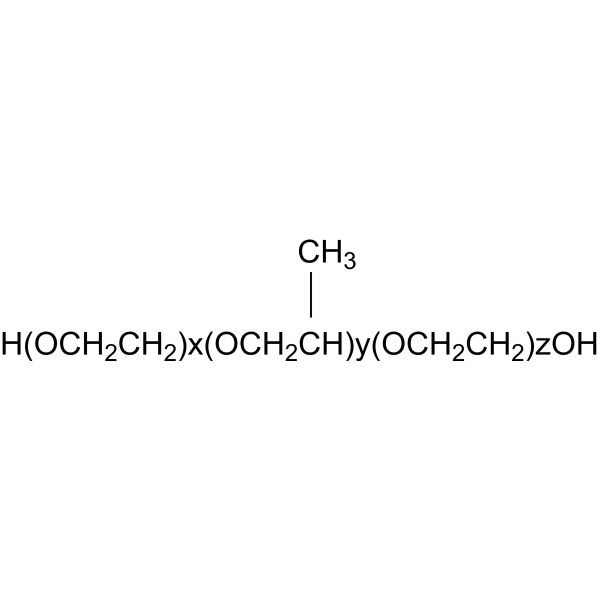
SMILES
[Poloxamer 105 (L35)]
-
Synonyms
PEG-PPG-PEG, 1900 (Average)
-
Shipping
Room temperature in continental US; may vary elsewhere.
-
Storage
Please store the product under the recommended conditions in the Certificate of Analysis.


Solvent & Solubility
In Vitro:
H2O : ≥ 200 mg/mL
* "≥" means soluble, but saturation unknown.

Protocols
-
3D Hydrogel Synthetic Scaffold Culture
3D hydrogel synthetic scaffold culture embeds cells, spheroids, organoids, or tissue fragments inside a hydrated crosslinked polymer network so that cells receive matrix and cell-cell cues in three dimensions rather than from a flat plastic surface. A literature-supported model protocol is PEG-4MAL hydrogel culture, in which four-arm maleimide-terminated PEG is functionalized with cysteine-containing adhesive peptides such as RGD and crosslinked with protease-degradable peptides such as GPQ-W; this creates a defined, modular scaffold that supports human organoid generation and culture. The readouts are scaffold-supported growth, morphology, lumen formation, budding, viability, proliferation, lineage-marker expression, and matrix-dependent expansion or differentiation; reported assays include transmitted-light imaging, immunofluorescence, in situ hybridization, qRT-PCR, and rheological characterization.


Purity & Documentation
-
Data Sheet (266 KB)
-
SDS (251 KB)
- English - EN (251 KB)
- Français - FR (251 KB)
- Deutsch - DE (251 KB)
- Norwegian - NO (251 KB)
- Español - ES (251 KB)
- Swedish - SV (251 KB)
- Italian - IT (251 KB)
- Korean - KR (251 KB)
- Portuguese - PT (251 KB)
-
Handling Instructions (2659 KB)
References
[1]. Singh-Joy SD, et al., Safety assessment of poloxamers 101, 105, 108, 122, 123, 124, 181, 182, 183, 184, 185, 188, 212, 215, 217, 231, 234, 235, 237, 238, 282, 284, 288, 331, 333, 334, 335, 338, 401, 402, 403, and 407, poloxamer 105 benzoate, and poloxamer 182 dibenzoate as used in cosmetics. Int J Toxicol. 2008;27 Suppl 2:93-128. [Content Brief]

Calculators
Concentration (start) × Volume (start) = Concentration (final) × Volume (final)


Poloxamer 105 (L35) Related Classifications
HY-D1005A2 Related Classifications
 Powered by Bioz