



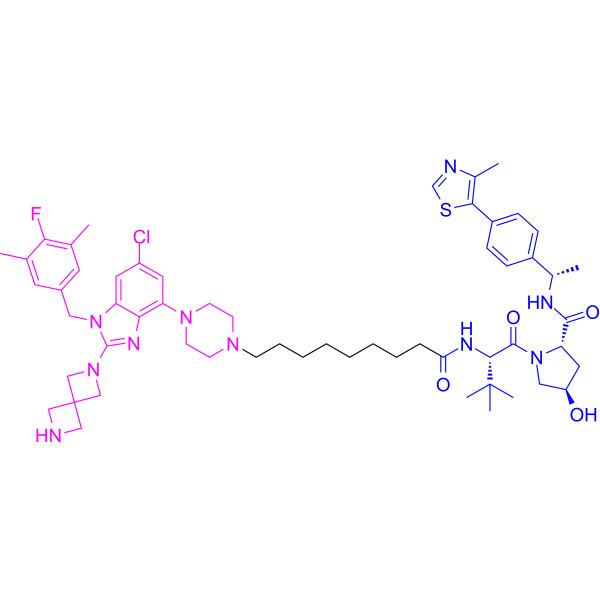
PROTAC SOS1 degrader-1
PROTAC SOS1 degrader-1 is a degrader of SOS1 PROTAC, with a DC50 of 98.4 nM and a Kd value of 44 nM. PROTAC SOS1 degrader-1 induces the formation of a ternary complex with SOS1 and the VCB E3 ubiquitin ligase complex, thereby promoting the ubiquitination and proteasomal degradation of SOS1. PROTAC SOS1 degrader-1 reduces KRAS-GTP levels, inhibits the phosphorylation of ERK in the RAS-RAF-MEK-ERK pathway, and suppresses the proliferation of cancer cells carrying KRAS mutations. PROTAC SOS1 degrader-1 inhibits tumor growth in mouse xenograft models. PROTAC SOS1 degrader-1 can be used for the research of KRAS-driven cancers.
(Pink: SOS1 ligand (HY-111671); Blue: VHL ligand (HY-112078); Black: linker).
For research use only. We do not sell to patients.
- CAS No.: 2913185-35-8
- Formula: C57H76ClFN10O4S
- Molecular Weight:1051.79
-
Storage:
Please store the product under the recommended conditions in the Certificate of Analysis.

To place orders, for customer services and technical support, please contact: MedChemExpress USA
Tel: 609-228-6898 E-mail: [email protected] [email protected]


-
 Biological Activity
-
Chemical Information
- Purity & Documentation
- References
-
 Help & FAQs


All PROTACs Isoforms
More

Biological Activity
Description
IC50 & Target
DC50: 98.4 nM (SOS1)[1]
Cellular Effect
|
Cell Line

|
Type | Value | Description | References |
|---|---|---|---|---|
| A549 | IC50 |
0.232 μM
Compound: 9d
|
Antiproliferative activity against human A549 cells harboring KRAS G12S mutant assessed as cell growth inhibition incubated for 7 days by CellTiter-Glo 3D cell viability assay
Antiproliferative activity against human A549 cells harboring KRAS G12S mutant assessed as cell growth inhibition incubated for 7 days by CellTiter-Glo 3D cell viability assay
|
[PMID: 35230841] |
| ASPC1 | IC50 |
0.307 μM
Compound: 9d
|
Antiproliferative activity against human ASPC1 cells harboring KRAS G12D mutant assessed as cell growth inhibition incubated for 7 days by CellTiter-Glo 3D cell viability assay
Antiproliferative activity against human ASPC1 cells harboring KRAS G12D mutant assessed as cell growth inhibition incubated for 7 days by CellTiter-Glo 3D cell viability assay
|
[PMID: 35230841] |
| ASPC1 | IC50 |
72.3 nM
Compound: 9d
|
Effect of compound on human ASPC1 cells harboring KRAS G12D mutant assessed as inhibition of ERK phosphorylation incubated for 24 hr by Western blot analysis
Effect of compound on human ASPC1 cells harboring KRAS G12D mutant assessed as inhibition of ERK phosphorylation incubated for 24 hr by Western blot analysis
|
[PMID: 35230841] |
| MIA PaCa-2 | IC50 |
0.218 μM
Compound: 9d
|
Antiproliferative activity against human MIA PaCa-2 cells harboring KRAS G12C mutant assessed as cell growth inhibition incubated for 7 days by CellTiter-Glo 3D cell viability assay
Antiproliferative activity against human MIA PaCa-2 cells harboring KRAS G12C mutant assessed as cell growth inhibition incubated for 7 days by CellTiter-Glo 3D cell viability assay
|
[PMID: 35230841] |
| NCI-H358 | IC50 |
0.525 μM
Compound: 9d
|
Antiproliferative activity against human NCI-H358 cells harboring KRAS G12C mutant assessed as growth inhibition incubated for 7 days by CellTiter-Glo 3D cell viability assay
Antiproliferative activity against human NCI-H358 cells harboring KRAS G12C mutant assessed as growth inhibition incubated for 7 days by CellTiter-Glo 3D cell viability assay
|
[PMID: 35230841] |
| SK-LU-1 | IC50 |
0.115 μM
Compound: 9d
|
Antiproliferative activity against human SK-LU-1 cells harboring KRAS G12D mutant assessed as cell growth inhibition incubated for 7 days by CellTiter-Glo 3D cell viability assay
Antiproliferative activity against human SK-LU-1 cells harboring KRAS G12D mutant assessed as cell growth inhibition incubated for 7 days by CellTiter-Glo 3D cell viability assay
|
[PMID: 35230841] |
| SW-620 | IC50 |
0.199 μM
Compound: 9d
|
Antiproliferative activity against human SW620 cells harboring KRAS G12V mutant assessed as cell growth inhibition incubated for 7 days by CellTiter-Glo 3D cell viability assay
Antiproliferative activity against human SW620 cells harboring KRAS G12V mutant assessed as cell growth inhibition incubated for 7 days by CellTiter-Glo 3D cell viability assay
|
[PMID: 35230841] |
In Vitro
PROTAC SOS1 degrader-1 (Compound 9d) (contact time: 120 s, dissociation time: 240 s) forms a ternary complex with highly positive cooperativity with SOS1 and VCB proteins, with a cooperativity factor of 15.1, a binary KD value of 56.0 nM, and a ternary KD value of 3.7 nM[1].
PROTAC SOS1 degrader-1 (0-2000 nM; 24 h) induces dose-dependent degradation of SOS1 in NCI-H358 cells, with a DC50 of 98.4 nM, and achieves a degradation rate of 92.5% after treatment at 1 μM for 24 h[1].
PROTAC SOS1 degrader-1 (1 μM; 1-24 h) induces time-dependent degradation of SOS1 in NCI-H358 cells (peaking at 24 h) and AsPC-1 cells (peaking at 16 h)[1].
PROTAC SOS1 degrader-1 (7 days) inhibits 3D proliferation of human cancer cells harboring KRASG12C, KRASG12D, KRASG12V, and KRASG12S mutations, with IC50 values ranging from 0.115 to 0.525 μM after 7 days of treatment, but exerts no inhibitory effect on the proliferation of CAL-62 or 293T cells[1].
PROTAC SOS1 degrader-1 (1 μM; 1-24 h) transiently increases pERK levels in NCI-H358 cells, followed by inhibition of ERK phosphorylation; it exhibits an IC50 of 72.3 nM for pERK inhibition after 24 hours of treatment[1].
Treatment with PROTAC SOS1 degrader-1 for 24 h reduces the level of activated KRAS-GTP in NCI-H358 cells in a dose-dependent manner[1].
MedChemExpress (MCE) has not independently confirmed the accuracy of these methods. They are for reference only.
-
Cell Line:NCI-H358 cells
-
Concentration:7.8, 15.6, 31.2, 62.5, 125, 250, 500, 1000, 2000 nM
-
Incubation Time:24 h
-
Result:Induced 56.2% SOS1 degradation at 0.1 μM.
Induced 92.5% SOS1 degradation at 1 μM.
Had a half-maximal degradation concentration (DC50) of 98.4 nM, with near-complete degradation at higher concentrations.
-
Cell Line:NCI-H358, AsPC-1 cells
-
Concentration:1 μM
-
Incubation Time:1, 2, 4, 6, 8, 12, 14, 16, 24 h
-
Result:Caused significant SOS1 degradation in NCI-H358 cells at 4 hours, with degradation peaking at 24 hours.
Caused SOS1 degradation in AsPC-1 cells that peaked at 16 hours.
Parmacokinetics
| Species | Dose | Route | AUC0-∞ | Cmax |
|---|---|---|---|---|
| Mice[1] | 10 mg/kg | i.p. | 4420 ng·h/mL | 1221 ng/mL |
In Vivo
MedChemExpress (MCE) has not independently confirmed the accuracy of these methods. They are for reference only.
-
Animal Model:BALB/c nude mice (6-8 weeks old; subcutaneously injected with 1 × 10⁷ NCI-H358 cells)[1]
-
Dosage:10 mg/kg; 20 mg/kg
-
Administration:i.p.; daily; 21 days
-
Result:Inhibited tumor growth by 72.5% (P < 0.001).
Inhibited tumor growth by 86.1% (P < 0.001).
Caused no statistically significant body weight loss.
Achieved persisted SOS1 degradation and pERK inhibition in harvested tumor xenografts.
-
Animal Model:BALB/c nude mice (6-8 weeks old; subcutaneously injected with 5 × 10⁶ NCI-H358 cells)[1]
-
Dosage:20 mg/kg; 50 mg/kg
-
Administration:intratumoral injection; twice weekly; 35 days
-
Result:Resulted in significant tumor growth inhibition.
Caused no body weight loss during the study.
Achieved persisted SOS1 degradation and pERK inhibition in harvested tumor xenografts.


Chemical Information
-
CAS No. 2913185-35-8
-
Molecular Weight 1051.79
-
Formula C57H76ClFN10O4S
-
SMILES
O=C([C@H]1N(C([C@@H](NC(CCCCCCCCN2CCN(C3=C4C(N(CC5=CC(C)=C(F)C(C)=C5)C(N6CC7(CNC7)C6)=N4)=CC(Cl)=C3)CC2)=O)C(C)(C)C)=O)C[C@H](O)C1)N[C@H](C8=CC=C(C9=C(C)N=CS9)C=C8)C
-
Shipping
Room temperature in continental US; may vary elsewhere.
-
Storage
Please store the product under the recommended conditions in the Certificate of Analysis.


Purity & Documentation
References

Calculators
Concentration (start) × Volume (start) = Concentration (final) × Volume (final)


PROTAC SOS1 degrader-1 Related Classifications
HY-145737 Related Classifications
 Powered by Bioz