



Ranolazine dihydrochloride (Standard)
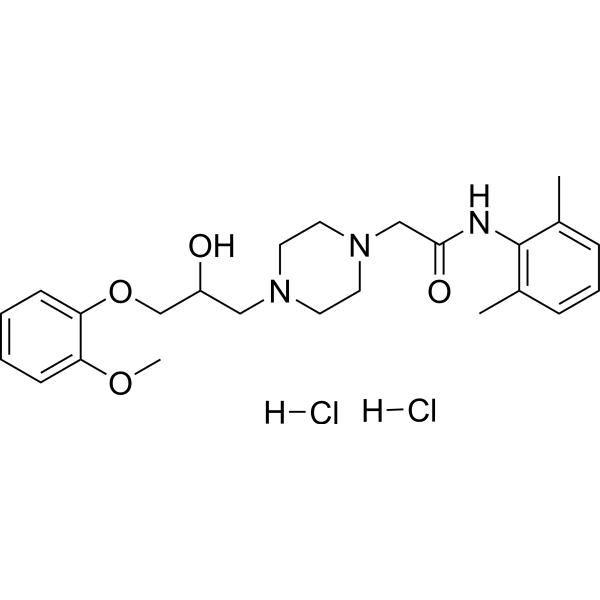
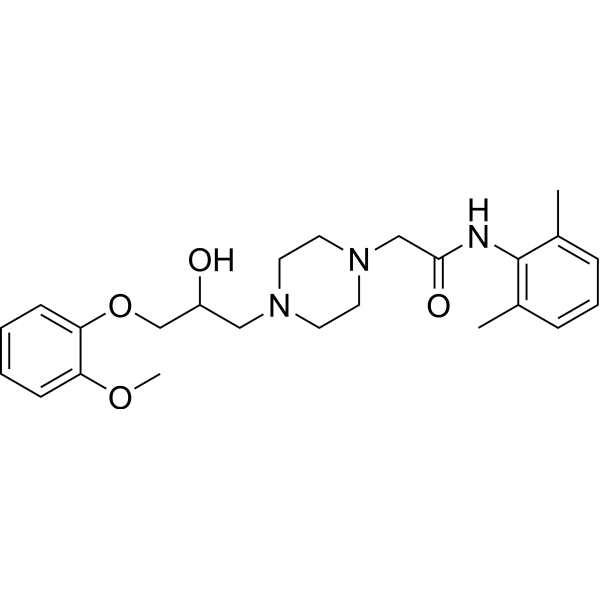
Ranolazine (dihydrochloride) (Standard) is the analytical standard of Ranolazine (dihydrochloride). This product is intended for research and analytical applications. Ranolazine dihydrochloride (CVT 303 dihydrochloride) is an anti-angina agent that achieves its effects by inhibiting the late phase of inward sodium current (INa and IKr with IC50 values of 6 μM and 12 μM, respectively) without affecting heart rate or blood pressure (BP). Ranolazine dihydrochloride is also a partial fatty acid oxidation inhibitor.
For research use only. We do not sell to patients.
- Purity: 98%
- CAS No.: 95635-56-6
- Formula: C24H35Cl2N3O4
- Molecular Weight:500.46
-
Storage:
Please store the product under the recommended conditions in the Certificate of Analysis.


To place orders, for customer services and technical support, please contact: MedChemExpress USA
Tel: 609-228-6898 E-mail: [email protected] [email protected]


-
 Product Information
-
Chemical Information
- Purity & Documentation
-
 Help & FAQs




Product Information
Information
Application
The compound is the grade of analytical standard, which is the reference standard supplied assay. It is commonly used in qualitative, quantitative and methodological research experiments in HPLC, GC and MS.


Chemical Information
-
CAS No. 95635-56-6
-
Molecular Weight 500.46
-
Formula C24H35Cl2N3O4
-
SMILES
O=C(NC1=C(C)C=CC=C1C)CN2CCN(CC(O)COC3=CC=CC=C3OC)CC2.[H]Cl.[H]Cl
-
Synonyms
CVT 303 dihydrochloride (Standard); RS 43285 (Standard)
-
Shipping
Room temperature in continental US; may vary elsewhere.
-
Storage
Please store the product under the recommended conditions in the Certificate of Analysis.


Purity & Documentation
References
[1]. Keating GM. Ranolazine: A Review of Its Use as Add-On Therapy in Patients with Chronic Stable Angina Pectoris. Drugs. 2013 Jan;73(1):55-73. [Content Brief]
[2]. Wang WQ, Robertson C, Dhalla AK, Belardinelli L. Antitorsadogenic effects of ({+/-})-N-(2,6-dimethyl-phenyl)-(4[2-hydroxy-3-(2-methoxyphenoxy)propyl]-1-piperazine (ranolazine) in anesthetized rabbits. J Pharmacol Exp Ther. 2008 Jun;325(3):875-81. doi: 10.1124/jpet.108.137729. Epub 2008 Mar 5. [Content Brief]
[3]. Zacharowski K, Blackburn B, Thiemermann C. Ranolazine, a partial fatty acid oxidation inhibitor, reduces myocardial infarct size and cardiac troponin T release in the rat. Eur J Pharmacol. 2001 Apr 20;418(1-2):105-10. [Content Brief]

Calculators
Concentration (start) × Volume (start) = Concentration (final) × Volume (final)


Ranolazine dihydrochloride (Standard) Related Classifications
HY-17401R Related Classifications
 Powered by Bioz